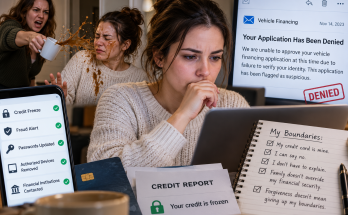
The notification was clear about one thing.
The vehicle loan hadn't been approved.
I had read that fact so many times that I could almost remember the wording without opening the message.
But every time I thought about it, another question followed.
Who had tried to get the loan?
That question was becoming difficult to separate from my memories of my sister.
I knew why.
She had wanted my credit card.
I had said no.
And she had responded by throwing hot coffee at my face.
Six weeks later, I had discovered that someone had attempted to borrow money using my identity.
It was natural to wonder whether she was involved.
But wondering wasn't the same as knowing.
I had to remember that.
Especially when I was angry.
The more I thought about the coffee incident, the more difficult it became to understand why I had ever questioned my refusal.
A credit card was not a shared family possession.
It was an account attached to my name.
Any spending associated with it could affect me.
Any unpaid balance would be my responsibility under the account's terms.
I had every reason to decide who could use it.
And I had decided not to give it to my sister.
That should have ended the conversation.
Instead, she had hurt me.
I couldn't explain that away.
For weeks, I had tried to think about the incident in softer terms.
A disagreement.
A moment of anger.
A family problem.
But none of those descriptions changed the physical act.
She had thrown hot coffee at me.
I had not deserved that.
The fact that I could finally say so without immediately questioning myself felt important.
I wasn't being unfair by acknowledging what happened.
I wasn't betraying my family.
I was describing something I had experienced.
The vehicle loan was different.
I hadn't witnessed the application being submitted.
I had no firsthand knowledge of the applicant.
And the lender's notification did not identify that person.
I could not describe the attempt with the same certainty about who was responsible.
That was the difference I needed to preserve.
My sister's behavior was known to me.
The applicant's identity was not.
Both facts mattered.
I didn't want my anger about the first event to distort my understanding of the second.
But I also didn't want uncertainty about the loan to make me minimize the coffee incident.
I could be precise about both.
That was something I had learned from examining the notification.
The lender had recorded a specific event.
An application had been made.
The fraud alert had required additional identity verification.
The applicant had failed to satisfy the lender's requirements.
The loan had been denied.
Those facts gave me a foundation.
Everything beyond them required more information.
I thought about the three emails again.
The first came from a bank I recognized.
The second came from a financing company I didn't remember using.
The third came from the vehicle lender.
At first, seeing three results had made me uneasy.
I had wondered whether each represented another attempt to use my identity.
But I hadn't established that.
I couldn't turn the number of search results into proof of three fraudulent applications.
That would have been careless.
Only the vehicle financing notice clearly described an application I knew I hadn't submitted.
So I kept my attention on that.
The other two messages remained unanswered questions.
They didn't become evidence of wrongdoing simply because they appeared beside something suspicious.
I was learning to separate facts from associations.
It wasn't easy.
I wanted the information to fit together neatly.
I wanted one explanation that accounted for everything.
My sister's demand.
The coffee.
The security changes.
The rejected auto loan.
But the evidence didn't yet establish such an explanation.
And I couldn't honestly supply it myself.
I looked at the screenshot again.
The date continued to bother me.
Eleven days earlier.
I wondered whether the applicant had known my credit was frozen.
Whether they had expected to complete the financing.
Whether they had been surprised by the verification requirements.
The notification didn't answer those questions.
I didn't know what the applicant expected.
I didn't know what they said to the lender.
I didn't know what information they were missing.
The only confirmed outcome was that the required verification hadn't been completed.
I had to resist the urge to imagine the rest.
It was tempting.
An imagined scene would have given the event a shape.
A person making a request.
A lender asking questions.
The applicant failing to respond correctly.
But none of those details was something I had witnessed.
I didn't want to confuse a possible sequence with a known one.
I had promised myself I wouldn't invent explanations.
Not when something this important involved my financial identity.
I thought back to the day I placed the fraud alerts.
I had done it because I wanted lenders to be careful.
I wanted my identity verified before anyone could create new financial obligations under my name.
At the time, it had felt like one step among several.
Now it had become the central detail in the vehicle loan notice.
The lender had noticed the alert.
The applicant had been required to provide additional information.
The application had failed.
That was a useful result.
I was glad I hadn't ignored the need for precautions.
But I also understood that the alert didn't identify the applicant.
It protected against a particular risk.
It didn't explain the relationship between the person submitting the application and the person whose identity was being used.
That question remained open.
I thought about how easily I might have treated the rejection as the end of the matter.
The lender hadn't approved the loan.
No vehicle financing had been granted through that application.
Surely that meant the immediate danger had passed.
In one respect, it had.
That particular application was denied.
But the attempted misuse still mattered.
Someone had tried to obtain credit without my permission.
I couldn't erase that simply because the lender refused the request.
At the same time, I couldn't declare that a broader fraud had been proved.
I didn't know whether anyone had tried elsewhere.
I didn't know whether there were additional applications.
The other search results weren't enough to establish that.
So I had to accept both reassurance and uncertainty.
I thought about forgiveness again.
I had always wanted to believe it was a simple decision.
That someone did something wrong, time passed, and eventually you chose to move forward.
But I was beginning to understand that forgiving a person and giving them access to your finances were entirely different decisions.
I could work through my feelings about my sister.
I could stop allowing the memory of the coffee to control every thought I had.
But none of that would mean she was entitled to my credit card.
It wouldn't mean I had to remove my fraud alerts.
It wouldn't mean I had to compromise the security of my accounts.
And it wouldn't mean I had to pretend her behavior had been acceptable.
The thought made me sad.
I had wanted family relationships to feel simpler.
I had wanted love to be enough to guarantee respect.
But the coffee incident had shown me that love did not prevent someone from hurting me.
And the unauthorized application had shown me why I needed to guard my financial identity regardless of who was responsible.
I couldn't depend on good intentions I hadn't verified.
I couldn't protect myself by hoping somebody else would make the right decision.
I had to maintain control over my own accounts.
That was not cruelty.
It was responsibility.
I returned to the lender's notice one last time.
I had spent so long wanting it to explain my sister that I had almost overlooked what it actually demonstrated.
My precautions had mattered.
The lender had taken the fraud alert seriously.
The application had been refused.
And I had discovered the attempt before mistaking the absence of withdrawals for proof that nobody had tried to use my name.
That knowledge was valuable.
It didn't answer every question.
But it gave me a clearer understanding of the risk.
I saved the screenshot because the details mattered.
I kept the information separate from my suspicions because the truth mattered too.
And I realized that I didn't have to choose between protecting myself and being fair.
I could do both.
The loan remained unauthorized.
The applicant remained unidentified.
My sister's coffee incident remained unacceptable.
Those were the facts I could defend.
I wasn't going to change them to make the story simpler.
Click here to continue reading: PART 19: I Had Finally Stopped Blaming Myself for Refusing the Credit Card, Even Though the Suspicious Loan Still Had No Identified Applicant
I Thought Refusing My Sister Access to My Money Would End the Argument, but Her Anger Left Me Afraid of Something Worse
Part 18 of 20