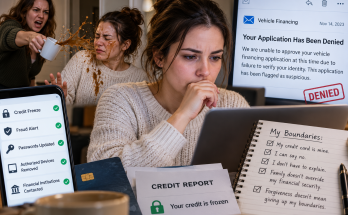
I kept thinking about the number three.
Three results from one email search.
Three messages connected in some way to credit inquiries.
But only one of them had told me something definite about an application I hadn't made.
I found that distinction surprisingly difficult to live with.
Because once I knew someone had attempted to use my name for an auto loan, every unfamiliar financial reference seemed more threatening.
The first message came from a bank I recognized.
That didn't mean it was harmless.
It also didn't mean it was suspicious.
Recognition alone couldn't answer the question.
The second result involved a financing company I had never used.
That seemed more concerning.
But unfamiliarity wasn't proof of fraud either.
I reminded myself of that whenever I felt tempted to put all three messages into the same category.
The third was different.
The vehicle lender's message concerned an application for a loan I had never requested.
It had been denied.
The applicant had not satisfied the lender's required identity checks.
The application had been marked suspicious.
That was concrete information.
It was enough to take seriously without needing the other emails to mean anything.
Still, I wished I understood why those three messages had appeared together.
I thought about how the search had begun.
I had checked my accounts.
Everything had looked ordinary.
Then I had searched my email for information about credit inquiries.
I hadn't expected to find proof of an unauthorized application.
I had simply wanted to be careful.
And now caution had become something more uncomfortable.
I had a genuine warning.
But not a complete explanation.
I looked at the screenshot again.
The message didn't tell me who had used my identity.
It didn't tell me whether the applicant had tried another financial institution.
It didn't explain whether the other two email results had any connection to the same person.
Those were separate questions.
I knew I couldn't answer them by grouping unrelated details together.
Yet my mind kept trying.
The unfamiliar financing company.
The auto loan.
My sister's demand for my credit card.
The coffee.
The fraud alert.
Everything felt connected when I was afraid.
But feelings were not the same as records.
I needed to keep remembering that.
The first record I trusted was the application notice.
It was specific.
It described a vehicle loan attempt.
It gave a date.
It explained the denial.
It identified a failed identity-verification process.
Those details made it meaningful.
The other two search results required more information before I could interpret them.
I hadn't established what the recognized bank's message meant.
I hadn't established what the unfamiliar financing company's message meant.
And I didn't want to turn uncertainty into a larger story simply because I found that story frightening.
There was already enough to deal with.
Someone had applied for financing using my identity.
I hadn't authorized it.
That alone was serious.
I remembered the feeling I had when I first opened my checking account.
Relief.
My money appeared untouched.
I had believed, briefly, that perhaps nothing further had happened after the confrontation with my sister.
Then I checked savings.
Again, nothing looked wrong.
I had wanted to stop there.
I had wanted to believe that the security measures I had taken six weeks earlier had settled everything.
But the email search had shown me how incomplete that belief was.
Money could remain untouched while someone attempted to create debt.
An application could fail without ever becoming a balance in an account I regularly checked.
And a warning could sit unread while I continued believing that everything was normal.
I didn't like knowing those things.
But once I knew them, I couldn't go back to my earlier assumptions.
I thought about how I had approached my financial security.
First, the credit freeze.
Then the passwords.
Then the authorized devices.
Then the fraud alerts.
Then the calls to financial institutions.
I had been thorough because I was frightened.
I had wanted to make sure the refusal of my credit card remained a refusal.
That nobody could simply find another way to use my financial information.
At the time, I didn't know an auto loan application would eventually appear.
I hadn't been trying to stop a particular vehicle purchase.
I hadn't known of any particular lender involved.
I had simply wanted control over my identity.
Now the precautions seemed less like an overreaction and more like a reasonable response to a serious concern.
Still, I couldn't tell whether my sister was responsible for the application.
That uncertainty remained.
I thought about the way she had reacted when I refused her credit card request.
I remembered how shocking it had been.
Hot coffee.
My face.
An ordinary disagreement becoming physical.
I couldn't make that memory less disturbing.
But I also couldn't use it as the missing proof in an unrelated financial record.
I needed to resist the urge to do that.
Because if I let myself decide the answer before I had evidence, I might stop looking carefully at the information I did have.
I might overlook details that didn't fit what I expected.
I might misunderstand an ordinary message.
Or I might convince myself that a suspicion had been confirmed when it hadn't.
I didn't want that.
I wanted the truth.
Even if it wasn't the explanation I expected.
Even if it left some questions unanswered.
That was a difficult promise to make to myself.
Because certainty would have felt easier.
If I knew who had applied, I could stop wondering.
If I knew why they had done it, I could stop imagining motives.
If I knew whether there had been other attempts, I could understand the limits of what had happened.
But I didn't know those things.
The notification hadn't supplied them.
The ordinary balances in my bank accounts hadn't supplied them.
And the email search results, considered as a group, hadn't supplied them either.
So I returned to the one thing I could say with confidence.
I had not applied for an auto loan.
The lender's notice concerned an application using my name.
The application had failed the required verification.
It had been rejected.
Those were the facts.
I thought about the person who had submitted it.
I wondered whether they had expected the process to be easy.
Whether they knew about the fraud alert.
Whether they understood why the lender was asking additional questions.
But I had no evidence about what the person expected or understood.
I was inventing an inner life for somebody I hadn't identified.
I stopped.
I didn't need to do that.
The attempted application was serious whether the applicant had been confident, desperate, careless, or calculating.
Their motive was unknown.
Their identity was unknown.
Their action was documented.
That was enough to keep the issue important.
I glanced at the date again.
Eleven days earlier.
There was something unsettling about the precision.
A date could make an event feel close.
It reminded me that the application wasn't some distant possibility I had imagined after the coffee incident.
It had actually been submitted.
It had actually been reviewed.
And it had actually been refused.
The warning was not hypothetical.
I felt my anger return.
Not the explosive kind.
The quieter kind that stayed with me while I tried to think.
Someone had taken the liberty of placing my identity on an application I had never authorized.
That wasn't a small misunderstanding.
And even if the loan had been rejected, the attempted misuse mattered.
I thought about how I might have reacted before learning to secure my finances.
I might have dismissed the message because no money had disappeared.
I might have assumed it was an error without examining the details.
I might have thought the problem was finished because the loan had been denied.
But the notice had taught me why those conclusions were incomplete.
A rejected application could still reveal an attempted use of my identity.
An unchanged bank balance couldn't disprove it.
And a failed attempt didn't tell me whether the same person might try again.
I couldn't know the future.
But I could acknowledge the information in front of me.
I looked at the screenshot one more time.
I no longer wanted it to provide answers it didn't contain.
I wanted to preserve the answers it did contain.
That was different.
It meant accepting evidence without exaggerating it.
It meant protecting myself without inventing a culprit.
It meant remembering that family history could explain my caution without proving the identity of the person responsible.
The email search had started with three results.
It had ended with one clear warning.
For now, I needed to treat that warning seriously while leaving the unanswered questions unanswered.
I couldn't force the truth to appear by deciding I already knew it.
Click here to continue reading: PART 11: Remembering the Coffee Made Me Want to Blame My Sister, but the Rejected Loan Notice Still Left One Essential Question Unanswered
I Thought Refusing My Sister Access to My Money Would End the Argument, but Her Anger Left Me Afraid of Something Worse
Part 10 of 20