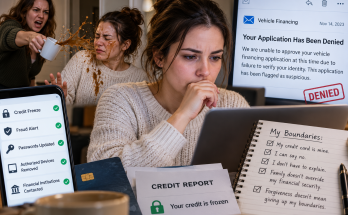
The worst part of finding that email was realizing how much I still didn't know.
I knew somebody had tried to get a vehicle loan using my identity.
I knew the lender had rejected the application.
I knew the fraud alert I had placed on my credit file had made a difference.
But I didn't know who had done it.
And that question kept bringing me back to my sister.
Six weeks earlier, she had demanded my credit card.
I had refused.
She had thrown hot coffee into my face.
Those were things I knew had happened.
I didn't need a document to prove what I had personally experienced.
But the vehicle loan was different.
I hadn't seen anyone submit the application.
I hadn't spoken to the applicant.
I hadn't authorized the transaction.
All I had was the notification from the lender.
And the screenshot I had saved.
I opened it again.
The same information appeared.
The application had been submitted eleven days before I discovered it.
The lender had attempted to verify the applicant's identity.
The verification had failed.
The application had been denied and flagged as suspicious.
I read the details slowly.
I had already read them several times.
But I kept hoping I might notice something I'd missed.
Something that would explain how my name had ended up on a vehicle financing application.
Something that would tell me who had entered the information.
There wasn't anything.
The notification documented the attempted loan.
It didn't name the person responsible.
I felt disappointed.
Then I felt foolish for being disappointed.
The lender hadn't promised to answer every question I had.
It had sent a notice about a financial application.
The application had been stopped.
That was what the message established.
Everything else remained uncertain.
I thought about my sister's reaction to being refused the credit card.
There had been no reason for her to throw the coffee.
None.
I had not taken anything from her.
I had not used her money.
I had not interfered with an account belonging to her.
I had simply refused to give her access to mine.
Even after six weeks, I was still tempted to explain that decision.
I would catch myself thinking about what I might have said differently.
Whether I could have made the refusal sound softer.
Whether another explanation might have prevented her anger.
Then I reminded myself that the explanation wasn't the problem.
The problem was that she had responded to my refusal by hurting me.
I didn't need to make that more complicated.
I had said no.
She had thrown the coffee.
Those two actions were not equal.
I wished I had understood that immediately.
Instead, I had spent weeks questioning whether protecting myself meant I was giving up on my family.
Now I realized how unfair that question had been.
Protecting my credit didn't require me to stop caring about anyone.
Changing my passwords didn't mean I hated my sister.
Removing authorized devices didn't mean I wanted to punish her.
And placing fraud alerts didn't mean I was declaring her guilty of something I couldn't prove.
Those actions were about my financial security.
They were not a verdict on anyone.
That distinction mattered more to me as I looked at the vehicle financing notice.
Because the attempt itself was real.
Someone had submitted an application in my name.
The lender had treated it as suspicious.
And I had not given permission.
The unanswered question was who.
I could acknowledge the attempt without pretending I knew the applicant.
I could remain concerned without making an accusation.
It wasn't satisfying.
But it was honest.
I returned to my email search.
The three results were still there.
The recognized bank.
The unfamiliar financing company.
The vehicle lender.
I considered how easy it would have been to describe all three as proof that somebody had been trying repeatedly to borrow money under my name.
But I didn't know that.
Only the vehicle financing notification clearly described an application I hadn't submitted.
The other two results remained unexplained.
I didn't want to ignore them.
But I also didn't want to give them meanings they hadn't yet earned.
A search result wasn't the same as a completed investigation.
I was learning that.
Slowly.
And with more discomfort than I expected.
For most of my life, I had wanted difficult situations to have simple answers.
Someone was right.
Someone was wrong.
Something could be fixed.
Something could be forgiven.
But this situation wouldn't fit neatly into those categories.
My sister had clearly wronged me by throwing the coffee.
The attempted loan was clearly unauthorized.
Yet I couldn't establish that the same person was responsible for both events.
That gap mattered.
It was the place where my fear kept trying to supply an answer.
I stopped looking at the search results.
I thought about the money in my accounts.
My checking balance had appeared normal.
My savings had been untouched.
There were no unfamiliar withdrawals.
No unexplained transfers.
I was grateful for that.
But the loan attempt had made me understand that protecting existing money was only part of protecting myself.
Someone could attempt to create a debt in my name without ever touching my savings.
Someone could submit an application without my knowledge.
And unless the lender noticed something wrong, I might not learn about the attempt immediately.
The thought made me uncomfortable.
I had believed my money was safe because I controlled my accounts.
Now I understood that my identity needed the same protection.
I had taken those precautions six weeks earlier.
At the time, I had wondered whether I was doing too much.
Now I was thankful I hadn't talked myself out of them.
The fraud alert had served a purpose.
The lender had required additional verification.
The applicant had failed.
The loan was rejected.
That outcome mattered.
Whatever else remained unknown, the application hadn't been approved.
I could allow myself to appreciate that.
I didn't have to turn every reassuring fact into another reason to worry.
But neither could I pretend the rejected application was harmless.
The attempt had still happened.
It was still unauthorized.
And it still raised questions about who had access to my personal information.
I looked at the screenshot again.
I didn't know whether the applicant had been someone close to me.
I didn't know whether they were a stranger.
I didn't know whether they had obtained my information recently or had possessed it for some time.
The message didn't say.
I refused to fill those gaps with guesses.
I thought about how quickly suspicion could become a family accusation.
All it would take was one statement made with too much certainty.
One claim that I knew my sister had submitted the application.
One conclusion repeated before I had evidence.
And suddenly I would have created another conflict without establishing the truth.
I didn't want that.
Not because I was afraid of making her angry again.
Because I wanted to be accurate.
Those were different reasons.
For a long time, I had avoided difficult conversations because I worried about other people's reactions.
Now I was learning to be careful for a better reason.
Facts mattered.
My feelings mattered too.
But they served different purposes.
My feelings told me why the application frightened me.
The evidence told me what had actually happened.
I needed both.
I couldn't let either replace the other.
I thought again about the day I secured my accounts.
I had done something that once would have seemed unnecessary.
I had taken control of my financial access without asking anyone's permission.
That was the part I wanted to remember.
I had not waited for another confrontation.
I had not waited for money to disappear.
I had not waited for somebody to convince me that a family relationship entitled them to my credit.
I had acted.
And the lender's notification showed why those actions mattered.
The loan attempt had been stopped.
The applicant remained unidentified.
I understood that my work wasn't to make the screenshot say more than it did.
It was to preserve the truth it contained.
I looked at the application date.
Eleven days.
That small detail carried more weight than I expected.
Somebody had attempted to make a financial decision under my name while I believed my accounts were secure.
And the first clear sign I had discovered was the denial.
Not an approval.
Not missing money.
A denial.
I had never imagined that a rejected application could make me feel so vulnerable.
But it did.
Because it showed me that someone had tried.
And I still didn't know who.
I put the screenshot aside.
I couldn't solve the question by reading it another time.
What I could do was stop doubting the decisions that had protected me.
I had every right to refuse my sister the credit card.
I had every right to secure my identity.
I had every right to take an unauthorized application seriously.
Those rights didn't depend on whether my family understood them.
And they didn't depend on identifying the applicant.
The uncertainty remained.
But for the first time, I could accept it without treating my own precautions as something I needed to apologize for.
Click here to continue reading: PART 14: My Bank Balances Were Safe, Yet the Rejected Auto Loan Taught Me How Someone Could Threaten My Financial Future Without Taking a Dollar
I Thought Refusing My Sister Access to My Money Would End the Argument, but Her Anger Left Me Afraid of Something Worse
Part 13 of 20