I kept thinking about the word family.
It was such a simple word.
But after the coffee incident, I had begun to hear something different whenever I used it to explain why I should tolerate another person's behavior.
Family meant caring.
Family meant helping.
Family meant trying to understand one another.
I still believed those things.
But I had started questioning what happened when only one person was expected to respect them.
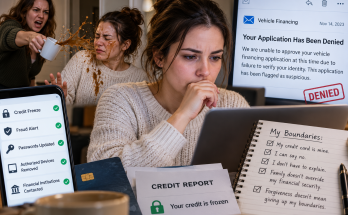
My sister had wanted my credit card.
I had said no.
She had thrown hot coffee into my face.
Those facts were impossible to soften.
I could call it an argument.
I could call it a terrible reaction.
I could tell myself that she had been angry.
None of those descriptions changed what happened.
She had hurt me because I refused to give her something that belonged to me.
I had struggled with that realization for six weeks.
Not because I couldn't remember the incident.
Because I didn't want to accept what it revealed about our relationship.
I had wanted the disagreement to be ordinary.
Something that could eventually be put behind us.
But there was nothing ordinary about throwing hot coffee at another person.
And there was nothing unreasonable about refusing to hand over a credit card.
Those two truths had taken me longer to accept than they should have.
Looking back, I understood why.
I had treated keeping peace in the family as a personal responsibility.
If someone became upset with me, I searched for something I could do differently.
If someone accused me of being unfair, I examined my decision again.
If somebody wanted something I wasn't comfortable giving, I sometimes felt guilty for disappointing them.
That habit had made the refusal feel more complicated than it was.
I hadn't owed my sister the card.
She had no automatic right to use my account.
And I wasn't required to risk my financial future because she wanted access to my credit.
I wished I could have understood that without being hurt.
But the coffee incident had forced the issue.
Afterward, I had stopped assuming that a personal boundary would be respected simply because we were related.
I had frozen my credit.
I had changed my passwords.
I had removed authorized devices.
I had placed fraud alerts.
And I had contacted the financial institutions associated with my name.
Those precautions had seemed drastic to the part of me that wanted to trust my family without question.
Now they seemed necessary.
Not because I had established that my sister had submitted the vehicle loan application.
I hadn't.
But because I had learned that my own financial security was my responsibility.
I couldn't make it depend on another person's willingness to hear no.
The lender's notification had reinforced that lesson.
Someone had tried to obtain financing using my identity.
I hadn't agreed.
The application had failed because the required verification hadn't been completed after the fraud alert.
That was a concrete example of why permission mattered.
An applicant couldn't simply claim my identity and expect that to be enough.
At least, not in that particular application.
The lender had required additional proof.
The applicant hadn't supplied it.
And the loan had been rejected.
I felt grateful each time I remembered that.
Then I thought about my sister again.
I wondered whether she had ever understood the difference between asking for help and demanding access.
I couldn't answer that.
I knew only how she had responded to my refusal.
And I knew that her response had been unacceptable.
I had spent too long looking for ways to make it less serious.
It was almost a habit.
I would remember the coffee.
Then I would try to imagine what had been going through her mind.
Then I would wonder whether she had been overwhelmed.
Whether she had expected me to agree.
Whether my refusal had embarrassed her.
But I didn't know those things.
And even if I had, they wouldn't excuse throwing hot coffee.
I had to stop treating imagined explanations as reasons to dismiss what actually happened.
I had witnessed her behavior.
That was enough.
I thought about forgiveness.
The word carried an expectation I had rarely examined.
If someone apologized, perhaps I was supposed to move on.
If enough time passed, perhaps the relationship was supposed to return to normal.
If we were family, perhaps continuing to protect myself meant I was holding a grudge.
But those ideas were beginning to feel wrong.
Forgiveness couldn't mean pretending that someone had never crossed a boundary.
It couldn't require me to hand over the same card I had refused.
It couldn't require me to expose my accounts.
And it couldn't demand that I ignore the possibility of financial harm simply because the truth might be uncomfortable.
I could care about my sister without trusting her with my money.
That distinction was painful.
But it was also freeing.
For the first time, I didn't feel obligated to turn every decision into a test of how much I loved her.
My credit card was a financial tool.
It wasn't a measure of affection.
My passwords were private information.
They weren't something I owed my relatives.
My credit record belonged to me.
It wasn't a resource available to whoever felt entitled to use it.
Those things should have been obvious.
But I had spent years allowing family expectations to make simple boundaries feel selfish.
Now I was learning to say the truth without apologizing for it.
I had refused the card because I didn't want to give it to her.
That was reason enough.
I thought about the vehicle loan application again.
The attempt was real.
The lender had documented it.
But the person responsible remained unknown.
I wouldn't blame my sister without evidence.
That was another boundary I wanted to maintain.
Fairness went both ways.
I wouldn't let family loyalty erase known harm.
But I also wouldn't let anger turn suspicion into certainty.
My sister was responsible for throwing the coffee.
I knew that.
Someone was responsible for attempting the unauthorized loan.
I knew that too.
Whether those were the same person remained unanswered.
I didn't have to force an answer to feel justified in protecting myself.
That was something I wished I had understood from the beginning.
I didn't need to prove that my sister would commit another wrong before deciding she couldn't use my credit card.
I didn't need to prove she had submitted the loan application before securing my credit.
My right to protect myself didn't depend on predicting what someone else might do.
It existed already.
I thought about how I had felt while checking my bank accounts.
The relief when checking appeared normal.
The relief when savings were untouched.
The hope that maybe nothing else had happened.
I hadn't been hoping to discover that my sister was involved in something worse.
I had been hoping to find peace.
That mattered to me.
Because sometimes anger made me wonder whether I was searching for reasons not to forgive her.
I wasn't.
I had wanted everything to be fine.
I had wanted my financial information to be secure.
I had wanted the coffee incident to remain the last frightening event connected to the disagreement.
Instead, I found an attempted vehicle loan.
I couldn't ignore it.
Not because I wanted someone punished.
Because I hadn't authorized it.
That was enough.
I looked at the saved screenshot again.
The lender's explanation remained clear.
Additional verification had been required.
The applicant had not completed it.
The loan hadn't been approved.
The attempted application had been marked suspicious.
I had preserved the message because I wanted to remember what it actually said.
Now I also wanted to remember what it didn't say.
It didn't identify my sister.
It didn't prove a broader pattern of applications.
It didn't establish that money had been taken from my accounts.
It documented one rejected attempt.
And that was serious enough.
I realized how much of my life I had spent trying to make uncomfortable facts disappear by explaining them differently.
My sister hadn't simply been disappointed by my refusal.
She had hurt me.
My financial precautions weren't a cruel rejection of my family.
They were safeguards.
The vehicle loan notice wasn't proof of every fear I had.
It was evidence of one unauthorized application.
I could accept those distinctions.
I didn't have to exaggerate.
And I didn't have to minimize.
I thought once more about the word forgiveness.
Perhaps one day I would understand exactly what it meant for my relationship with my sister.
But I already knew what it couldn't mean.
It couldn't mean giving up my right to say no.
It couldn't mean making my financial identity available to someone who wanted it.
And it couldn't mean treating my own safety as less important than another person's disappointment.
I had refused my sister's request.
That decision remained mine.
No amount of anger could change it.
And whatever happened with the unanswered loan application, I would not confuse loving my family with giving them unlimited access to my life.
Click here to continue reading: PART 16: The Rejected Loan Was the Clearest Warning I Had Found, and I Finally Stopped Apologizing to Myself for Protecting My Own Name
I Thought Refusing My Sister Access to My Money Would End the Argument, but Her Anger Left Me Afraid of Something Worse
Part 15 of 20