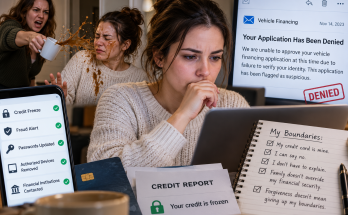
I used to believe that being careful with money was enough to keep me safe.
I was wrong.
Because the person I eventually had to protect myself from wasn't a stranger.
It was my own sister.
And the hardest part wasn't admitting that she could hurt me.
It was admitting that I had been making excuses for her long before I finally decided to protect myself.
Six weeks earlier, I had refused to give her my credit card.
It should have been a simple answer.
My card.
My account.
My decision.
But my sister had never been comfortable hearing no when she wanted something from me.
That didn't mean I expected what happened.
She threw hot coffee into my face.
Even remembering it made me uncomfortable.
Not just because of the pain.
Because I knew exactly why it had happened.
I had refused her access to something that belonged to me.
And she had responded by hurting me.
For a while, I couldn't separate those two facts.
I kept thinking about how ordinary my decision had been.
I hadn't asked her for anything.
I hadn't tried to control her.
I hadn't taken something away from her that was hers.
I had simply decided not to hand over my credit card.
That was all.
And yet the moment had become something I could no longer dismiss as another disagreement between sisters.
I didn't want to think of her as dangerous.
That word felt too large.
Too final.
Too difficult to say about someone who belonged to my family.
But I also couldn't pretend that throwing hot coffee at another person was a normal response to disappointment.
There was no version of that moment that made it reasonable.
I knew that.
I just didn't like what knowing it meant.
For years, I had associated family with an obligation to forgive.
Not necessarily immediately.
Not necessarily without an apology.
But eventually.
I believed that whatever happened between us, being sisters meant finding some way to move past it.
Looking back, I had confused forgiveness with giving someone another opportunity to do the same thing.
And I had confused keeping the peace with keeping myself unprotected.
After the coffee incident, something changed in the way I thought about my finances.
Until then, my credit card had been just another practical part of my life.
A way to pay for things.
An account attached to my name.
A responsibility that belonged to me.
Suddenly, it represented something different.
Access.
That was the word I kept returning to.
Who had access to my money?
Who knew enough about me to try to get more?
And what could happen if someone decided that my refusal didn't matter?
I didn't have answers to those questions.
I didn't even know whether I was asking them because I had a real reason to be afraid.
But I knew that I couldn't keep behaving as though nothing had happened.
My sister had shown me how she responded when I established a boundary.
I couldn't control that response.
I could control what I did afterward.
So I started with the part of my life I could actually secure.
My financial information.
I didn't make the decision lightly.
I understood that protecting my accounts would take more than changing one password.
There were banks to contact.
Credit records to secure.
Existing account access to examine.
I had to think about information I normally trusted to remain private.
And I had to think about the possibility that being related to someone didn't automatically make that person trustworthy with it.
That was difficult.
More difficult than I wanted to admit.
I could have told myself that the coffee incident was over.
I could have decided that my sister had lost her temper and that I should stop thinking about it.
I could have avoided all the uncomfortable questions.
For a moment, avoiding them would have been easier.
But every time I considered doing nothing, I came back to the same fact.
She had wanted my card.
I had refused.
And she had hurt me.
There was no reason to believe that simply waiting would make me safer.
I didn't know whether she would try to get money from me again.
I didn't know whether she had any of my personal financial information.
I didn't know whether she would stop at the card she had demanded.
Those were uncertainties.
Not accusations.
And I wanted to keep them that way unless I found actual evidence.
Still, I had learned something important.
I didn't have to wait for another problem before taking precautions.
I was allowed to protect what belonged to me.
Even from family.
Especially when family was the reason I felt unprotected.
That realization didn't make me feel powerful.
It made me sad.
I hadn't imagined that setting a financial boundary with my sister would lead me to examine every account connected to my identity.
But that was where I found myself.
Not planning revenge.
Not trying to punish her.
Trying to make sure that my name and my money remained under my control.
I began taking the steps I had previously assumed would never be necessary.
The first was to secure my credit.
The next was to make sure access to my existing accounts couldn't be used without my permission.
I was determined not to leave an obvious opening.
Not because I knew something else had happened.
Because I knew I couldn't afford to find out too late.
I kept reminding myself that being cautious didn't make me cruel.
Refusing my sister's request hadn't been cruel either.
That distinction mattered.
It was something I would have to remember whenever the discomfort of protecting myself made me question my own judgment.
My sister had made her choice when she threw that coffee.
Now I had to make mine.
I decided that whatever our relationship eventually became, my finances would no longer depend on her willingness to respect the word no.
That was the first boundary I could put into action.
And for once, I didn't intend to abandon it just because it involved my family.
Click here to continue reading: PART 2: After I Locked Down My Credit and Accounts, I Believed I Had Protected My Future Without Realizing What Might Already Be Happening
I Thought Refusing My Sister Access to My Money Would End the Argument, but Her Anger Left Me Afraid of Something Worse
Part 1 of 20