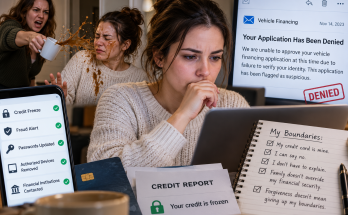
I couldn't stop thinking about how different things might have been if I had simply given my sister the card.
For a moment, the thought seemed reasonable.
Perhaps she wouldn't have become angry.
Perhaps the coffee wouldn't have been thrown.
Perhaps I wouldn't have spent the following weeks worrying about my financial security.
But then I understood what I was doing.
I was imagining that surrendering my boundary would have prevented someone else's harmful choice.
And I was treating that imagined outcome as though it would have been better.
I didn't actually know what would have happened.
I couldn't know.
But I knew something important.
The card belonged to me.
I had the right to refuse.
And no possible argument about what might have happened differently could make that refusal wrong.
I wished I had stopped questioning myself sooner.
Instead, I had spent six weeks returning to the same memory.
My sister wanted the card.
I said no.
She threw hot coffee.
The sequence was simple.
What made it complicated was my reluctance to accept that someone in my family had behaved that way.
I had wanted an explanation that would make the incident feel less serious.
Something that would allow me to put it behind me.
But I couldn't explain it away without minimizing what had happened.
That was what I finally recognized.
The problem wasn't that I had failed to understand her disappointment.
The problem was that she had hurt me because I wouldn't give her something she wanted.
I didn't need to solve her feelings before protecting myself.
I didn't need to make her agree with my decision.
And I didn't need to offer my credit card as proof of affection.
Those realizations should have been obvious.
But they had taken time.
Now I was looking at a separate problem.
An unauthorized vehicle financing application.
The lender had denied it.
The identity verification had failed.
The fraud alert had made additional checks necessary.
And my name had been involved in a request I hadn't authorized.
I understood those facts.
What I couldn't establish was the applicant's identity.
That was still the missing answer.
I thought about how tempting it had been to blame my sister.
The memory of her demanding the card made the suspicion difficult to ignore.
But I couldn't claim she had submitted the loan application simply because she had behaved badly before.
I had no confirmation.
No statement from the lender identifying her.
No evidence in the notice that established her involvement.
I could suspect.
I couldn't know.
That distinction had become one of the most important things I had learned during the entire experience.
Because I didn't want to respond to a violation of my boundaries by abandoning fairness.
I wanted to be accurate.
Even when I was frightened.
Even when I was angry.
I thought about the screenshot.
I had saved it immediately after reading the notification.
That had been a sensible decision.
The message contained a date.
A description of the attempted loan.
And an explanation of why the lender had refused it.
Preserving those details mattered.
I didn't have to rely on memory.
I didn't have to wonder whether I had misunderstood the wording.
I could look at the original message and the screenshot.
And both showed the same event.
Someone had submitted an application using my name.
The application had not passed verification.
It had been rejected.
That record was real.
The applicant's identity remained unknown.
I could accept the limits of the evidence without ignoring its significance.
I thought again about the three search results.
The familiar bank.
The unfamiliar financing company.
The vehicle lender.
Only the third had clearly established an application I knew I hadn't made.
The other two remained unexplained.
I couldn't declare them fraudulent.
And I wasn't going to pretend I knew more about them than I did.
It would have made the situation sound bigger.
But sounding bigger wasn't the same as being truthful.
I had enough to concern me already.
One unauthorized application was serious.
One attempted misuse of my identity was serious.
And one failed verification process was enough to show why the precautions I had taken mattered.
I didn't need additional invented events to justify feeling worried.
I looked at my existing bank accounts again.
Checking was normal.
Savings was untouched.
No unfamiliar withdrawals.
No strange transfers.
I remembered how relieved I had felt when I first saw those balances.
Now I could appreciate them without treating them as a complete answer.
My existing money appeared safe.
An attempt to obtain new credit had still occurred.
Those facts weren't contradictory.
They described different parts of my financial life.
Understanding that made me feel less confused.
I had been searching for a single sign that everything was either safe or unsafe.
But the information was more limited.
Some safeguards had worked.
Some questions remained unanswered.
And I needed to accept both.
I thought about the calls I had made to financial institutions six weeks earlier.
I had wanted to prevent accounts and loans from being opened without my permission.
I hadn't known there would be an attempted vehicle loan.
I hadn't known any particular financing company would become relevant.
But I had recognized that identity misuse could involve more than my existing credit card.
That recognition had led me to act.
And now I could see why.
The fraud alert had mattered to the lender.
The application had been stopped.
I was grateful for that.
I wished the attempted loan had never happened.
But I couldn't change it.
I could only acknowledge that my earlier precautions had helped protect me.
I thought about how often I had questioned those precautions.
Whether I was being too suspicious.
Whether I had allowed one family argument to frighten me unnecessarily.
Whether locking down my credit was somehow excessive.
Now those doubts seemed misplaced.
I didn't need to prove that my sister intended to misuse my identity before protecting it.
I didn't need to wait for a fraudulent account to be approved.
And I didn't need to lose money before taking my own security seriously.
The precautions were reasonable because my financial identity deserved protection.
That was all.
I remembered my sister's anger.
I remembered the coffee.
I remembered the disbelief I had felt afterward.
And for the first time, I stopped trying to make my refusal responsible for what happened next.
I had not thrown the coffee.
I had not authorized the auto loan.
I had not given someone permission to create a debt in my name.
Those choices were not mine.
What I had chosen was to refuse financial access.
To secure my accounts.
To place fraud alerts.
And to preserve the evidence when I found something suspicious.
Those were decisions I could stand behind.
I thought about my family.
I wanted to believe that the people closest to me could understand why I needed boundaries.
I wanted to believe they could recognize the difference between helping someone and surrendering financial control.
But I couldn't make that understanding a condition of protecting myself.
I couldn't wait until everyone agreed.
I couldn't wait until my sister accepted that my credit card belonged to me.
My financial identity wasn't something that became mine only after a family discussion.
It was mine already.
And the responsibility for protecting it belonged to me.
I thought about forgiveness.
I had once believed that forgiveness meant returning everything to the way it had been before.
But now I wasn't sure that was possible.
Not because I wanted to remain angry forever.
Because the past couldn't be made harmless simply by refusing to discuss it.
The coffee had been thrown.
The relationship had been damaged.
And I had taken precautions because I no longer felt comfortable leaving my finances exposed.
I couldn't pretend those things had never happened.
Whether I eventually forgave my sister was a separate question from whether she should have access to my credit card.
I understood that now.
I could care about someone without financing their choices.
I could wish them well without giving them my passwords.
I could stop arguing without removing safeguards.
And I could hope for a better relationship without pretending trust had never been affected.
Those distinctions mattered.
They allowed me to stop treating every boundary as an act of rejection.
I returned to the vehicle loan notice.
The application had failed.
The fraud alert had played a role.
The applicant was still unknown.
That was the situation.
I couldn't claim a complete resolution.
But I could recognize that I had done something important before the notification ever arrived.
I had protected my identity.
I had made it harder for somebody else to use my name.
And when the lender encountered the suspicious application, the verification process had stopped it from going forward.
That was not a small thing.
I was grateful.
I still wanted answers.
But I no longer needed those answers to prove that I had been justified in saying no to my sister.
My refusal had been justified from the beginning.
Nothing that happened afterward could change that.
And I finally stopped treating my own financial boundaries as something I owed my family an apology for.
Click here to continue reading: PART 20: The Loan Was Denied and My Money Remained Safe, but I Finally Understood That Forgiveness Could Never Require Surrendering My Boundaries
I Thought Refusing My Sister Access to My Money Would End the Argument, but Her Anger Left Me Afraid of Something Worse
Part 19 of 20