
The strangest part was how ordinary everything else looked.
My banking application still showed familiar balances.
My savings hadn't been emptied.
My checking account hadn't displayed a sudden unexplained transfer.
If I had relied only on those details, I would have believed my precautions had solved the problem.
Maybe I would have stopped looking.
Maybe I would have accepted that there was nothing more to worry about.
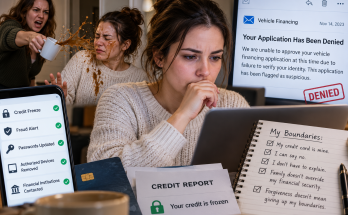
But the vehicle financing notice existed.
I couldn't forget it.
An unauthorized credit application could leave no immediate mark on the account balances I checked every day.
I had known that in theory.
Now I understood it personally.
Someone had attempted to borrow money under my identity.
The lender had rejected the request.
And for eleven days, I hadn't realized the notice was waiting in my email.
That fact bothered me.
I had tried to be careful.
I had changed passwords.
I had removed authorized devices.
I had frozen my credit.
I had arranged fraud alerts.
I had contacted financial institutions to secure my accounts against unauthorized activity.
I had done those things because I was frightened by what had happened with my sister.
At the time, I had thought of the precautions as a response to a problem that might come later.
Now I had evidence that a problem had been attempted after those precautions were in place.
It changed the way I understood their purpose.
Security wasn't proof that nobody would ever try to misuse my information.
It was a way to reduce the damage if someone did.
That was a harder lesson than I expected.
I had wanted certainty.
I had wanted to put protections in place and know that nothing else could happen.
But the notification didn't offer that kind of certainty.
It showed a particular attempt being stopped.
That was valuable.
It wasn't the same thing as showing that no other attempts existed.
I thought about the three search results again.
The first message came from a familiar bank.
The second came from a financing company I didn't recognize.
The third concerned the attempted vehicle loan.
I had only one clear conclusion about them.
The vehicle financing application had been submitted without my permission.
I couldn't honestly say more about the other two from the information I had reviewed.
I wanted to be precise.
That was something the coffee incident had made difficult for me.
When someone close to you behaves badly, it can become tempting to explain every later problem through that person.
I knew that temptation.
I felt it each time I looked at the loan notice.
My sister had wanted access to my credit card.
She had reacted violently when I refused.
Then, weeks later, an application appeared under my name.
The sequence was disturbing.
But a sequence wasn't the same thing as a proven connection.
I couldn't identify an applicant from timing alone.
And I couldn't tell myself I knew something simply because it seemed possible.
That didn't mean I owed anyone the benefit of ignoring evidence.
It meant I needed more than suspicion before naming a person responsible.
I thought about what I would have believed before the coffee incident.
If I had found the loan notification without any family conflict, I would still have considered it serious.
I would still have known I hadn't submitted the application.
I would still have wanted to protect my financial identity.
That helped me separate the issue from my emotions about my sister.
The application was wrong regardless of who had submitted it.
The person responsible didn't become less responsible because I didn't yet know their name.
And the seriousness of the attempt didn't depend on my being able to prove that it was connected to the credit card confrontation.
I found that thought grounding.
For weeks, I had felt caught between being cautious and being unfair.
Part of me worried that taking precautions meant I was making an accusation.
But securing an account wasn't an accusation.
Checking a credit-related notification wasn't an accusation.
Preserving evidence of an application I hadn't made wasn't an accusation.
Those were reasonable responses to a risk.
I wished I had understood that sooner.
I had been treating my own protection as though it required a defense.
As though I needed to show that someone had already done enough harm before I was permitted to prevent more.
But the purpose of a safeguard was to act before damage occurred.
That was why I had placed the credit freeze.
That was why I had arranged fraud alerts.
I wasn't required to wait for an approved loan to justify protecting my identity.
I wasn't required to lose savings before reviewing my accounts.
And I wasn't required to hand over my credit card to prove I loved my sister.
That last thought hurt.
It brought me back to the argument six weeks earlier.
My refusal had been simple.
No.
I had not wanted to give her the card.
There was nothing complicated about that.
But her response had made the refusal feel like something I needed to explain.
I had spent too much time examining my own decision instead of examining what she had done.
I wondered whether I had said no too firmly.
Whether I should have chosen different words.
Whether some small change in my behavior might have prevented the coffee from being thrown.
Then I stopped.
Those questions placed responsibility in the wrong place.
I hadn't thrown anything.
I hadn't tried to force someone to give me money.
I hadn't demanded access to another person's financial identity.
I had refused a request.
She had chosen her response.
That distinction was not negotiable.
It mattered even more now because the same basic issue was present in the loan notification.
Consent.
I hadn't consented to the application.
I hadn't authorized anyone to use my identity.
No amount of family closeness could create that consent on my behalf.
And no explanation about need or disappointment could make an unauthorized loan application legitimate.
I didn't know whether my sister was involved.
But I knew what I believed about permission.
It was something a person had to give.
Not something another person could assume.
Not something that could be taken because saying no was inconvenient.
I looked again at the email.
The lender had required verification.
The applicant had failed to complete it.
And the application had been stopped.
That was an example of a boundary functioning the way it was supposed to function.
The lender hadn't simply accepted the application without the required checks.
The fraud alert had mattered.
The request had not gone through.
I felt relieved each time I remembered that.
Then I remembered that the attempt itself remained unexplained.
And the relief settled into caution.
I wasn't going to pretend that the rejected loan meant everything was now safe.
But I wasn't going to treat the notice as proof that every part of my financial life had been compromised either.
My checking account remained normal.
My savings were still there.
I had found no unfamiliar transfers or withdrawals.
Those were also facts.
I needed to hold on to all of them.
That was difficult because worry made me want to choose the worst interpretation.
But I had promised myself I would be careful.
I would trust what I could verify.
I would preserve what I found.
I would avoid inventing what I couldn't establish.
I returned to the screenshot.
It was an ordinary image of a financial notification.
Nothing more.
Yet to me it represented a moment when my precautions had mattered.
The warning had been noticed by the lender.
The lender had required proof.
The person submitting the application hadn't provided what was needed.
I didn't know whether they had tried again somewhere else.
I didn't know whether they had abandoned the attempt.
I didn't know whether this was the only time my information had been used.
Those uncertainties remained.
But the screenshot established something important.
The application had been made.
I hadn't made it.
And it had been refused.
For once, I didn't try to make those facts answer every question I had.
I let them mean exactly what they meant.
I couldn't solve the uncertainty simply by worrying harder.
I could only stop pretending that reassurance and evidence were the same thing.
My accounts looked normal.
The loan notice did not.
I accepted both.
And I knew that any decision I made about what had happened would have to begin with that distinction.
Click here to continue reading: PART 8: I Could Not Prove Who Used My Name, but I Finally Understood Why Family Loyalty Could Never Replace My Permission
I Thought Refusing My Sister Access to My Money Would End the Argument, but Her Anger Left Me Afraid of Something Worse
Part 7 of 20

One Comment on “PART 7 – I Had Protected My Accounts Before the Loan Attempt, Yet the Eleven-Day-Old Warning Showed Why I Could Not Rely on Reassurance Alone”