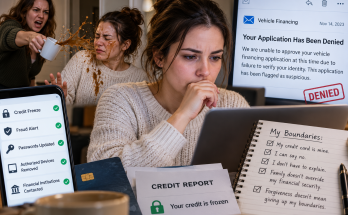
The screenshot gave me proof of something I hadn't done.
It did not tell me who had done it.
That was the difference I kept struggling with.
I had spent six weeks protecting my finances because my sister had thrown hot coffee at my face when I refused to give her my credit card.
Now someone had attempted to obtain a vehicle loan using my name.
I wanted those two events to make sense together.
But wanting an explanation and having one were not the same thing.
I opened the saved notification again.
Eleven days earlier, an application had been submitted.
The lender had encountered the fraud alert on my credit file.
The applicant had failed to complete the required identity verification.
The lender had refused the application.
Those facts had not changed since I first read them.
Neither had the question bothering me.
Who had submitted it?
I looked for an answer in the wording of the message.
There wasn't one.
The notice identified the suspicious application.
It explained why the lender hadn't approved it.
It did not identify the person who had tried to borrow the money.
That omission left me with a strange mixture of relief and fear.
I was relieved the application hadn't succeeded.
I was afraid because I couldn't tell whether the person responsible might try again.
The money in my checking account was still there.
My savings remained untouched.
Nothing in those accounts showed an unfamiliar withdrawal or transfer.
Before finding the email, I would have considered those facts enough to reassure me.
I couldn't do that anymore.
An attempted loan didn't have to appear as money leaving my bank.
It could begin somewhere else entirely.
With an application.
With personal information.
With somebody claiming to be me.
That was what frightened me.
Not simply the possibility of losing money.
The possibility that someone believed they could make financial decisions under my identity without asking me.
I thought about my sister.
I tried not to.
But the memory came back whenever I looked at the words vehicle financing.
She had wanted my credit card.
I had refused.
And she had answered that refusal by throwing hot coffee at me.
Those were facts I couldn't change.
But they were not proof that she had submitted the vehicle loan application.
I knew that.
The difficulty was making myself remember it when I was angry.
I wanted to point to someone.
I wanted the uncertainty to stop.
I wanted to know whether the person who had already hurt me had also tried to use my identity.
But I couldn't turn suspicion into evidence simply because the suspicion felt reasonable.
So I read the notification again.
Not looking for what I hoped to find.
Looking for what it actually contained.
There was the application date.
There was the lender's decision.
There was the failed verification.
There was the suspicious designation.
And there was nothing identifying my sister.
I put the screenshot aside for a moment.
The silence around that missing answer was frustrating.
I had evidence of an attempted financial transaction.
I did not have evidence of the applicant's identity.
The distinction was important enough that I made myself repeat it.
Because I knew what could happen when emotions began filling gaps in information.
A possibility could start sounding like a certainty.
An assumption could become something I repeated as fact.
And by the time I realized what I had done, I might no longer remember where the actual evidence stopped.
I didn't want that.
Not even with my sister.
Not even after what she had done to me.
The coffee incident had taught me how easily someone could ignore another person's boundaries.
It hadn't given me permission to ignore the difference between what I knew and what I suspected.
That was uncomfortable to admit.
I wanted to be angry without having to be careful.
But anger didn't make accuracy less important.
I returned to my email search.
Three results remained.
The first involved a bank whose name I recognized.
The second involved a financing company I didn't remember using.
The third was the vehicle lender.
I had opened that third message because it directly concerned an application for a loan I hadn't requested.
The other two messages still raised questions.
But I couldn't honestly say they documented additional fraudulent applications.
Their presence in the search results wasn't enough.
An email containing the words credit inquiry could mean more than one thing.
And I hadn't established what those other messages represented.
I knew how easy it would be to call all three suspicious.
I also knew that would be more than the available information supported.
So I kept them separate in my mind.
Three search results.
One confirmed unauthorized application.
An unidentified applicant.
That was the situation I actually had.
I found myself wishing the message had been more detailed.
A name.
A clearer description of the applicant.
Something that would explain why my identity had been used.
But the notification wasn't written to answer my personal questions.
It was a financial notice.
It described a lending decision.
The application had been rejected.
That was its immediate purpose.
Everything else I wanted to know remained outside the information I had.
I couldn't get those answers by reading the same words more intensely.
Still, I kept returning to them.
The date especially.
Eleven days.
The attempted loan had been submitted eleven days before I found the email.
I wondered what had happened during those eleven days.
Had the person simply moved on after being refused?
Had they tried another lender?
Had they abandoned the idea?
I didn't know.
The thought that there might have been another attempt frightened me.
But I had no evidence of one beyond the application already documented.
So I stopped there.
I had spent too much time imagining what my sister might do next.
I didn't want to make the same mistake with an unidentified applicant.
I needed facts.
Even when facts were incomplete.
Especially then.
I looked at my banking application again.
The familiar numbers appeared.
My accounts looked normal.
That should have been reassuring.
And it was, in one limited way.
I had not found money missing from checking.
I had not found money missing from savings.
Those were good things.
I didn't want my anxiety to erase them.
But I understood why the absence of withdrawals couldn't explain the vehicle financing notice.
The application hadn't been a withdrawal from my account.
It had been an attempt to obtain new credit.
That difference had taken me longer than I wanted to admit.
I had assumed that if someone was trying to take advantage of my finances, I would see the evidence where I kept my money.
Instead, the most important evidence had appeared in my email.
Not as a debit.
Not as a transfer.
As a rejected application.
A record of something someone had tried to make happen.
I thought about the credit freeze I had put in place six weeks earlier.
At the time, I had wondered whether I was going too far.
I had been upset.
I had been frightened.
And I had been trying to make sure nobody could use my identity without my consent.
Now I was glad I had acted.
The notification specifically showed that the fraud alert had mattered.
The lender had required additional verification.
The applicant hadn't completed it.
The loan hadn't been approved.
I couldn't say what would have happened without those protections.
I didn't know the lender's entire process.
But I could see that the alert had played a role.
That was enough to make the precautions worthwhile.
I looked at the screenshot again.
It was proof that a safeguard had helped.
It was also proof that someone had tried to obtain financing under my name.
Both things could be true.
I didn't need to choose between being grateful and being concerned.
I could feel both.
And I did.
I thought about the boundary I had established with my sister.
I hadn't wanted to hand over my credit card.
That was all.
I had not been making a statement about her worth.
I had not been deciding whether she deserved to be loved.
I had been deciding what happened to an account belonging to me.
Her response had made that decision feel dangerous.
But looking at the loan notification, I understood something more clearly.
My right to control my financial identity didn't depend on whether another person liked my decision.
The lender's verification process existed because consent mattered.
Identity mattered.
Authorization mattered.
Someone else's desire for credit could not replace those things.
I wished my sister had understood the same principle when I refused her my card.
But whether she understood it or not, my decision had been valid.
I didn't have to keep debating that with myself.
I had spent enough time doing it already.
I looked again at the unanswered question.
Who had applied?
I still couldn't say.
And I wasn't going to claim otherwise.
For the first time, I allowed myself to accept the limits of what I knew.
I had evidence of the attempt.
I had evidence that the lender had refused it.
I had evidence that my fraud alert had helped trigger additional verification.
I did not yet have evidence identifying the person behind it.
The distinction frustrated me.
But it also protected me from turning fear into a false conclusion.
I saved the screenshot because I wanted a faithful record.
I intended to treat the information with the same care.
For now, the record established the unauthorized application.
Nothing more.
Nothing less.
That was where I had to begin.
Click here to continue reading: PART 10: The Three Credit Inquiry Emails Raised More Questions Than They Answered, and I Had to Stop Treating Every Suspicion as Proof
I Thought Refusing My Sister Access to My Money Would End the Argument, but Her Anger Left Me Afraid of Something Worse
Part 9 of 20