I used to think financial safety was something I could see.
A familiar balance.
A payment I recognized.
Money sitting where I had left it.
That was how I had checked my accounts for years.
If the numbers made sense, I believed everything was fine.
And six weeks after the coffee incident, those numbers had looked exactly as they should.
My checking account was normal.
My savings were untouched.
No unfamiliar transfers.
No withdrawals I couldn't explain.
I had felt relieved.
That relief had been genuine.
But it hadn't told me the whole story.
Because the attempted vehicle loan existed outside those familiar balances.
I had not requested it.
I had not authorized it.
Yet somebody had submitted an application connected to my name.
I thought about how different that was from someone taking money from my checking account.
A withdrawal would have left a visible change.
A transfer would have shown money moving.
An unauthorized payment might have appeared among my transactions.
But the attempted auto loan hadn't required someone to enter my existing bank account and remove funds.
It was an effort to obtain new financing.
To create an obligation associated with my identity.
And that meant the warning had arrived somewhere else.
My email.
I remembered typing the search terms.
Credit inquiry.
Two ordinary words.
I hadn't expected those words to lead me to an application I hadn't made.
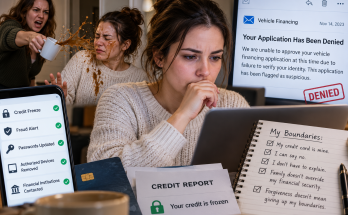
I certainly hadn't expected to find a vehicle lender's notification dated eleven days earlier.
At first, I hadn't understood what I was seeing.
I had needed to read the message twice.
The lender had denied the application.
The fraud alert had caused additional verification to be required.
The applicant had not supplied the necessary information.
The application was considered suspicious.
That explanation had brought relief.
Then fear.
I was grateful the attempt had failed.
But I was disturbed that it had been made at all.
I couldn't make those feelings cancel each other.
They both belonged to the same discovery.
I thought about the person who had submitted the application.
I wondered whether they understood what they were doing to me.
Not that I knew their intentions.
I didn't.
But I understood what unauthorized borrowing could mean for the person whose identity was used.
A financial obligation could affect someone's future.
It could create confusion about who owed money.
It could force someone to explain transactions they had never agreed to.
Those were the possibilities that had frightened me when I froze my credit.
I had wanted to prevent them.
And now I had evidence that someone had attempted a loan despite those precautions.
I looked at the date again.
Eleven days earlier.
That detail reminded me that my sense of security had not been the same thing as a complete picture of what was happening.
I had been checking my existing accounts.
The attempted borrowing had occurred through a lender I hadn't approached.
That was the lesson I kept returning to.
Protecting money and protecting identity were connected.
But they were not identical.
I had secured both because I was worried about what might happen after refusing my sister's credit card demand.
I hadn't known whether anything would happen.
I had only known that her willingness to throw coffee at me made it impossible to rely on her respecting my boundaries.
The memory still hurt.
I could admit that now.
Not just the memory of the coffee.
The knowledge that my own sister had treated my refusal as something she was entitled to punish.
I had spent too much time wondering whether my decision had been selfish.
Looking back, that seemed deeply unfair to myself.
The credit card belonged to me.
My sister had asked for it.
I had refused.
That was a complete and reasonable decision.
Her anger didn't transform my card into something she owned.
And her relationship to me didn't make her entitled to my credit.
I knew those things intellectually.
What had taken longer was learning to believe them without feeling guilty.
I looked at the screenshot again.
It was still difficult to understand how a financial notice could carry so much emotion.
The message wasn't dramatic.
It described a rejected application.
It stated why the lender had refused it.
But I couldn't separate it from the fear that had led me to secure my accounts.
I hadn't wanted to be right to worry.
That was something I needed to admit.
Part of me had hoped I would never find anything suspicious.
That six weeks would pass.
Then more time.
And eventually I would look back at the precautions as something I had done out of understandable fear, but never actually needed.
That would have been a relief.
Instead, the vehicle loan notification showed that an unauthorized attempt had occurred.
I couldn't identify the applicant.
But the attempt was real.
And one of the safeguards I had arranged had helped stop it.
I felt grateful for my earlier decision.
I also felt sad that it had been necessary.
I thought about all the steps I had taken.
Freezing my credit.
Changing passwords.
Removing previously authorized devices.
Placing fraud alerts.
Contacting financial institutions.
Each one had required me to admit that my financial information deserved protection.
Even from the possibility of misuse by someone close to me.
I had resisted that thought at first.
I didn't want to imagine family as a source of financial risk.
But being related to someone couldn't guarantee that they would respect my choices.
The coffee incident had already shown me that.
I couldn't pretend otherwise.
At the same time, I was careful not to assume the vehicle loan application had come from my sister.
I still didn't know.
The lender's notice didn't provide the applicant's identity.
And the timing alone couldn't establish responsibility.
I kept returning to that point because I didn't want my fear to become a false accusation.
I had enough reasons to be concerned.
I didn't need to manufacture more.
My sister had hurt me.
Somebody had attempted to borrow money as me.
Those events were both serious.
Their connection remained unproved.
I accepted that.
Not comfortably.
But honestly.
I thought again about the first two credit-related emails.
The familiar bank.
The unfamiliar financing company.
I had noticed them before opening the vehicle loan notice.
Their presence still raised questions.
But I had not established what either message actually represented.
I couldn't use them as evidence of additional fraudulent applications.
I had to resist that temptation.
One confirmed unauthorized application was enough to justify concern.
Adding uncertain claims wouldn't make the truth stronger.
It would only make it less precise.
I looked at my banking application again.
I appreciated the ordinary balances.
They meant I hadn't discovered unauthorized withdrawals from those accounts.
That was good news.
I allowed it to remain good news.
I didn't have to dismiss it simply because another problem existed.
But I wouldn't let it erase the attempted loan either.
The two discoveries belonged together.
One showed that my existing accounts appeared untouched.
The other showed that somebody had tried to obtain credit under my identity.
That was the situation.
No more.
No less.
I thought about what I would have done if I hadn't searched my email.
The notification might have remained unnoticed longer.
I would have continued relying on the reassuring bank balances.
I might have believed that nobody had attempted anything.
I couldn't know how long the email would have remained unread.
But I knew I had found it when I looked beyond my existing accounts.
That mattered.
I had learned that sometimes the most important financial warning wasn't a missing dollar.
It was a record of an obligation somebody tried to create.
I couldn't see the person behind that attempt.
I couldn't explain their motive.
But I could recognize the violation.
My identity had been used without my permission.
I didn't need to wait for an approved loan to take that seriously.
I didn't need to wait for money to disappear.
And I didn't need to identify the applicant before deciding that my financial boundaries would remain in place.
That was the decision I had finally become comfortable making.
I would continue to regard my credit as mine.
My name as mine.
My financial choices as mine.
I had not authorized the vehicle loan.
The lender had rejected it.
And I would not allow the fact that the application failed to make me dismiss the fact that it had been attempted.
Click here to continue reading: PART 15: I Wanted to Believe My Sister Could Still Understand My Refusal, but I Could No Longer Confuse Family Love With Financial Permission
I Thought Refusing My Sister Access to My Money Would End the Argument, but Her Anger Left Me Afraid of Something Worse
Part 14 of 20