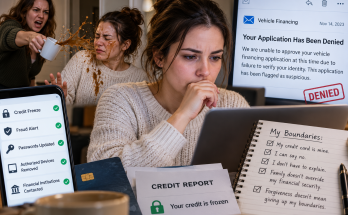
I wanted the story to end with every question answered.
I wanted to know who had submitted the vehicle loan application.
I wanted to understand how that person had obtained my information.
And I wanted to know whether the attempted loan had anything to do with my sister.
But the notification didn't answer those questions.
I couldn't pretend it did.
What I knew was enough to change how I thought about my financial security.
Someone had attempted to obtain a vehicle loan using my identity.
I had never applied for that loan.
The lender had encountered the fraud alert on my credit file.
The applicant had failed the required identity verification.
And the application had been rejected as suspicious.
Those facts were clear.
They were also the limit of what the notice established.
I had preserved the message.
I had taken a screenshot.
And I had carefully separated what the lender confirmed from what I feared might have happened.
The result wasn't the complete explanation I wanted.
But it was a truthful one.
The application hadn't been approved.
That mattered.
My checking account appeared normal.
My savings remained untouched.
I hadn't discovered unfamiliar withdrawals or transfers in those accounts.
That mattered too.
And my earlier precautions had helped protect me against at least one attempted misuse of my identity.
I was grateful for that.
Six weeks earlier, I had frozen my credit.
I had changed my passwords.
I had removed authorized devices.
I had placed fraud alerts with the credit bureaus.
And I had contacted the institutions connected to my name.
I had done those things because my sister's behavior made me realize I couldn't assume that my financial boundaries would be respected.
I hadn't known that an unauthorized loan application would later appear.
I had simply been trying to protect myself.
At the time, I worried that I was going too far.
I wondered whether I was treating a family disagreement as something more serious than it needed to be.
But I no longer described what happened as an ordinary disagreement.
My sister had wanted my credit card.
I had refused.
She had thrown hot coffee at my face.
That was not a small argument.
It was not something I had caused by being unwilling to share my account.
It was a harmful response to a reasonable boundary.
I had struggled to admit that.
For a long time, I wanted the relationship to matter more than the incident.
I wanted to believe that because we were sisters, the hurt could eventually disappear.
But I had begun to understand that loving someone didn't require me to pretend they had done nothing wrong.
The coffee had been thrown.
I had been hurt.
And the memory remained part of what had happened between us.
I couldn't change that by forgiving faster.
I couldn't change it by giving her the card.
And I couldn't change it by blaming myself for her reaction.
My responsibility was my decision.
Her responsibility was her behavior.
I had to stop confusing those things.
I thought about the word no.
It had seemed so difficult to defend when my sister became angry.
But the decision itself had been simple.
My credit card belonged to me.
I hadn't wanted to give it away.
I hadn't consented to anyone else using it.
That was enough.
I didn't need to explain what I planned to purchase.
I didn't need to justify keeping my available credit.
I didn't need to show that I had a more important use for my money.
And I didn't need to prove that my sister was undeserving of help.
It was my account.
The choice was mine.
I had finally learned to let that decision stand.
The attempted auto loan made the importance of permission even clearer.
Somebody had submitted an application using my identity.
Whoever they were, I hadn't agreed to it.
I hadn't requested the financing.
I hadn't authorized anyone to borrow on my behalf.
The lender had refused the application after the necessary verification failed.
And I was relieved that the attempt hadn't succeeded.
But the rejection didn't make the attempt acceptable.
A failed attempt to use someone else's financial identity remained serious.
I didn't have to wait for an approved loan to acknowledge that.
I didn't have to wait for missing money.
And I didn't have to invent additional financial harm to make the discovery matter.
The facts were enough.
I thought back to the moment I searched my email.
Three results.
The first came from a bank I recognized.
The second came from a financing company I had never used.
The third came from the vehicle lender.
That third message had been the one that stopped me.
It was dated eleven days earlier.
It described a loan application I hadn't submitted.
I remembered opening it.
Reading it.
Then reading it again.
At first, I hadn't wanted to believe that somebody had used my name.
But the notice made the attempted application clear.
I hadn't imagined it.
The application existed.
The lender had denied it.
And the attempt had been marked suspicious.
I couldn't ignore those facts.
I also couldn't use them to prove something they didn't establish.
The notice didn't identify my sister.
That was important.
I could not truthfully say that the bank had confirmed her involvement.
I couldn't say the other two email messages proved additional fraudulent applications.
And I couldn't claim that the attempted vehicle loan had been part of a larger plan whose details I didn't possess.
I had wondered about those possibilities.
But wondering didn't make them true.
I thought about how strongly I had wanted the applicant to be identified.
At first, it seemed as though knowing the name would explain everything.
But even without that answer, I could understand something about my own choices.
I had been right to protect my credit.
I had been right to refuse access to my account.
And I had been right to preserve the notification instead of dismissing it.
Those decisions didn't depend on identifying someone to blame.
They were responsible decisions in their own right.
I found comfort in that.
Not the kind of comfort that erased the worry.
The kind that came from knowing I hadn't acted carelessly.
I had taken precautions.
One of those precautions had mattered when the lender reviewed the application.
And I had discovered the attempted loan before assuming that normal bank balances meant nothing suspicious had occurred.
That was what I could say with confidence.
I thought about how much my understanding of family had changed.
I had always wanted to believe that people who loved one another would respect each other's boundaries.
But I now understood that love and respect were not automatically the same thing.
Someone could be related to me and still behave badly.
Someone could be disappointed by my refusal and still have no right to punish me for it.
Someone could want financial help without being entitled to my credit.
Those distinctions were simple.
I wished I had learned them under different circumstances.
But I had learned them.
I thought about the expectation that family problems should eventually be forgiven.
I hadn't stopped believing forgiveness was possible.
What had changed was my belief that forgiveness required giving up protection.
It didn't.
Forgiving a person did not mean approving everything they had done.
It didn't require pretending an act of aggression had been harmless.
It didn't require restoring financial access.
And it didn't mean that the person who had been hurt was responsible for preventing the same harm from happening again.
I could care about my sister without giving her my credit card.
I could hope that one day our relationship might feel less painful without removing safeguards from my accounts.
I could acknowledge that she was part of my family without allowing that fact to decide how my money was used.
That was the boundary I needed.
I realized how much energy I had spent trying to make it seem reasonable to everyone else.
I had wanted approval.
Understanding.
Reassurance that I wasn't being selfish.
But I didn't need someone else's permission to protect my financial identity.
I didn't need my sister to agree with my decision.
I didn't need a family explanation that made my refusal acceptable.
It was acceptable already.
And I had every right to maintain it.
The notification remained in my email.
The screenshot remained saved.
Those records didn't provide a complete answer about the applicant.
But they showed what had been attempted and why that particular application had failed.
I didn't want to lose that distinction.
The evidence established a suspicious vehicle financing application using my name.
It established that the lender denied it.
It established that the fraud alert had led to additional identity verification.
It did not establish the applicant's identity.
I had to accept that the complete truth about the person behind the attempt was still beyond the information I possessed.
That wasn't the resolution I had hoped for.
But pretending otherwise wouldn't make it better.
I thought about my checking account.
The balance had looked normal.
My savings had remained untouched.
There was comfort in knowing I hadn't found money missing from those accounts.
I allowed myself to appreciate it.
For weeks, I had been so focused on what might happen that I sometimes overlooked what had actually been prevented.
The rejected application was one example.
My safeguards had helped.
That was worth recognizing.
It didn't mean I could stop caring about my financial security.
It meant the precautions had served an important purpose.
I remembered how uncertain I had felt when I first decided to freeze my credit.
I had questioned whether taking those steps was an overreaction to my sister's conduct.
Now I was glad I hadn't allowed that doubt to stop me.
I wasn't required to wait for financial damage before protecting myself.
I didn't have to prove that someone had already obtained money under my name.
The purpose of prevention was to act before a problem became worse.
And in the case of the rejected auto loan, additional identity verification had made a difference.
That was a fact I could hold on to.
I thought once more about my sister.
I knew what she had done with the coffee.
I knew I had refused to give her the card.
I knew that her behavior had changed how safe I felt.
Those things would remain part of our history.
But I didn't know whether she had submitted the loan application.
I couldn't claim she had.
Not from the evidence available to me.
That distinction mattered because I wanted to be fair, even when I was hurt.
Being fair didn't require me to excuse her behavior.
It required me to describe it accurately.
I could hold her responsible for throwing hot coffee.
I could refuse her access to my finances.
And I could acknowledge that the unauthorized vehicle loan remained an unresolved question about someone else's identity.
Those statements could all be true at the same time.
I didn't have to force them into a simpler explanation.
That was perhaps the most important change in how I understood the situation.
I could live with a question unanswered without abandoning the facts I already knew.
I could protect myself without making accusations I couldn't support.
And I could stop feeling guilty for refusing something I had never been obligated to give.
I looked at the saved screenshot again.
It reminded me of the eleven-day-old notification.
Of the application I hadn't made.
Of the verification that failed.
Of the fraud alert I had placed six weeks earlier.
And of the decision to protect my identity even while I was unsure what might happen next.
I had been frightened.
I could admit that.
I had also been careful.
And those precautions had mattered.
The lender had stopped the application.
My existing bank accounts showed no missing money.
The identity of the applicant remained unknown.
Those were the outcomes I could establish.
I couldn't claim that my family had learned every lesson I wished they would learn.
I couldn't claim that my sister had apologized or accepted responsibility for anything beyond what I personally knew.
And I couldn't claim the bank had identified her as the person behind the attempted loan.
Those events weren't established by the information I had.
But I had learned something about myself.
I would not hand over my financial security to prevent somebody else's anger.
I would not treat a family relationship as permission to use my credit.
And I would not believe that loving someone required me to excuse the same harm again and again.
I thought about my original refusal.
Such a small decision.
A credit card I didn't want to give away.
A simple no.
I hadn't imagined how much I would later question that moment.
But I no longer questioned the answer.
I had been entitled to refuse.
I had been entitled to protect my accounts.
And I had been entitled to take the unauthorized application seriously.
The person behind the attempted loan remained unidentified.
The record of the attempt remained preserved.
The safeguards remained important.
And my refusal remained valid.
I couldn't decide when somebody else would respect my boundaries.
I could only decide whether I would continue respecting them myself.
This time, I would.
Because love might involve patience.
It might involve understanding.
It might even involve forgiveness.
But it did not give anyone unlimited permission to hurt me, use my money, or make financial decisions under my name.
I finally understood that.
And I was no longer willing to forget it just because the person asking was family.
The End
Read more original stories on Feel Every Story.
I Thought Refusing My Sister Access to My Money Would End the Argument, but Her Anger Left Me Afraid of Something Worse
Part 20 of 20