Six weeks passed.
I had already done what I could to secure my accounts.
I wanted to believe that was enough.
But I couldn't completely shake the feeling that there might be something I hadn't checked.
I didn't have proof.
That was what made it so uncomfortable.
If I had found an unauthorized charge, at least I would have known what I was dealing with.
If money had disappeared, I would have had a clear problem to report.
Instead, I had questions.
And the unpleasant memory of why I had started asking them.
I thought about the card my sister had wanted.
I thought about how firmly I had refused.
And I thought about the consequences of that refusal.
I didn't want those memories controlling every financial decision I made.
But neither did I want to pretend that my concerns were unreasonable.
So I opened my banking application.
It was something I could check for myself.
No guesses.
No family explanations.
No arguments about what anybody had meant.
Just the information associated with my accounts.
I began with checking.
I looked through the account information.
The balance appeared normal.
There were no withdrawals that stood out as unauthorized.
No unfamiliar transfers.
Nothing suggesting that money had been taken from that account.
I checked again.
I wasn't looking for a reason to accuse anyone.
I was looking for a reason to stop worrying.
And for a moment, the information gave me one.
My checking account looked the way it should.
Then I opened savings.
That was the account I was especially relieved to see unchanged.
My money was still there.
I didn't see unexpected activity.
No amount appeared to have been taken without my permission.
No transfer suggested that someone had gained access and moved money elsewhere.
I looked carefully.
Then I looked again.
Everything appeared ordinary.
And ordinary was exactly what I had hoped to find.
I felt some of the tension leave me.
Perhaps my precautions had worked.
Perhaps the coffee incident had been the end of the financial problem.
Perhaps I had spent six weeks worrying about something that wasn't going to happen.
I wanted that explanation to be true.
I had never wanted to discover wrongdoing.
That was one thing I needed to be honest about.
I wasn't hoping to catch my sister doing something.
I wasn't hoping for a reason to feel justified in distrusting her.
I wanted my accounts to be safe.
And I wanted the matter to be finished.
Finding nothing unusual in my checking and savings accounts seemed like a good sign.
It was a good sign.
But it wasn't a complete answer.
That distinction took me a moment to recognize.
My bank balances could tell me whether money had moved through those accounts.
They couldn't tell me whether someone had tried to obtain credit elsewhere.
They couldn't show me every application submitted using my identity.
They couldn't prove that no one had attempted to borrow money under my name.
I had been thinking mainly about money being taken from what I already owned.
But my earlier precautions had addressed another possibility.
Someone attempting to create a debt that would be associated with me.
That was a different kind of risk.
And a normal checking balance would not rule it out.
I remembered the credit freeze.
The fraud alerts.
The financial institutions I had contacted.
Those protections weren't limited to my existing bank balances.
They were also intended to protect me against new unauthorized accounts and loans.
If someone had attempted to use my information, there might be a record of that attempt even if no money had disappeared.
So I turned to my email.
I wasn't expecting to find anything specific.
I simply wanted to check whether I had received notices connected to my credit.
I searched for credit inquiry.
Two ordinary words.
Words I had seen in financial communications before.
But this time, they mattered in a way I hadn't expected.
Three results appeared.
I looked at the number first.
Three.
It didn't automatically mean anything was wrong.
There were legitimate reasons for financial institutions to send messages involving credit checks and inquiries.
I understood that.
But I hadn't been applying for new financing.
And I had already taken precautions because I was concerned about unauthorized use of my identity.
So the results deserved a closer look.
I began reading them.
The first message came from a bank whose name I knew.
I recognized the institution.
That familiarity made the result less immediately alarming.
It didn't establish what the email meant, but it wasn't enough by itself to convince me that something suspicious had happened.
I moved on.
The second message involved a financing company I didn't remember using.
I stopped there.
It was an unfamiliar name.
That didn't prove anything either.
Companies sometimes used names that differed from the businesses people recognized.
And a message in an inbox wasn't the same thing as evidence that a financial account had been opened.
I reminded myself not to jump to conclusions.
I had spent six weeks trying to make careful decisions.
I wasn't going to abandon that care because an email made me nervous.
But I was no longer feeling the relief I had felt while checking my bank balances.
The questions had returned.
Then I looked at the third result.
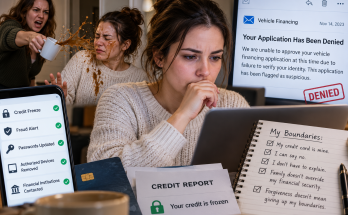
It came from a company involved in vehicle financing.
I read the sender information.
Then the date.
Eleven days earlier.
I hadn't applied for financing eleven days earlier.
I hadn't been shopping for an auto loan.
And I hadn't given anyone permission to submit an application in my name.
My attention settled on that message.
Not the first one.
Not the unfamiliar financing company in the second result.
The third.
Because the subject matter pointed toward a type of borrowing I knew I hadn't requested.
I could no longer tell myself that my normal bank balances answered every question.
A person could attempt to borrow money without touching an existing checking account.
The attempted borrowing could still involve my identity.
And I would have no reason to know about it unless I found a notification or a record.
I sat with that thought.
I didn't want to open the message and discover that someone had used my name.
But leaving it unread wouldn't change whatever it contained.
I had checked my accounts because I wanted facts.
Now I had to follow through.
I opened the vehicle financing notification.
Click here to continue reading: PART 4: The Vehicle Loan Application Was Eleven Days Old, and the Reason the Lender Rejected It Made Me Question Whether I Had Acted Soon Enough
I Thought Refusing My Sister Access to My Money Would End the Argument, but Her Anger Left Me Afraid of Something Worse
Part 3 of 20