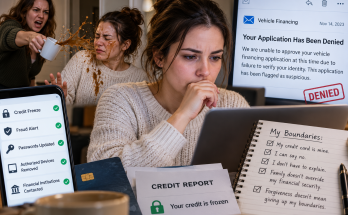
I looked at the notification one more time.
Not because I expected the words to change.
Because I wanted to remember exactly what they said.
The loan application had been submitted eleven days before I discovered the message.
It concerned vehicle financing.
My identity had been used.
The fraud alert on my credit file had caused the lender to seek additional verification.
The applicant hadn't provided what was required.
The application had been rejected.
Those details were clear.
The identity of the applicant was not.
I understood that distinction now.
I didn't like it.
But I accepted it.
I had spent too much time wanting the notice to tell me everything.
Who had applied.
Why they had done it.
What they knew about me.
Whether they had tried before.
Whether they would try again.
The email couldn't answer those questions.
It was a notification about a specific application.
Not a complete explanation of the person behind it.
I thought about how disappointed I had felt when I realized that.
For a moment, I had wanted to believe that the bank had uncovered the entire truth.
That one message would explain every troubling detail.
That I could finally connect the confrontation with my sister to the attempted vehicle loan.
But the evidence didn't go that far.
It confirmed the application.
It confirmed the denial.
It confirmed the failed identity verification.
And it confirmed that the lender had considered the attempt suspicious.
Nothing in the notice established who had submitted it.
I had to live with that unanswered question.
At least for now.
I thought about the six weeks since my sister threw hot coffee at me.
Before that incident, I hadn't expected to feel the need to secure every financial account associated with my name.
I had assumed my money was mine.
My credit was mine.
My identity was mine.
I hadn't spent much time considering what could happen if someone close to me refused to respect those boundaries.
Then I refused my sister's request for my credit card.
And she hurt me.
The memory hadn't become easier.
But my understanding of it had changed.
At first, I had been focused on the argument.
What I had said.
Whether I should have handled the refusal differently.
Whether I could have avoided upsetting her.
Now those questions seemed misplaced.
The important fact was that I had the right to refuse.
Her anger didn't cancel that right.
Her relationship to me didn't cancel it.
And her decision to throw coffee didn't make my refusal wrong.
I wished I had understood that immediately.
Instead, I had needed time to stop treating her response as something I should have prevented.
I couldn't change what happened.
But I could change how I responded to it.
That was why I had frozen my credit.
That was why I had replaced my passwords.
That was why I had removed authorized devices.
That was why I had arranged fraud alerts and contacted financial institutions.
I had not been trying to punish my sister.
I had been trying to protect my own financial identity.
The distinction mattered.
Because for a while, even I had questioned whether taking those precautions meant I was being too suspicious.
Now I knew that protecting myself had been reasonable.
An application had been submitted using my identity.
The fraud alert had mattered.
The lender had stopped that particular loan from being approved.
I didn't know what would have happened without the alert.
I didn't know whether the applicant would have passed other checks.
I couldn't claim that my precautions had prevented every possible form of fraud.
But I could see that a safeguard I had arranged had played an important role.
That was enough to make me grateful.
I thought about the difference between prevention and proof.
A financial precaution could help prevent an unauthorized account from being opened.
It couldn't automatically identify the person making the attempt.
The vehicle financing notice had shown me that difference.
The loan had been stopped.
The applicant was still unknown.
I couldn't ignore either fact.
I returned to the three email search results.
The first came from a bank I knew.
The second involved a financing company unfamiliar to me.
The third contained the vehicle loan warning.
I still didn't have enough information to declare that all three represented unauthorized applications.
I hadn't established that.
The third message alone gave me a clear reason for concern.
That was the record I had saved.
I wasn't going to make the situation more dramatic by exaggerating what the other messages showed.
The reality was already disturbing.
Someone had attempted to obtain a loan in my name.
I hadn't authorized it.
The application had been rejected.
Those facts were enough.
I looked at my bank balances again in my mind.
Checking was normal.
Savings was normal.
There had been no unfamiliar transfers or withdrawals.
I had been so relieved when I first saw that.
The relief had been genuine.
I didn't want to forget it.
My existing accounts had not shown the kind of unauthorized activity I feared.
But the loan notice had revealed something that those account balances couldn't show.
A person could attempt to borrow money under my identity without first taking money from my checking or savings account.
I had learned that through a message I almost might have overlooked.
It was an uncomfortable education.
But it was one I needed.
I thought about how the notification had sat in my email for eleven days.
I hadn't known what was there.
I had continued believing my precautions were enough to keep every financial problem away.
Then a simple search had brought the message to my attention.
Three results.
One suspicious vehicle loan application.
A denial.
And a question about the applicant that still hadn't been answered.
I couldn't change the eleven days that had passed.
I could only deal honestly with what I now knew.
I looked at the screenshot I had saved.
The image was ordinary.
It didn't look like evidence of something that might change how I thought about my family.
But it mattered.
It preserved the details of an application I had never submitted.
It preserved the date.
It preserved the lender's explanation.
And it reminded me that I wasn't imagining the attempted misuse.
The event had been documented.
That mattered because I had spent too long questioning my own reasons for taking precautions.
I had wondered whether the confrontation with my sister justified freezing my credit.
I had wondered whether changing everything connected to my finances was too much.
I had wondered whether I should simply move past what happened.
But the existence of the rejected application showed that financial caution was not pointless.
The safeguards had been relevant.
And I was grateful I had taken them before discovering the notice.
I thought about the phrase unlimited forgiveness.
I hadn't used those exact words during the confrontation with my sister.
But the idea had shaped how I viewed family.
I had believed that loving someone meant eventually overlooking whatever they did.
That if a relationship mattered, I should be willing to absorb the hurt and keep moving.
But I was beginning to see how unfair that expectation could become.
Forgiveness couldn't undo an unauthorized application.
It couldn't turn a refusal into consent.
It couldn't make hot coffee thrown at someone's face acceptable.
And it couldn't require me to surrender my financial security.
I could still care about my sister.
I could still be saddened by what had happened between us.
I could still wish our relationship had not reached this point.
But none of those feelings meant I had to give her my card.
They didn't mean I had to share access to my accounts.
And they didn't mean I had to pretend that her behavior six weeks earlier had been harmless.
Love and permission were different things.
That was becoming clear to me.
A person could love a family member and still refuse a request.
A person could want reconciliation and still require boundaries.
And a person could acknowledge uncertainty about one accusation while remaining certain about harm they had personally experienced.
I knew my sister had thrown the coffee.
I knew someone had attempted the vehicle loan.
I didn't know whether those actions had been committed by the same person.
That was the truth as far as the evidence went.
I wasn't going to force it beyond that.
I thought about the temptation to call my sister responsible for everything.
It would have given my fear a single target.
It would have made the story simpler.
But the simplest explanation wasn't automatically the proven one.
I needed to remember that.
If I wanted to be treated fairly, I had to be careful about the claims I made regarding someone else.
Even someone who had hurt me.
That didn't mean excusing the coffee incident.
It meant refusing to invent evidence about the loan.
I could do both.
I could hold a firm boundary.
And I could remain honest about what I knew.
I found that realization more useful than the certainty I had been trying to force.
Because the unauthorized application had already taught me something important.
My financial identity required protection whether or not I could identify the person attempting to misuse it.
The safeguards didn't depend on an accusation.
My right to refuse financial access didn't depend on winning an argument.
And my right to take an attempted loan seriously didn't depend on proving that the applicant was related to me.
Those rights existed regardless.
I had spent six weeks learning that.
Slowly.
Uncomfortably.
One precaution at a time.
Then the vehicle loan notification had made the lesson impossible to ignore.
I wasn't going to dismiss the attempt because the lender had stopped it.
I wasn't going to pretend I had lost money when my accounts showed no such loss.
I wasn't going to claim the two other email results proved things I hadn't established.
And I wasn't going to name my sister as the applicant without evidence identifying her.
That was the position I could stand behind.
It wasn't the complete answer I wanted.
But it was honest.
I thought once more about the moment I refused her credit card request.
I had not known that six weeks later I would be staring at a suspicious auto loan notification.
I had not known that I would question whether someone had tried to use my identity.
I had not known that a fraud alert would play a role in stopping an application I hadn't made.
All I had known then was that the card belonged to me.
And that I didn't want to give it away.
That should have been enough.
It still was.
I looked at the saved screenshot.
The application had been denied.
The notice remained.
The identity of the person behind it remained unanswered.
I couldn't pretend the matter had been fully resolved.
But I could recognize what had already changed.
I no longer believed I had to make myself financially vulnerable to prove that I loved my family.
I no longer believed another person's anger made my boundaries unreasonable.
And I no longer believed that forgiveness required pretending a serious violation hadn't occurred.
The questions about the loan remained.
So did the evidence.
I would not confuse one with the other.
And whatever the unanswered questions eventually revealed, I knew I had been right to protect my credit, my accounts, and my right to say no.
Click here to continue reading: PART 13: I Had Evidence Someone Tried to Borrow Money in My Name, but I Still Had No Proof of Who Was Responsible
I Thought Refusing My Sister Access to My Money Would End the Argument, but Her Anger Left Me Afraid of Something Worse
Part 12 of 20