
I used to think forgiveness meant putting an argument behind you.
That was easier when the argument was small.
A careless remark.
A disagreement.
Something said in frustration and later regretted.
But I had been trying to apply that same thinking to something much more serious.
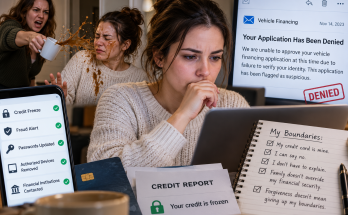
My sister had thrown hot coffee at my face because I refused her my credit card.
That wasn't a misunderstanding about money.
It was a refusal followed by an act of physical aggression.
I didn't want to call it that.
For a long time, I preferred softer words.
An argument.
A bad moment.
Something that got out of hand.
But those descriptions made what happened sound less serious than it was.
I had been hurt because I set a boundary.
And afterward, I had taken steps to make sure that boundary could not be easily ignored in my financial life.
Six weeks later, I was looking at evidence of an unauthorized loan application.
I didn't know whether the events were connected by the same person.
That was the hardest uncertainty.
My mind kept trying to complete the story.
The demanded card.
The coffee.
The security changes.
The rejected vehicle loan.
It was easy to place those events in a line.
It was much harder to admit that the line still had an unanswered question in it.
Who submitted the application?
The notification didn't say.
I couldn't answer by remembering how angry my sister had been.
I couldn't answer by studying the date.
And I couldn't answer simply because the possibility of her involvement felt frighteningly believable.
I needed evidence for that.
I didn't have it yet.
But I had enough information to understand that something serious had occurred.
An application had been submitted in my name.
The loan was for a vehicle.
I hadn't requested it.
I hadn't authorized it.
And the lender had refused it after the required identity verification wasn't completed.
Those details didn't need embellishment.
They were troubling on their own.
I looked at the screenshot again.
By then, the image had become familiar.
I knew where to look for the date.
I knew which part of the notice explained the denial.
I knew why the suspicious designation mattered.
But familiarity hadn't made the message ordinary.
It still represented someone trying to use a financial identity that belonged to me.
I thought about how different that was from the simple act of borrowing something with permission.
If I agreed to let someone use something of mine, that would be my choice.
If I declined, the answer would be no.
It shouldn't have become more complicated because the person asking was related to me.
Yet that was exactly how I had treated my sister's request.
I had felt that refusing her needed an explanation.
That I should consider her feelings before my own security.
That perhaps I was being selfish for wanting to keep control of my credit card.
Looking back, I found that painful.
I had allowed the fear of upsetting someone to make an ordinary boundary seem unreasonable.
But I had never owed her my card.
And I had never owed anyone permission to borrow money under my name.
The two issues were not identical.
I understood that.
Refusing to hand over a credit card was one decision.
Discovering an unauthorized vehicle loan application was another problem entirely.
What connected them in my mind was the importance of consent.
I could give it.
I could refuse it.
And nobody else had the right to decide that my refusal didn't count.
I wished that understanding had come without so much fear.
I wished I could have looked at my sister's demand and simply known that no explanation was necessary.
Instead, I had learned through consequences.
The memory of hot coffee.
The anxiety that led me to secure my accounts.
And now a financial notice I had never expected to receive.
I didn't want those experiences to define everything about my family.
But I couldn't let my feelings about family erase the facts.
My sister had hurt me.
That much was established.
Someone had attempted a loan using my identity.
That was established too.
Whether my sister had submitted the application was not yet established.
I had to leave that final question unanswered.
It felt unsatisfying.
I wanted certainty.
I wanted the kind of explanation that made every detail fit together.
But I had learned that wanting an answer didn't make one appear.
Sometimes the responsible thing was to stop at what could be proved.
I thought again about the three emails.
The familiar bank.
The financing company I didn't recognize.
The vehicle lender.
I remembered how ordinary the search had seemed at first.
Just two words entered into my email.
Credit inquiry.
Three results.
And then one notification that changed the meaning of my earlier precautions.
I hadn't gone looking for a reason to blame somebody.
I had gone looking for information.
That distinction mattered to me.
I wanted to protect myself without allowing fear to turn into an accusation unsupported by facts.
I wanted to acknowledge the seriousness of the unauthorized application without pretending I knew every detail behind it.
And I wanted to stop treating my sister's anger as something I was responsible for preventing.
That last part was perhaps the most difficult.
I had spent too long measuring my decisions by whether someone else would be upset.
I had treated peace as something I had to purchase by surrendering a little more of myself.
A little more patience.
A little more understanding.
A little more willingness to give in.
Until the day I refused the card.
Then I discovered just how much my refusal could upset her.
I couldn't undo that day.
I couldn't change her reaction.
And I couldn't make the coffee incident less serious simply by wanting the relationship to feel normal again.
But I could decide how I understood my own part in it.
I had said no.
That was not wrongdoing.
I had secured my credit.
That was not betrayal.
I had preserved evidence of a suspicious loan application.
That was not an attack on my family.
Those were choices I had made to protect myself.
And I didn't need to feel ashamed of them.
I looked at the lender's explanation again.
The application had failed.
For a moment, I let myself appreciate that without adding another worry.
The safeguard had helped.
The applicant had not completed the required verification.
No approval had resulted from that application.
I was grateful.
I could be grateful and still concerned.
I could be relieved and still require answers.
I could love someone and still refuse to give them access to my finances.
That was the lesson I was beginning to accept.
Love didn't make permission unnecessary.
A family relationship didn't grant ownership of another person's credit.
And forgiveness, whatever it eventually meant for me, couldn't require that I pretend harm hadn't occurred.
I hadn't reached a conclusion about who submitted the loan application.
The screenshot couldn't tell me that.
The other two emails hadn't yet supplied an answer.
My normal bank balances couldn't answer it either.
But I had reached a conclusion about myself.
I wasn't going to dismiss what happened merely because it was uncomfortable.
I wasn't going to invent a culprit just to end the uncertainty.
And I wasn't going to surrender the boundaries that had helped keep the attempted loan from being approved.
The screenshot remained saved.
The original notice remained in my email.
The application date still mattered.
Eleven days before I discovered it, someone had tried to obtain financing under my identity.
The lender's fraud checks had stopped that particular request.
That was what I knew.
For the moment, it was all I could honestly say.
I thought once more about the credit card my sister had demanded.
It had been mine to keep.
The decision should have ended there.
Instead, six weeks later, I was having to examine what protecting my financial identity really meant.
I didn't have every answer.
But I no longer believed that uncertainty required me to give up my right to protect myself.
I had refused the card.
I had secured my accounts.
I had found an application I hadn't made.
And I had kept the evidence.
I still needed to understand who had used my name.
But whatever that answer turned out to be, one thing was already settled for me.
Being family did not mean being entitled to my money, my credit, or my permission.
Click here to continue reading: PART 9: I Kept Searching for the Person Behind the Rejected Loan, but the Evidence Still Could Not Tell Me Who Had Used My Name
I Thought Refusing My Sister Access to My Money Would End the Argument, but Her Anger Left Me Afraid of Something Worse
Part 8 of 20

One Comment on “PART 8 – I Could Not Prove Who Used My Name, but I Finally Understood Why Family Loyalty Could Never Replace My Permission”