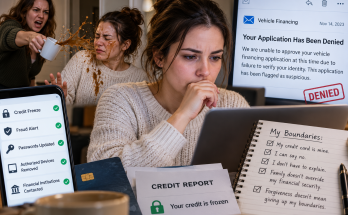
I didn't know who had submitted the vehicle loan application.
That hadn't changed.
I had the notification.
I had the screenshot.
I had the date.
I knew why the lender had refused the request.
But the person behind it remained unidentified.
For a while, I had treated that missing answer as though it prevented me from understanding anything else.
I kept thinking that once I knew who had applied, everything would become clear.
The reason.
The motive.
The connection, if there was one, to my sister.
But I was asking too much from one piece of evidence.
The lender's notice was not a complete account of the attempted fraud.
It was a record of an application that had been rejected.
And it had already told me something important.
Someone had tried to use my identity without my permission.
The safeguards I had put in place had helped stop that particular attempt.
I didn't need to know the applicant's name to recognize those facts.
I thought about how frightened I had been when I first discovered the email.
My accounts had looked normal.
No unfamiliar withdrawals.
No strange transfers.
Savings untouched.
I had wanted to believe that meant everything was fine.
Then I opened the credit inquiry search results.
Three messages.
One from a bank I recognized.
One from a financing company I didn't remember using.
And one from a vehicle lender.
The last message had changed my understanding of the situation.
An application had been submitted eleven days earlier.
I hadn't submitted it.
The lender had required additional verification because of the fraud alert.
The applicant hadn't completed the process.
The loan had been rejected.
I remembered reading those details twice.
I had been trying to decide whether I understood them correctly.
Now I knew I had.
The notification described an unauthorized application.
It had been blocked.
That was what happened.
I still didn't know whether anyone had attempted another loan elsewhere.
I still didn't know what the first two email results represented.
I still didn't know whether my sister had been involved.
Those questions remained.
But the unanswered questions didn't erase the facts.
I had been so focused on what I couldn't establish that I sometimes forgot what I had already learned.
My precautions had mattered.
That realization deserved more attention than I had given it.
Six weeks earlier, I had been frightened after my sister threw coffee in my face.
I had decided to secure my financial identity.
I froze my credit.
Changed passwords.
Removed authorized devices.
Placed fraud alerts with the credit bureaus.
And contacted financial institutions to protect against unauthorized accounts and loans.
I had done those things before discovering the vehicle financing notice.
I hadn't known a suspicious application would appear.
I had simply decided that my money and my name were worth protecting.
At the time, I had questioned whether I was overreacting.
Now I wished I hadn't doubted myself so much.
I had not acted out of revenge.
I hadn't tried to harm my sister financially.
I hadn't made a false accusation.
I had protected my accounts.
That was all.
It sounded simple when I said it that way.
And it was simple.
But emotionally, it had been difficult.
Because protecting myself meant acknowledging that being related to someone didn't guarantee their respect.
I hadn't wanted to accept that.
Not about my sister.
Not about my own family.
I had wanted to believe the coffee incident was something that could be explained away.
A moment of anger.
A mistake.
Something we could eventually forget.
But I couldn't forget what had happened.
I had refused to give her my credit card.
She had thrown hot coffee at me.
Those events belonged together.
One followed the other.
And no amount of explanation would make the second acceptable.
I had been trying to understand whether my refusal had been too harsh.
Now I realized that question was irrelevant.
Even a refusal someone disliked did not justify physical aggression.
I didn't have to find the perfect words before I was allowed to protect my property.
I didn't have to prevent another person's anger before my decision became valid.
And I didn't have to surrender my card to prove that I cared.
That was a truth I had resisted for too long.
I thought about how many times I had mentally returned to the confrontation.
Each time, I had searched for a different outcome.
Perhaps I could have avoided the argument.
Perhaps I could have explained my reasons more gently.
Perhaps she would have accepted a different answer.
But those possibilities were imaginary.
What actually happened was clear.
I said no.
She threw coffee.
Afterward, I secured my finances.
That was the sequence.
Everything else was speculation.
I wanted to stop living inside those imagined alternatives.
They didn't change the past.
They only made me question a decision I had every right to make.
I looked at the screenshot again.
I had started doing that whenever I felt uncertain about whether the precautions had been necessary.
The rejected vehicle loan reminded me that my financial identity could be targeted without my knowledge.
The lender had caught the problem before approving the application.
That mattered.
I felt relieved.
And for once, I let the relief stay without immediately trying to turn it into another worry.
A suspicious application had been denied.
That was a good outcome.
It didn't resolve every question.
But it prevented that particular loan from going forward.
I could appreciate that.
I thought about the three credit-related messages again.
I had not established what the first two meant.
I wouldn't call them fraudulent without evidence.
The third was different.
It concerned an application I knew I hadn't made.
I had preserved it.
That was the information available to me.
I didn't need to pretend I knew more.
I had learned something about the difference between being cautious and being suspicious of everything.
Caution meant checking facts.
Suspicion could become a habit of assuming the worst.
I didn't want to live that way.
I wanted to protect myself while remaining fair.
Even when the people involved might be members of my family.
Especially then.
Because family relationships were complicated enough without adding accusations I couldn't support.
My sister had already given me a real reason to establish boundaries.
I didn't need to invent another one.
She had thrown hot coffee at my face when I refused the card.
That alone was serious.
I could hold her responsible for it.
And I could refuse to give her financial access.
Neither decision required me to prove she was the person behind the vehicle financing application.
I wished I had reached that understanding earlier.
For weeks, I had felt as though I needed a larger reason to justify protecting myself.
As though being hurt wasn't enough.
As though saying no wasn't enough.
As though I had to wait until a financial disaster occurred before anyone would understand why I had taken precautions.
But my financial security wasn't a question that needed a family vote.
It belonged to me.
My accounts.
My credit.
My identity.
I had the right to protect all three.
That right didn't disappear when the person asking for access was my sister.
It didn't disappear because she became angry.
And it didn't disappear because someone else might think I should forgive more easily.
I thought about forgiveness again.
The word no longer felt as simple as it once had.
I still believed people could forgive.
I still believed relationships could sometimes heal.
But I no longer believed forgiveness had to mean removing every boundary.
There was a difference between deciding not to carry anger forever and deciding to trust someone with financial access.
There was a difference between wanting peace and pretending harmful behavior had never happened.
I hadn't worked out what forgiveness would eventually look like between my sister and me.
I didn't know whether our relationship would ever feel the way it had before.
I didn't know what she would say if she understood how seriously I now guarded my finances.
But I didn't need those answers before deciding what belonged to me.
I looked at the lender's notification.
The rejected application remained a serious concern.
The applicant remained unknown.
I wasn't going to declare the matter solved.
But I was also finished treating myself as unreasonable for having protected my accounts.
I had not caused the unauthorized loan attempt.
I had not authorized it.
And the fact that the lender had rejected it did not make the attempt acceptable.
I had done what I could to make my financial identity harder to misuse.
The fraud alert had played a role.
And I was grateful.
I returned to the memory of my sister demanding the credit card.
For the first time, I didn't imagine giving her a different answer.
I didn't imagine trying to explain more.
I didn't imagine surrendering the card just to prevent the confrontation.
I remembered my refusal.
And I let it stand.
That was the decision I had made.
It had been mine to make.
The coffee she threw afterward was her responsibility.
The unauthorized vehicle loan application remained an unanswered matter of its own.
And my right to protect my financial life remained unchanged by either one.
I kept the screenshot.
I kept the facts separate from my suspicions.
And I stopped looking for a reason to apologize to myself for saying no.
Click here to continue reading: PART 17: I Had Spent Six Weeks Protecting My Credit, but the Rejected Loan Made Me Realize How Much I Still Needed to Understand
I Thought Refusing My Sister Access to My Money Would End the Argument, but Her Anger Left Me Afraid of Something Worse
Part 16 of 20