I hated how quickly my thoughts returned to my sister.
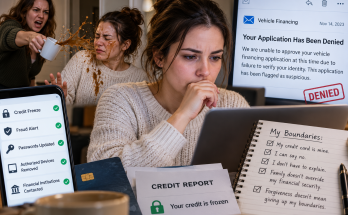
I would be looking at the vehicle financing notice.
Then I would remember the credit card.
Then the coffee.
And suddenly I would feel as though I already knew who had submitted the application.
But I didn't.
That was the part I had to keep telling myself.
I knew what my sister had done six weeks earlier.
I knew what the lender had reported eleven days before I found the email.
I did not know whether she had been the applicant.
Those three statements had to remain separate.
It would have been easier to combine them.
Emotionally, they already felt connected.
My sister had demanded access to my money.
I had refused.
Her response had frightened me enough to freeze my credit and secure my accounts.
And now an unauthorized application existed under my name.
I understood why the sequence made me suspicious.
Anybody listening to those facts might understand why I had questions.
But understanding a suspicion wasn't the same as proving it.
I couldn't forget that.
I thought about my sister asking for my card.
I remembered that the card belonged to me.
My responsibility.
My account.
My choice.
Even now, I felt a small need to justify refusing her.
That embarrassed me.
Because the justification was already complete.
I hadn't wanted to give it to her.
That should have been enough.
I didn't need to prove that I had a better use for the available credit.
I didn't need to explain my financial priorities.
I didn't need to argue that my own future mattered more than whatever she wanted at the time.
The card belonged to me.
Permission had to come from me.
And I had declined.
Nothing about that decision justified what happened afterward.
Hot coffee thrown at my face wasn't an ordinary disagreement.
It was an act that hurt me.
For weeks, I had tried to understand it through the language of family conflict.
I had told myself that sisters sometimes fought.
That anger could make people behave badly.
That perhaps time would make the whole thing easier to think about.
But the memory refused to become harmless.
The fact remained.
She had hurt me when I wouldn't give her access to my credit card.
I didn't need to make her into something more frightening than that.
The truth was already serious.
And I didn't need to make myself responsible for preventing her reaction.
That was another lesson I kept learning.
I could have spoken differently.
I could have been more patient.
I could have tried to soften the refusal.
But none of those possibilities changed who was responsible for throwing the coffee.
My decision had been mine.
Her behavior had been hers.
I wished that separation felt as simple emotionally as it did logically.
It didn't.
I was still uncomfortable admitting how much her conduct had changed my sense of safety.
I had frozen my credit because I no longer trusted that my financial boundaries would be respected.
I had changed passwords because I wanted control over access to my accounts.
I had removed authorized devices because I didn't want old permissions creating uncertainty.
I had arranged fraud alerts because I wanted lenders to verify my identity carefully.
And I had contacted financial institutions because I wanted to prevent accounts or loans from being opened without my authorization.
Those were ordinary security measures.
But the reason I had taken them felt deeply personal.
I had been afraid of my own sister's disregard for my refusal.
Now I was looking at evidence that someone had attempted to use my name for a loan.
I wanted to know whether my fear had been justified in the specific way I had imagined.
The lender's notice couldn't answer that.
It showed that an attempted misuse had occurred.
It did not show who had committed it.
I looked again at the failed verification details.
The fraud alert had prompted additional identity checks.
The applicant had not completed them.
The application had been denied.
I could see the result.
I couldn't see the person.
I couldn't see what information they had supplied.
I couldn't see their relationship to me.
I couldn't see their motive.
Those were the missing parts.
I thought about how much trouble I could cause by pretending otherwise.
If I accused my sister without proof, I would be making a claim the available evidence didn't support.
If I ignored the possibility because she was family, I would be dismissing a concern I had reason to examine.
Neither choice seemed right.
So I allowed myself to remain uncertain.
That wasn't easy.
Uncertainty felt weak.
It felt as though I was failing to take action.
But I began to understand that being accurate was not the same as being passive.
I had already acted to protect myself.
The credit freeze existed.
The fraud alerts existed.
The passwords had been changed.
Authorized devices had been removed.
I had contacted the institutions connected to my name.
And when I found the suspicious application, I had preserved the notice.
Those were real actions.
I hadn't needed to identify the applicant before taking them.
My financial security was important regardless of who might be responsible.
That realization helped me separate my immediate safety from the larger question of accountability.
I could protect myself now.
I could acknowledge what had been attempted.
And I could avoid making claims about a person I couldn't yet identify.
That was not giving up.
It was refusing to replace evidence with anger.
I thought about the words love and forgiveness.
They had been complicated for me long before I understood how much my sister's behavior had affected my finances.
I had always wanted to believe that loving family meant finding a way through disagreements.
I still believed people could apologize.
I still believed relationships could sometimes recover from painful events.
But I no longer believed that recovery could be demanded by the person who had caused the harm.
And I didn't believe love required me to give someone financial access they hadn't earned.
My sister and I were related.
That fact wouldn't change.
But our relationship didn't make my credit card community property.
It didn't make my credit record something she could use.
And it didn't mean I had to accept being hurt because I maintained a boundary.
I looked at the screenshot again.
Someone had attempted to borrow money as me.
The person responsible had acted without my permission.
I couldn't identify that person from the notification.
But I could identify the principle they had violated.
My name was not available for someone else's financial decisions.
My credit was not theirs to use.
And my consent could not be assumed.
I found myself feeling calmer about that part.
Not because I knew what had happened.
Because I knew what I believed.
I didn't have to choose between loving my sister and protecting myself.
Those things should never have been treated as opposites.
If our relationship required me to surrender control of my money to prove my affection, then something was wrong with the expectation.
Not with my refusal.
That thought stayed with me.
For the first time, I could look back at the coffee incident without immediately searching for a way I might have prevented it.
I had done something ordinary.
I had said no.
My sister had done something harmful.
She had thrown hot coffee.
I wasn't responsible for making those two actions morally equal.
They weren't.
The loan notification added another serious problem.
But I wasn't going to let it distort what I already knew.
I could hold my sister responsible for the act I had witnessed.
I couldn't yet hold her responsible for an application whose applicant remained unidentified.
That distinction mattered.
It was a form of fairness I wanted to maintain, even while protecting myself.
I returned to the banking application once more.
My checking account still showed no unfamiliar withdrawals.
My savings still appeared untouched.
The financial precautions had not prevented every attempted misuse of my information.
But the lender's notice suggested that one important safeguard had worked.
I wanted to remember that.
I wasn't powerless.
I had made decisions that helped protect me.
And the fact that someone had attempted something didn't erase the value of those decisions.
I thought again about the day I refused my sister's card request.
I had felt that my refusal needed to survive her anger.
Now I understood that it didn't need her approval at all.
The boundary was valid because it was mine to set.
That remained true whether she accepted it or not.
And it remained true whether the unidentified loan applicant turned out to be someone close to me or someone I had never met.
The application was unauthorized.
The lender had rejected it.
The applicant remained unknown.
I could be honest about all three.
And I could stop blaming myself for having protected what belonged to me.
Click here to continue reading: PART 12: The Bank Had Stopped One Suspicious Application, but I Was Left With Evidence, Unanswered Questions, and a Boundary I Would No Longer Abandon
I Thought Refusing My Sister Access to My Money Would End the Argument, but Her Anger Left Me Afraid of Something Worse
Part 11 of 20