I knew immediately that something was wrong.
The notification wasn't describing a loan I recognized.
It concerned an application made using my identity.
An auto loan.
And I had never submitted one.
I read the message carefully.
Then I went back to the beginning and read it again.
I wanted to make sure I hadn't misunderstood.
It was possible to misread a financial notice.
It was possible to mistake an inquiry for an approved account.
It was possible to see an unfamiliar company name and assume the worst.
I didn't want to do any of those things.
So I concentrated on what the notification actually said.
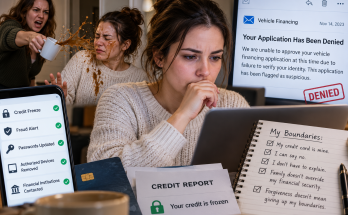
An application for vehicle financing had been submitted in my name.
It had not been approved.
The lender had encountered the fraud alert associated with my credit file.
Additional identity verification had been required.
The person submitting the application had not provided the information necessary to complete that verification.
The lender had rejected the application.
It had also identified the attempt as suspicious.
I read those details slowly.
That was the information I had been afraid I might find.
Not missing money.
Not a withdrawal I couldn't explain.
An attempt to obtain credit using my identity.
I hadn't authorized it.
I hadn't applied for a vehicle loan.
And the application had been submitted only eleven days earlier.
That date mattered.
It was long after the incident with my sister.
It was also after I had taken the precautions intended to protect my credit.
For a moment, I felt relieved.
The application had failed.
The fraud alert had triggered additional checks.
The lender had not simply treated the submitted information as sufficient.
Whatever the applicant had tried to do, the process had stopped before the loan was approved.
I was grateful for that.
But the relief didn't last.
Because the notification told me something else.
Someone had tried.
Someone had submitted information connected to my identity in an application for financing I had never requested.
The application had not appeared in the checking or savings activity I had reviewed.
My account balances were normal.
My savings remained untouched.
And yet someone had attempted to create a new financial obligation using my name.
I thought about the difference.
Before opening the email, I had been reassured by the absence of unauthorized withdrawals.
Now I understood how incomplete that reassurance had been.
My financial identity was larger than the money in my existing accounts.
It included my credit history.
My personal information.
My ability to borrow.
And the possibility that another person could try to use those things without my knowledge.
I returned to the part of the message describing the failed identity verification.
The application had been denied because the required checks had not been completed.
That fact gave me something solid.
The attempted loan hadn't gone through.
But it also raised an uncomfortable question.
What would have happened without the fraud alert?
I couldn't answer that.
I didn't know whether the lender would have approved the application under different circumstances.
I didn't know what other verification procedures it might have used.
I didn't know whether the person applying would have succeeded.
I refused to invent answers.
Still, I knew that the fraud alert had mattered.
The notification said so.
That was enough to make me grateful I had taken those precautions six weeks earlier.
And enough to make me frightened that I might have needed them.
I read the application date again.
Eleven days.
I had been going through my ordinary life while a record of that attempted loan sat in my email.
I hadn't realized what the message meant.
I hadn't known there was an application to investigate.
I had assumed that securing my credit would keep the problem from reaching me.
Now I understood that preventing a fraudulent application from being approved wasn't the same thing as preventing someone from trying.
That distinction was important.
A blocked attempt was still an attempt.
And a rejected application could still tell me something I needed to know.
I thought back to the day my sister demanded my credit card.
I remembered the refusal.
And what had followed.
I couldn't ignore that history.
It was the reason I had begun protecting my financial information in the first place.
But I also knew what the email didn't tell me.
It didn't identify my sister as the applicant.
It didn't establish who had submitted the loan request.
It didn't explain how the applicant had obtained the information used.
It didn't prove whether anyone else had access to my personal details.
Those questions remained unanswered.
I could suspect.
I could worry.
I could remember everything that had happened six weeks earlier.
But suspicion wasn't evidence.
And if I was going to understand what had happened, I needed to keep that distinction clear.
That was harder than I expected.
Because this wasn't an abstract problem anymore.
An application existed.
A date existed.
A lender had flagged it.
The fraud alert had been involved.
And my name had been used without my permission.
Those were facts.
I didn't need to add anything to make them serious.
I looked at the message again.
The application had been rejected.
That detail kept drawing my attention.
Part of me wanted to focus only on the good outcome.
No approved loan.
No new debt confirmed by that notice.
No successful verification.
But that would have been another way of avoiding the larger issue.
Someone had attempted to borrow money as me.
The failure of the attempt didn't erase it.
I began thinking about how easily I might have overlooked the notification.
If I had stopped after checking my bank balances, I would have believed everything was fine.
If I hadn't searched my email for credit inquiries, I might not have noticed the vehicle financing message when I did.
And if I hadn't placed the fraud alert, the lender might not have encountered the same warning that caused it to request additional verification.
I couldn't know what would have happened in that alternative situation.
I could only look at what actually happened.
My precaution had been relevant.
The attempted application had been rejected.
And now I had a record that needed to be preserved.
I thought about the three search results.
The recognized bank.
The unfamiliar financing company.
The vehicle lender.
I still didn't know exactly what the first two messages meant.
I wasn't going to treat all three as proof of the same thing.
The third message was specific.
It described an application that I knew I had not submitted.
That was the immediate evidence.
I returned to it.
There was something strange about seeing such an important warning in the same place as ordinary emails.
It was just a message.
A date.
A financial institution.
A notice about an application.
Nothing about its appearance reflected how serious the information felt to me.
But there it was.
I couldn't make it disappear by closing the email.
And I couldn't change what had happened by wishing the application had never been submitted.
I could, however, make sure I kept a copy of what I had found.
That became my next decision.
I took a screenshot of the notification.
I wanted the date preserved.
I wanted the lender's explanation preserved.
I wanted the record showing that the application had been rejected after an unsuccessful attempt to verify the applicant's identity.
I didn't want to rely on my memory later.
Not when the details were this important.
I looked at the screenshot.
Then I looked back at the original email.
They showed the same thing.
An attempted vehicle loan.
My identity.
A denial connected to the fraud alert.
An application marked suspicious.
I hadn't expected to feel both safer and more frightened at the same time.
Safer because the lender had stopped the application.
More frightened because someone had attempted it at all.
I knew that protecting my money was no longer only about refusing to hand someone my credit card.
It was about protecting my name.
The name attached to my accounts.
The name attached to my credit.
The name that could be used on a financial application without my knowledge.
Six weeks earlier, I had believed that my sister's behavior had forced me to take precautions.
Now those precautions had helped expose a problem I hadn't known existed.
I still didn't know who was responsible.
I still didn't know whether any other applications had been attempted.
And I still didn't know whether I had acted early enough to protect every part of my financial life.
But I wasn't looking at an imaginary fear anymore.
I had the notification.
I had the date.
I had the lender's decision.
And I had the screenshot.
For the first time, I understood that the question wasn't simply whether my sister would accept my refusal.
The question was whether someone had already decided that my permission was unnecessary.
I didn't have the answer yet.
What I had was evidence of an application I had never made.
I saved it.
And I knew I could no longer treat the matter as nothing more than a family disagreement.
Click here to continue reading: PART 5: I Saved the Suspicious Loan Notice, but the Details on My Screen Forced Me to Face How Little I Actually Knew
I Thought Refusing My Sister Access to My Money Would End the Argument, but Her Anger Left Me Afraid of Something Worse
Part 4 of 20