The first thing I wanted was peace of mind.
Not an apology.
Not an argument.
Not another conversation about why I shouldn't have refused my sister.
I wanted to know that my financial identity was safe.
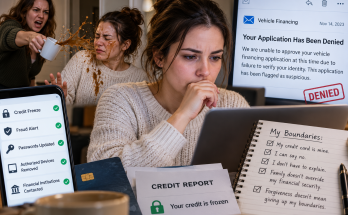
So I froze my credit.
It was a practical decision.
One that made sense regardless of what my sister did next.
I didn't want someone opening a new credit account using my personal information without my knowledge.
The freeze was intended to make that much harder.
I also knew it wouldn't protect every part of my financial life.
That mattered.
A credit freeze wasn't the same thing as securing my bank accounts.
And changing a banking password wasn't the same thing as protecting my identity from a fraudulent credit application.
Each measure covered something different.
I had to think about all of them.
I started treating my personal information as something that needed active protection.
I changed my passwords.
Not just one.
The passwords associated with my financial accounts.
I wanted to remove the possibility that an old login could continue providing access after I believed it was secure.
Then I reviewed authorized devices.
That was another detail I might once have ignored.
A password could be changed while an existing authorized session remained a concern.
I didn't want to leave that question unanswered.
So I removed authorized devices.
I wanted access to require fresh verification rather than relying on permissions I might not fully understand anymore.
None of those steps felt dramatic.
There was no argument taking place.
No confrontation.
No visible sign that anything was wrong.
Just me working through the security measures available to me.
But the reason I was doing it remained impossible to ignore.
My sister had wanted my credit card.
I had refused.
And afterward, I had started looking at my financial information in a way I never had before.
I found that difficult to accept.
Families were supposed to be the people who helped you feel secure.
At least, that was what I had always wanted to believe.
I hadn't expected that protecting myself would involve considering whether someone close to me might attempt to use my identity.
Still, I was careful not to confuse fear with proof.
I didn't know that anyone had accessed my accounts.
I didn't know that anyone had tried to borrow money using my name.
I didn't know that a financial crime had occurred.
All I knew was that the possibility frightened me enough to act.
And I had good reason to take my own safety seriously.
Next came the fraud alerts.
I arranged protection with all three major credit bureaus.
I wanted lenders to be aware that additional identity verification was necessary.
The process forced me to confront something I hadn't fully considered before.
A person's name could be used in a financial application without that person ever agreeing to the transaction.
The money might never appear in their account.
They might never receive the item being financed.
And they might not even know an application had been submitted.
That was the possibility I wanted to guard against.
I didn't want someone else's choices attached to my financial history.
I didn't want to spend my future explaining an account I had never opened.
I wanted my credit record to reflect my decisions.
Mine.
Nobody else's.
That was reasonable.
I kept telling myself so.
Because there was something uncomfortable about having to treat financial security as a family concern.
Part of me wanted to believe I was overreacting.
That nothing further would happen.
That I could finish securing my accounts and eventually stop thinking about the confrontation.
And perhaps nothing would.
I had no evidence to the contrary then.
But I no longer believed that uncertainty was a reason to leave myself exposed.
I continued with the next step.
I contacted the financial institutions associated with my name.
I wanted to confirm that appropriate safeguards were in place against unauthorized activity.
New accounts.
Loans.
Attempts to obtain financing without my permission.
I wanted to make sure my identity couldn't be used without the verification those institutions required.
The conversations were about procedures, not family.
I wasn't asking anyone to judge my sister.
I wasn't asking anyone to decide whether she had done something wrong.
I was asking how to keep my information secure.
That difference was important to me.
I had spent too much time feeling as though every decision involving my sister came with an emotional argument.
Financial security had to be different.
Either access was authorized or it wasn't.
Either I had applied for a loan or I hadn't.
Either a transaction belonged to me or it didn't.
There was no room for family pressure in those answers.
And I found that strangely reassuring.
I could still feel upset about what had happened between us.
I could still wonder what our relationship would look like in the future.
But protecting my finances didn't require me to resolve those feelings first.
I could act while still being uncertain.
So I did.
By the time I had completed the security changes, I had taken several precautions.
My credit was frozen.
My passwords had been changed.
Previously authorized devices had been removed.
Fraud alerts were in place.
Financial institutions had been contacted.
I understood that no collection of security measures could guarantee that nothing would ever go wrong.
But I had reduced the risks I knew how to address.
For the first time since refusing my sister the card, I felt that I had done something constructive.
I wasn't relying on her behavior.
I wasn't waiting for her to understand my decision.
I wasn't asking for permission to protect myself.
I had taken responsibility for the part I could control.
That should have been the end of it.
At least, I wanted it to be.
In the weeks that followed, I held on to the belief that taking those precautions had been enough.
I had not given her my credit card.
I had not authorized her to use my financial identity.
And I had secured the accounts and records I could protect.
I wanted to believe the danger had passed.
But there was a question I hadn't answered.
Had I protected myself before someone attempted to use my information?
Or had I only made it harder for them to succeed?
At the time, I didn't know there was a reason to distinguish between those possibilities.
Six weeks after the incident with my sister, I would begin looking for an answer.
Click here to continue reading: PART 3: Six Weeks After My Sister Demanded My Credit Card, I Checked My Bank Accounts and Found Nothing Wrong Until I Opened My Email
I Thought Refusing My Sister Access to My Money Would End the Argument, but Her Anger Left Me Afraid of Something Worse
Part 2 of 20