I thought protecting myself would make the fear disappear.
It didn't.
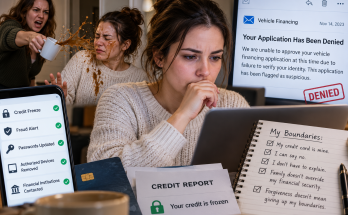
Even after the vehicle loan application was rejected, I kept thinking about the person who had submitted it.
I didn't know who they were.
I didn't know how they had obtained my information.
And I didn't know whether they had attempted anything else.
Those unanswered questions made it difficult to feel completely safe.
But I had one thing I didn't have before.
Evidence.
The lender's notification was still in my email.
The screenshot was still saved.
And the application had been refused.
I kept returning to that last detail.
Refused.
The same kind of answer I had given my sister six weeks earlier.
No.
Such a small word.
Yet so much of what had happened began with someone being unwilling to accept it.
I had refused to give my sister my credit card.
She had thrown hot coffee into my face.
I had responded by securing my financial identity.
Then someone had tried to obtain a vehicle loan using my name.
The lender had demanded additional verification.
The applicant hadn't provided it.
And the application had been denied.
I couldn't say those events were all connected by the same person.
That remained unproved.
But they had changed how I understood permission.
For most of my life, I had treated a refusal as something that needed careful handling.
Especially with family.
I didn't like disappointing people.
I didn't like arguments.
And I especially disliked being made to feel that protecting my own interests meant I was being selfish.
So I often spent more time explaining a decision than actually making it.
That was what bothered me when I remembered the credit card.
I hadn't asked my sister to approve my decision.
I had simply refused to give her access.
Yet afterward, I had found myself questioning whether I could have prevented her anger.
Looking back, I was ashamed of how readily I had placed that responsibility on myself.
She had chosen to throw the coffee.
I had not made that choice for her.
My refusal had not required violence.
And my relationship with her did not make that violence acceptable.
I knew those things now.
But understanding them hadn't made the memory disappear.
Whenever I thought about the card, I remembered why I had started securing my accounts.
At first, the precautions had seemed like a response to fear.
A credit freeze.
New passwords.
Removal of authorized devices.
Fraud alerts.
Calls to financial institutions.
I had worked through them because I wanted to make sure my identity couldn't easily be used without my permission.
I hadn't known that an unauthorized loan application would later appear.
I had simply wanted to be safe.
Now the vehicle financing notice showed why those precautions mattered.
The fraud alert had caused the lender to seek additional verification.
The applicant had failed to satisfy that requirement.
The loan had been refused.
I could not know what would have happened otherwise.
I didn't know whether the lender would have approved the application.
I didn't know what other checks might have been performed.
I only knew what the notification documented.
And that was enough to make me grateful I had taken the warning seriously.
I thought about the eleven days between the application and my discovery.
Eleven days.
During that time, I hadn't known somebody had attempted to borrow money as me.
I had continued believing that my accounts were secure.
And in one sense, they appeared to be.
My checking account looked normal.
My savings remained untouched.
There were no unfamiliar transfers.
No withdrawals that raised questions.
Those were reassuring facts.
But they couldn't tell me everything.
The attempted borrowing hadn't appeared as money leaving my existing accounts.
It had appeared as a request for new financing.
That difference had changed my understanding of financial security.
I had always thought first about keeping the money I already possessed.
Now I understood that protecting my name was just as important.
Someone could attempt to create a debt attached to me.
Someone could use information associated with my identity.
And the first indication might come from a lender rather than my own bank balance.
I found that frightening.
Not because the application had succeeded.
It hadn't.
But because I had never authorized it in the first place.
I opened the screenshot again.
The words remained unchanged.
The date.
The attempted auto loan.
The failed identity verification.
The decision to reject the application.
I looked for a name that wasn't there.
The applicant's name.
Not the name used on the application.
Mine.
I meant the actual person who had submitted it.
The notice didn't identify that person.
And I had to keep reminding myself not to replace that missing information with my own fears.
I thought about my sister.
Of course I did.
She had already shown me how she behaved when I refused her financial access.
But knowing that didn't prove she had submitted this application.
The facts had to remain separate.
My sister had thrown the coffee.
Someone had attempted the loan.
I didn't yet know whether those actions belonged to the same person.
I disliked how unsatisfying that conclusion felt.
I wanted a clear explanation.
I wanted to know exactly what had happened.
I wanted to stop wondering whether the precautions I had taken were enough.
But the lender's message couldn't answer every question.
It told me that one attempted application had been stopped.
That was important.
It wasn't a complete account of every possible risk.
I looked again at the other two email results.
One involved a bank I recognized.
The other came from a financing company I hadn't used.
I still hadn't established what those messages represented.
It would have been easy to assume they were connected to the vehicle loan.
But I had no evidence of that connection.
I refused to claim more than I knew.
The vehicle financing notice was the one that clearly described an application I hadn't made.
That was the evidence I had preserved.
And it was serious enough without any additions.
I thought about how I had once understood trust.
I had believed that trusting family meant not questioning their intentions.
That if I worried about what somebody close to me might do, I was somehow being disloyal.
But the coffee incident had forced me to reconsider that belief.
Trust couldn't mean ignoring what someone had already done.
And loyalty couldn't mean allowing another person to use my financial identity without permission.
Those things were different.
I could love my sister.
I could hope that our relationship might someday become less painful.
But I didn't have to give her my credit card.
I didn't have to give her access to my accounts.
And I didn't have to abandon the precautions I had put in place.
My money remained my responsibility.
My credit remained attached to my name.
And any decision about allowing someone else to use either one belonged to me.
I realized that I had spent too much time trying to make my boundaries comfortable for other people.
I wanted them to understand.
I wanted them to agree.
I wanted them to believe I wasn't being cruel.
But a boundary didn't become valid only after someone else accepted it.
It was valid because I had the right to make the decision.
I thought about the moment I refused my sister.
I couldn't change her reaction.
I couldn't take back the coffee she had thrown.
And I couldn't undo the fear that followed.
But I could stop telling myself that a different answer from me might have made everything right.
Giving her the card wouldn't have made her entitled to it.
It would only have meant that I had surrendered something I wanted to keep.
I wasn't willing to do that now.
The vehicle loan notification remained unresolved in one important way.
The person responsible had not been identified by the information I possessed.
But another matter was clear.
My decision to secure my finances had been reasonable.
It didn't require an apology.
It didn't require an accusation.
And it didn't require me to know everything about the attempted loan before I was allowed to protect myself.
I looked at the screenshot once more.
The application had been denied.
My name had been protected from that particular loan being approved.
I felt relieved.
Then I accepted the part I couldn't yet explain.
Somebody had tried.
I didn't know who.
And I wasn't going to pretend otherwise.
That was where the evidence ended.
For the moment, I had to let it end there.
Click here to continue reading: PART 18: I Wanted the Bank’s Warning to Explain Everything About My Sister, but the Truth Was More Limited Than My Fear Allowed
I Thought Refusing My Sister Access to My Money Would End the Argument, but Her Anger Left Me Afraid of Something Worse
Part 17 of 20