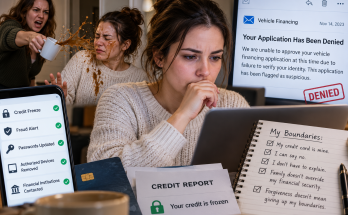
I kept looking at the screenshot.
It should have made me feel better.
The application had been refused.
The lender had followed the warning attached to my credit file.
Nobody had received an approved vehicle loan through that particular application.
Those were good things.
I understood that.
But I couldn't stop thinking about the person who had submitted it.
Somebody had entered my information into a financial application.
Somebody had tried to borrow money under my name.
And I hadn't agreed to any of it.
I wanted to believe there was a simple explanation.
Maybe an error.
Maybe a message connected to somebody else's account.
Maybe something that had nothing to do with my family.
The trouble was that the notification specifically concerned my identity.
I couldn't explain that away just because the alternative frightened me.
I opened the screenshot again.
The date was still there.
Eleven days earlier.
I had been living with the belief that my credit protections were doing their job.
Apparently, they had been.
But someone had still tried to get around the boundary I had established.
That was the part I found hardest to accept.
A precaution could stop an application from succeeding without stopping another person from submitting it.
I hadn't understood how unsettling that difference would feel until I saw it documented.
I looked at my banking application again.
Everything remained normal.
My checking account hadn't suddenly developed an unfamiliar withdrawal.
My savings still appeared untouched.
The numbers gave me no immediate reason to believe anybody had taken money from those accounts.
Yet the email said something serious had happened.
I began to understand that an empty transaction history wasn't the same as a clean record of every possible attempt at fraud.
A loan could be requested somewhere else.
An application could exist without an approved account.
A lender could have information about an attempt that never appeared in my regular banking activity.
And the person whose identity had been used might only learn about it through a notification.
That person was me.
I wished I could say I reacted calmly.
I didn't.
I wasn't shouting or crying.
I was simply unable to settle on one thought long enough to finish it.
I would look at the application date.
Then I would think about the fraud alert.
Then the coffee.
Then my sister demanding the card.
Then I would tell myself to stop making connections I couldn't prove.
It was exhausting.
I knew why my sister had become the first person I thought about.
She had demanded access to my credit card.
When I refused, she had thrown hot coffee at my face.
Six weeks had passed, but that incident had not become easier to explain.
The thought of it still made me feel foolish for ever believing that a normal refusal would be respected.
And now there was a suspicious application involving my name.
I couldn't pretend those two things felt unrelated.
But feeling wasn't proof.
I had to be careful about that.
The lender's notification had not named my sister.
It had not identified the applicant to me.
It had not explained how the information had been obtained.
It had not established whether the same person had made any other attempts.
I knew only what the message actually documented.
Somebody had applied.
The identity verification had failed.
The lender had refused the application and marked it suspicious.
Nothing in those facts gave me permission to invent the missing details.
I kept reminding myself of that.
It mattered because I was angry.
I hadn't wanted to admit how angry.
My sister's behavior had already forced me to change the way I protected my finances.
Now I had discovered that somebody had attempted to use my name anyway.
And I felt as though a private part of my life had been entered without my permission.
I didn't know whether the person had succeeded in obtaining anything elsewhere.
I didn't know whether the other two email results were connected.
I didn't even know whether this attempted loan represented the beginning or the end of the problem.
That uncertainty frightened me more than I expected.
I had spent years thinking of financial trouble in terms of money leaving an account.
A bill.
A charge.
A transfer.
A balance that didn't make sense.
This was different.
A new debt could be attempted without any of those familiar signs appearing.
That thought made the ordinary numbers in my banking application seem less reassuring.
I had checked them because I wanted to know whether I was safe.
They answered one question.
They didn't answer all of them.
I returned to the original email.
I read the lender's explanation slowly.
I wasn't searching for dramatic language.
I was searching for exact information.
What had been attempted?
When had it happened?
Why had the lender refused it?
What had caused the application to be treated as suspicious?
Those were the questions I could answer.
Anything beyond them remained uncertain.
I thought about the credit freeze I had placed six weeks earlier.
I had taken that step because I didn't want anyone using my identity to create new financial obligations.
At the time, the precaution had felt almost excessive.
I had wondered whether I was allowing one terrible confrontation to change too much of my life.
Now I was grateful I hadn't ignored my concerns.
The fraud alert had been involved in the lender's decision.
The required verification had not been completed.
The application had been declined.
That was a result I could see.
I didn't know everything the lender had done internally.
I didn't know what information the applicant had supplied.
And I didn't know whether the credit freeze had affected every possible route to financing.
But I knew that an important warning had been in place.
Without it, I might have been facing a different situation.
I couldn't prove exactly what that situation would have been.
So I stopped trying to imagine it.
The facts were serious enough.
I looked at the screenshot I had saved.
It contained information I hadn't expected ever to need.
A date I hadn't chosen.
An application I hadn't submitted.
A decision from a lender I hadn't approached for a vehicle loan.
It felt strange to realize that somebody else's action had created a record attached to my identity.
I hadn't participated.
I hadn't agreed.
I hadn't even known.
And yet there it was.
I thought about deleting the search results from my mind.
Not literally deleting the messages.
Just putting them aside.
Telling myself that because the application had been blocked, I could return to my ordinary routine.
Part of me desperately wanted that.
I was tired of worrying.
Tired of thinking about my sister.
Tired of wondering whether an act of self-protection would lead to another painful discovery.
But I couldn't dismiss an unauthorized application simply because it had failed.
If I did, I would be choosing comfort over information.
I had already spent too much time doing that in my family relationships.
I didn't want to repeat the same mistake with my financial identity.
I checked the date again.
Eleven days.
It had taken me that long to notice what the email contained.
I wondered how many other things might be sitting somewhere I hadn't looked.
Then I stopped myself.
Wondering wasn't evidence.
Fear could make every ordinary detail seem suspicious.
I needed to avoid turning the search for facts into a search for reasons to panic.
So I focused on what I could preserve.
The message remained in my email.
The screenshot captured the notification.
I could compare the two without relying on memory.
That gave me something concrete.
And concrete things had become important.
The card my sister wanted.
The coffee she threw.
The accounts I secured.
The fraud alert.
The vehicle financing notice.
Each one marked something that had actually happened.
I didn't need to make the story bigger.
I needed to understand the story those facts already told.
The most troubling part was how little I knew about the person behind the application.
I could imagine motives.
I could imagine conversations.
I could imagine someone assuming that my personal information was available for their use.
But I had no right to turn those imagined details into certainty.
Not yet.
That didn't mean I had to ignore my concerns.
It meant I had to handle them carefully.
I had refused to give my sister my credit card because it belonged to me.
I had secured my accounts because my financial identity belonged to me.
And I had every right to take an unauthorized application seriously.
None of those decisions required me to know who had submitted it.
That realization helped.
I didn't have to resolve my feelings about my sister before acknowledging that something was wrong.
I didn't have to forgive the coffee incident before protecting my credit.
And I didn't have to accuse anyone to recognize that someone had attempted to borrow under my name.
For the moment, I could hold those truths separately.
I had already learned what happened when I treated family loyalty as a reason to doubt my own boundaries.
I wasn't going to make that same choice again.
I closed the banking application.
There was nothing more in those balances that could explain the loan attempt.
Then I returned to the screenshot.
The lender had rejected the application.
That was the one clear outcome in front of me.
I was relieved the loan hadn't been approved.
But relief didn't mean the attempt was harmless.
It meant one protection had worked.
And I finally understood why protecting myself couldn't end with checking whether my money was still there.
Click here to continue reading: PART 6: The Fraud Alert Had Stopped an Auto Loan I Never Requested, but I Could Not Yet Connect the Attempt to My Sister
I Thought Refusing My Sister Access to My Money Would End the Argument, but Her Anger Left Me Afraid of Something Worse
Part 5 of 20