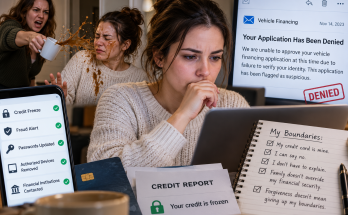
I kept coming back to one word.
Verification.
The vehicle lender had required it.
The applicant hadn't satisfied it.
And the application had been refused.
I had seen financial notices before, but I had never been so interested in the process behind one.
Usually, verification was something I thought about when logging into an account.
A code.
A password.
A question intended to establish that I was the person requesting access.
This was different.
Somebody had tried to obtain financing using my identity.
The lender had needed proof.
And whoever submitted the application hadn't provided what was required.
I didn't know exactly what had been requested.
The notification didn't give me the full exchange between the lender and the applicant.
It didn't say what the person knew.
It didn't say what the person lacked.
It simply made clear that the verification had not been completed successfully.
That detail was important.
I wasn't looking at an application that had been voluntarily canceled by me.
I hadn't been involved in the application at all.
I was looking at a request the lender had refused.
A request that had been treated as suspicious.
I thought about the fraud alert I had arranged six weeks earlier.
At the time, I had considered it another item on a list of necessary precautions.
I hadn't known whether it would ever matter.
I had hoped it wouldn't.
But now there was a direct connection between that alert and the lender's response.
I felt grateful.
Then uncomfortable.
Because gratitude for a successful safeguard came with the realization that someone had attempted something requiring a safeguard.
I had wanted my precautions to remain unused.
A lock on a door nobody tried to open.
A warning nobody triggered.
Instead, there was a rejected loan application.
I thought about the difference between protecting my identity and protecting my relationship with my sister.
For a long time, I had treated family disagreements as things that eventually had to be repaired.
Someone became angry.
Someone said something hurtful.
Time passed.
And somehow I was supposed to behave as though the passage of time had settled the matter.
But the coffee incident had been different.
My sister had not merely disagreed with me.
She had thrown hot liquid at my face because I wouldn't give her my card.
I couldn't reduce that to an unpleasant conversation.
And yet part of me still wanted to find an explanation that would make it easier to live with.
I wondered whether she understood why I had refused.
Then I caught myself.
She didn't need to agree with my decision to respect it.
My credit card was mine.
I was not required to justify withholding it.
The more I thought about that, the more obvious it became.
And the more embarrassed I felt that I had struggled so long with such a basic boundary.
I had been treating my right to say no as something that needed outside approval.
It didn't.
The lender's notification made that lesson even clearer.
A legitimate financial application required my authorization.
Family connection couldn't substitute for it.
Neither could anger.
Neither could an expectation that I should help.
If someone submitted an application using my identity without permission, the fact that they might know me wouldn't make it acceptable.
I didn't yet know who had done that.
But I knew the principle.
And I wasn't willing to compromise it.
I looked at the screenshot again.
I had preserved the notification because I didn't want to lose the details.
I also didn't want my own fear to alter them.
Memory could be unreliable when something felt personal.
I knew that from the weeks after the coffee incident.
I remembered certain parts sharply.
My refusal.
Her reaction.
The hot coffee.
Other things mattered much less than the central fact that she had hurt me when I maintained a boundary.
I wanted to keep the financial discovery just as clear.
An application was submitted.
It concerned a vehicle loan.
It used my name.
It had been declined because identity verification wasn't completed after the fraud alert.
Those were the facts.
I could repeat them without adding accusations.
And repeating them helped me understand the seriousness of what I had found.
I opened my email search results again.
Three messages.
That number still bothered me.
The first was associated with a bank whose name I recognized.
The second involved a financing company I didn't remember dealing with.
The third contained the vehicle loan notice.
I knew the third involved an application I hadn't submitted.
The other two remained less clear from what I had examined.
I didn't want to assume that every message represented another unauthorized attempt.
That would have been careless.
A familiar institution might communicate about ordinary account activity.
An unfamiliar company name might appear in correspondence for reasons I didn't understand yet.
A search result wasn't proof by itself.
I had to remember that.
At the same time, I couldn't disregard them entirely.
They had appeared because I searched for information related to credit inquiries.
And the third result showed why such information mattered.
The question wasn't whether I could turn every unfamiliar email into evidence.
The question was whether I could distinguish an actual warning from something routine.
That required patience.
I didn't feel patient.
I felt nervous.
But I didn't want my fear making the decisions.
I thought again about the financial institutions I had contacted when I secured my credit.
Those calls had been intended to prevent unauthorized accounts or loans.
I hadn't been thinking about a specific vehicle.
I hadn't been trying to stop one particular lender.
I was protecting my name generally.
That seemed important now.
If I had focused only on refusing my sister's access to the credit card itself, I might have ignored the larger risk of identity misuse.
A credit card was one form of financial access.
An attempted loan was another.
They weren't identical.
And I didn't know that the same person was responsible.
But the distinction reminded me why my precautions had needed to extend beyond a single card.
I looked again at my checking balance.
Normal.
My savings balance.
Normal.
Those were reassuring facts.
I refused to stop appreciating them just because I had discovered something else.
No unfamiliar transfer had appeared.
No unauthorized withdrawal had caught my eye.
I hadn't found missing money.
That mattered.
But it didn't settle the loan issue.
I was learning how two seemingly opposite things could be true.
My existing bank accounts could appear secure.
And my identity could still have been used in an unauthorized credit application.
I didn't like living with both facts.
I wanted a simple conclusion.
Everything was fine.
Or everything was not.
Instead, I had a successful safeguard and evidence of an attempted misuse.
Neither canceled the other.
I found myself thinking about the date again.
Eleven days before I noticed the email.
I wondered what the applicant had expected.
Had they known about the fraud alert?
Had they expected the lender not to require more information?
Had they believed using my name would be enough?
I didn't know.
And I couldn't answer those questions by studying the same notice another ten times.
That was frustrating.
I had proof of the attempted application.
But proof of an attempt wasn't proof of the applicant's identity.
I needed to remember that no matter how strongly my thoughts returned to my sister.
She had supplied a reason for me to be cautious.
She had not, through that incident alone, supplied proof of this loan attempt.
The two events belonged in the same personal history.
They didn't automatically belong to the same factual conclusion.
I sat with that distinction.
It was difficult because I wanted answers.
I wanted to know whether the person who had already ignored one boundary was now ignoring another.
I wanted to know whether the precautions I had taken had prevented something worse.
And I wanted to know whether my family relationships were ever going to feel ordinary again.
But those were different questions.
The lender's email could help with some of them.
It couldn't answer all of them.
I realized that I had been asking one message to explain far more than it actually contained.
It was a record of a specific financial event.
It wasn't a complete account of my sister's behavior.
It wasn't a statement about my family's obligations.
It wasn't proof of a motive.
And it wasn't an explanation of every possible risk connected to my credit.
It was important precisely because it documented something definite.
Someone had applied for a vehicle loan under my name.
The application had not passed verification.
The lender had rejected it.
I had not authorized it.
I repeated those facts silently until I stopped trying to fill in the gaps.
There was a kind of relief in doing that.
Not happiness.
Not forgiveness.
Just the relief of refusing to let fear become certainty.
My sister's conduct six weeks earlier remained unacceptable.
The unauthorized application remained serious.
And I could take both seriously without pretending that I already knew how they were connected.
That became the boundary I set for myself.
I would not minimize what I knew.
And I would not claim knowledge I didn't have.
Click here to continue reading: PART 7: I Had Protected My Accounts Before the Loan Attempt, Yet the Eleven-Day-Old Warning Showed Why I Could Not Rely on Reassurance Alone
I Thought Refusing My Sister Access to My Money Would End the Argument, but Her Anger Left Me Afraid of Something Worse
Part 6 of 20