The next morning, I woke before five.
No missed calls.
No messages.
For the first time in days, my phone was quiet.
The silence felt more ominous than the ringing had.
I made coffee and sat at the kitchen table where Ruth used to organize our bills.
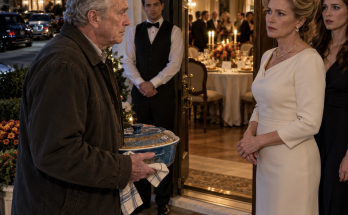
The blue casserole dish was still at Daniel’s house.
That detail bothered me.
Of everything happening—investigations, shareholder rights, disputed signatures, frozen credit—I kept thinking about that dish.
Perhaps the mind chooses manageable grief when the larger kind becomes too heavy.
At six fifteen, Daniel arrived.
He knocked instead of using his key.
That told me something.
I opened the door.
“You’re early.”
“You’re awake.”
“I’m old.”
“You keep saying that like it explains everything.”
“It explains mornings.”
He carried a paper bag.
“Breakfast.”
We ate eggs and biscuits at the kitchen table.
For several minutes we talked about nothing important.
Weather.
The truck.
A leaking gutter on his house.
It was the first normal conversation we had shared since Thanksgiving.
Then Daniel put down his coffee.
“Are you going to trigger the clause?”
“I don’t know.”
“Do you want to?”
“No.”
“Then don’t.”
I looked at him.
“That simple?”
“No.”
He stared at the table.
“I’m trying to learn not to tell you what to do with your property.”
That was progress.
I smiled slightly.
“Thank you.”
He nodded.
“Richard wants you to.”
“Yes.”
“Patricia?”
“She wants options.”
“What does Harold say?”
“That lawyers become expensive when clients ask them what they should do instead of what they can do.”
Daniel smiled.
“Sounds like him.”
Then his expression changed.
“If you don’t trigger it, what happens?”
“Depends on the bank.”
“And if you do?”
“I could temporarily hold enough voting power to stabilize governance.”
“Meaning remove Richard.”
“He’s already on leave.”
“Replace directors?”
“Potentially.”
“Approve financing?”
“With the board.”
Daniel looked at me.
“You’d hate it.”
“Yes.”
“Mom would think that was funny.”
“Yes.”
We sat quietly.
Then he said, “Dad, don’t do it to beat Richard.”
“I know.”
“Do it only if you’d do the same thing if Thanksgiving never happened.”
That surprised me.
I looked at him.
He seemed uncomfortable with his own wisdom.
“Your mother say that?”
“No.”
“Good.”
“Why?”
“I was getting worried she left instructions for every conversation we’d ever have.”
He laughed.
Then his eyes filled.
We both looked away.
At eight, Harold picked me up.
We drove to Merritt headquarters.
The atmosphere had changed overnight.
Reporters stood outside.
Someone had leaked news that the acquisition was dead and Richard had taken temporary leave.
No details about the Bennett dispute had appeared publicly.
Yet.
Employees clustered in the lobby.
Some whispered.
Some stared at phones.
One woman was crying beside the elevators.
I stopped.
“What happened?”
Patricia met us upstairs.
“The bank freeze leaked internally.”
“Payroll?”
“Covered for the next cycle.”
“And after?”
“We need liquidity.”
“Can Merritt borrow elsewhere?”
“Eventually. Not quickly.”
“Sell assets?”
“Possibly, but a rushed sale would be expensive.”
“What about Richard?”
“He offered a personal guarantee.”
I almost laughed.
“Of course.”
“Board rejected it for now.”
“Why?”
“Because we’re still determining how much of his personal structure is entangled with the company.”
Fair.
The board meeting began at nine.
Independent counsel attended.
So did forensic accountants.
Richard did not.
His administrative leave prevented participation unless invited.
I sat beside Harold.
Patricia explained the misconduct clause.
Nobody dramatized it.
That helped.
The independent lawyer described the activation process.
Evidence had to be reviewed.
Richard had an opportunity to respond.
A neutral determination procedure existed under the agreement.
If intentional manipulation affecting Bennett rights was established, the temporary voting suspension activated.
“How long?” Gordon asked.
“Initially twelve months, extendable to eighteen under specified conditions.”
“And Bennett becomes controlling shareholder?”
“Not technically controlling under every definition. It becomes the largest active voting position.”
Everyone looked at me.
I disliked that.
“I don’t want the company.”
Gordon answered.
“We’ve heard.”
“Then stop looking at me like I bought it.”
A few people smiled.
Patricia did not.
“Lucas, wanting control and having responsibility are different.”
I knew.
That was the problem.
Independent counsel reviewed the evidence Richard had voluntarily produced.
His written instruction regarding the marked duplicate.
The disputed consent.
Samuel’s affidavit.
The Bennett strategy documents.
Nobody challenged authenticity yet.
Richard’s lawyer had requested time to respond formally.
I asked the question that mattered.
“How long?”
“Potentially several weeks.”
Patricia looked frustrated.
“We may not have several weeks.”
The bank would not wait indefinitely.
Vendors would not wait.
Employees certainly should not have to.
Gordon asked, “Can Lucas waive the process?”
Harold answered.
“He can waive his own rights. He cannot magically cure governance questions the bank already knows about.”
“So even if he says forget it, the problem remains.”
“Yes.”
That was important.
I could not rescue Merritt simply by forgiving Richard.
The board had its own duties.
The bank had its own concerns.
Ruth’s protections had revealed the problem.
They had not created it.
At lunch, I left the boardroom.
I needed air.
Instead of going outside, I wandered through the lower floors.
Nobody recognized me.
That was useful.
I passed drafting teams, finance offices and project managers.
People worked despite uncertainty.
At a break area, two men were talking.
“If they freeze projects, contractors are screwed.”
“My wife already asked whether we should cancel Christmas travel.”
“Payroll is fine.”
“For now.”
I kept walking.
A woman in a safety vest stood by the elevator talking on the phone.
“No, don’t tell Mom yet. We don’t know anything.”
These were the consequences Richard claimed to be protecting people from.
But hiding danger had not protected them.
It had delayed their chance to respond.
On the sixth floor, I found a wall covered with photographs of completed projects.
Schools.
Warehouses.
Medical buildings.
Apartment complexes.
Hundreds of people had built them.
Richard’s name appeared on plaques.
But his hands had not poured concrete.
His hands had not installed electrical panels.
His hands had not drawn every plan.
Companies make powerful men look singular.
They rarely are.
Patricia found me there.
“You disappeared.”
“I’m thinking.”
“Dangerous.”
“So Harold tells me.”
She stood beside me.
“You know what Richard’s mistake was?”
“Which one?”
“He believed saving Merritt meant saving his authority.”
I looked at her.
“And you?”
“I think saving Merritt means making it able to survive whoever leads it.”
That sounded closer to Ruth.
“What do you want from me?”
“Stability.”
“That’s vague.”
“Then specifically: if the clause activates, commit publicly to temporary stewardship, not permanent control.”
I considered it.
“Meaning?”
“No takeover.”
“I don’t want one.”
“Say it formally.”
“Fine.”
“No transfer to Daniel during the period.”
Daniel would hate that only if he had learned nothing.
“Fine.”
“No special dividend to Bennett.”
“Fine.”
“Independent board review.”
“Good.”
“And once governance and financing stabilize, you support a structure that prevents any single family shareholder from dominating.”
I looked at her.
“Including me.”
“Yes.”
That interested me.
“You’ve been thinking.”
“All night.”
“What does Harold say?”
“I haven’t asked him.”
“Smart.”
We returned upstairs.
Before the meeting resumed, my phone rang.
Unknown number.
I answered.
“Mr. Bennett?”
A woman.
“Yes.”
“My name is Margaret Ellis.”
I stopped walking.
The name from Richard’s confession.
The former administrative employee who reproduced my signature.
“How did you get my number?”
“Richard gave it to me.”
That surprised me.
“When?”
“Last night.”
“What did he tell you?”
“That the past finally caught up.”
I looked toward Harold.
He saw my face and approached.
I put the call on speaker.
Margaret continued.
“I owe you an apology.”
“For signing my name?”
“Yes.”
“Why did you do it?”
“Richard told me you had approved the consent but were traveling.”
“I had not.”
“I know that now.”
“Did you know then?”
“No.”
Her voice shook.
“I was twenty-seven. Richard was my boss. He said it was administrative.”
Harold asked, “Did anyone instruct you to backdate or notarize the document?”
“No. I only reproduced the signature from another file.”
“Who handled the rest?”
“I don’t know.”
“Would you provide a sworn statement?”
“Yes.”
“Why now?”
Margaret was silent.
Then:
“Because Ruth called me.”
My throat tightened.
“When?”
“Six years ago.”
“What did she say?”
“She asked whether I had signed your name.”
“And?”
“I lied.”
That hurt.
Not because Margaret owed me more than Richard did.
Because Ruth had known she was being lied to and still kept working patiently through the facts.
Margaret continued.
“Ruth said she wasn’t calling to ruin my life. She said she needed to know whether Richard had done it deliberately.”
“What did you tell her?”
“Nothing.”
“Then why are you calling now?”
“Because I’ve regretted it for six years.”
Harold took her contact information.
He arranged for independent counsel to interview her.
When the call ended, I stood in the hallway.
Another piece.
Another person Richard had used because he assumed authority would substitute for consent.
Patricia came out.
“The bank wants a call.”
“When?”
“Now.”
We joined the board.
The bank representatives appeared by video.
Their position was straightforward.
Merritt needed credible governance.
Full disclosure.
A plan for the related-party loans.
And evidence that shareholder-control representations were accurate.
One banker asked me directly.
“Mr. Bennett, do you intend to seek permanent control of Merritt Development?”
“No.”
“Do you intend to exercise the triggered voting rights if available?”
I paused.
Everyone watched.
I thought of Daniel’s question.
Would I do the same if Thanksgiving had never happened?
Yes.
Because the company needed someone who could say no.
“I intend to preserve the rights until the investigation determines what happened.”
The banker nodded.
“That is not exactly an answer.”
“It’s the only honest one.”
Harold almost smiled.
I continued.
“If the clause activates, I will use the temporary voting position only to stabilize the company, protect legitimate shareholder rights, support independent oversight and restore financing.”
“Would you commit that in writing?”
“Yes.”
Patricia looked relieved.
The banker asked, “Would you support restrictions preventing Bennett Holdings from using the period for personal enrichment?”
“Yes.”
“Would you support equivalent restrictions on Merritt family entities?”
I looked at Victoria’s empty chair.
Emily.
Caroline.
Richard.
“Yes.”
The banker muted himself.
The board waited.
After several minutes he returned.
“If the board adopts an acceptable governance framework and independent counsel confirms the investigation process, we are prepared to restore limited revolving access.”
Not everything.
Enough.
Enough for payroll.
Enough for vendors.
Enough to breathe.
After the call, Gordon leaned back.
“So we have a path.”
“A narrow one,” Patricia said.
“But a path.”
That afternoon, the board adopted temporary safeguards.
No extraordinary related-party transfers.
No share restructuring.
No new family trusts affecting voting rights without disclosure.
No changes to Bennett protections during the investigation.
I supported all of it.
At five thirty, Harold and I left.
Employees were still working.
The woman in the safety vest stood near the elevators again.
This time she was laughing with someone.
She still had no idea who I was.
I preferred it that way.
Outside, Daniel waited beside my truck.
“What happened?”
“We may have payroll.”
His shoulders dropped.
“That’s good.”
“Yes.”
“And the clause?”
“Still being reviewed.”
He nodded.
Then held something toward me.
The blue casserole dish.
Clean.
Wrapped in Ruth’s old towel.
“I thought you’d want it back.”
I took it.
For some reason that nearly broke me.
“Thank you.”
Daniel looked toward the tower.
“Richard called me.”
“What did he want?”
“To apologize.”
“Did he?”
“He tried.”
“That sounds ominous.”
Daniel smiled weakly.
“He asked whether I hated him.”
“What did you say?”
“That I don’t know him well enough anymore to answer.”
I nodded.
That was fair.
Then Daniel looked at me.
“He said something else.”
“What?”
“He said if the clause activates, you’ll discover something the board hasn’t found yet.”
Of course.
“What?”
“He wouldn’t tell me.”
“Why?”
“He said you’d understand when you see the original ownership register.”
Harold, standing beside us, stopped.
“What original ownership register?”
Daniel shook his head.
“I don’t know.”
Harold looked toward Merritt headquarters.
Neither did I.
But Ruth had taught me enough by then to recognize a clue disguised as a warning.
Somewhere inside Merritt’s history was another ownership record.
And Richard seemed certain that once I found it, temporary control of the company would no longer be the most important thing Bennett Holdings possessed.
Click here to continue reading: PART 15: The Original Ownership Register Revealed Ruth Had Protected Someone Besides Me, and Caroline Discovered Her Place in Merritt Was Never a Gift
I Carried My Wife’s Thanksgiving Dish to My Son’s Door, Never Imagining I Would Be the Guest Asked to Leave
Part 14 of 28