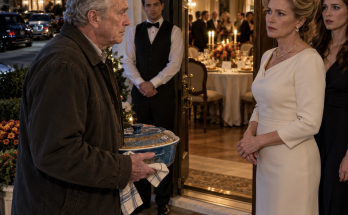
For three weeks after the casserole-dish joke, nothing happened.
That felt suspicious.
When your life has spent a month producing hidden trusts, disputed signatures, secret children, frozen credit lines, old shareholder clauses and documents concealed beneath cookware, ordinary mornings begin to feel like the calm before another attorney enters your kitchen.
But the mornings stayed ordinary.
I drank coffee.
I repaired the gutter Daniel had promised to fix and then forgotten.
I argued with Harold about whether I needed to update my own estate plan.
I lost that argument.
Mostly.
Merritt continued operating.
Patricia began the new year by presenting a five-year strategic plan that Richard described as “too cautious,” which I interpreted as a strong endorsement.
Caroline remained on the board.
Daniel remained involved with Bennett Holdings but held no position at Merritt.
Emily began working less with her parents’ social circle and more with a nonprofit she had supported quietly for years.
Victoria joined her twice a month.
Richard claimed volunteer committees were more political than corporate boards.
Nobody disagreed.
The extraordinary Bennett protections were gone.
That fact took longer to feel real than I expected.
For two years I had carried authority I never wanted.
Then one signature ended it.
Ordinary shareholder rights remained.
Daniel’s interest remained.
Caroline’s ownership remained.
The governance reforms remained.
What disappeared was the emergency machinery Ruth built when normal accountability could not be trusted.
I thought I would feel exposed.
Instead, most days, I felt free.
Then Samuel Grant died.
The call came from his daughter.
He passed quietly in Oregon after a short illness.
Seventy-five.
I had known him properly for less than two years, but the news landed heavier than I expected.
Samuel had been one of the last people alive who knew Ruth professionally before her illness.
He remembered the version of her who walked into conference rooms with a legal pad and refused to let powerful men speed past uncomfortable questions.
I attended the memorial.
Harold came.
Richard asked whether he should.
I told him that was not my decision.
He went anyway.
He sat in the back.
Samuel’s daughter spoke about her father’s frustrating devotion to documentation.
Everyone laughed.
I thought of Ruth.
After the service, Samuel’s daughter approached me.
“Mr. Bennett?”
“Lucas.”
She smiled.
“Dad left something for you.”
I nearly said no.
Not because I didn’t want it.
Because I was tired of dead people managing my calendar.
Instead I accepted the envelope.
It was thin.
No corporate seal.
No legal notation.
Only my name.
Harold leaned over.
“Open it.”
“You are developing poor boundaries.”
“My profession requires curiosity.”
“No. Your profession bills curiosity.”
Richard stood nearby.
“What is it?”
I looked at him.
“Apparently another opportunity for Ruth to control us from beyond the grave.”
To my surprise, he laughed.
We went to a coffee shop.
Harold sat across from me.
Richard remained standing until I told him to sit.
“Why am I included?” he asked.
“You attended the funeral.”
“That is not an answer.”
“Neither was ‘you weren’t invited.’”
He winced.
I regretted it immediately.
Not because it was untrue.
Because I had used an old wound merely because I could.
“Sorry.”
Richard looked at me for several seconds.
Then nodded.
Progress sometimes looks like an apology being accepted without ceremony.
I opened the envelope.
Inside was a short note from Samuel.
Lucas,
Ruth asked me to retain the enclosed letter until one of two things happened: either Merritt’s extraordinary Bennett protections were voluntarily terminated, or twenty-five years passed from the original restructuring.
You have reached the first condition.
I stopped.
Harold leaned closer.
“Of course she did.”
Richard sighed.
“She really never stopped.”
I unfolded Ruth’s letter.
Her handwriting was steadier than in the final letters she wrote during her illness.
This one was old.
More than twenty years.
Lucas,
If you are reading this, then either the company became healthy enough that our special rights were no longer necessary, or everyone ignored me for so long that time finally did the work.
I smiled.
“That’s her.”
Richard nodded.
I continued.
If the protections ended voluntarily, I hope you did not keep them merely because you could.
If you did keep them too long, forgive yourself after correcting it. Power makes sensible arguments for its own survival.
I thought of the night I had considered retaining one clause.
Just in case.
She had known.
Of course.
The next paragraph changed the tone.
There is one more thing I need you to understand about Daniel.
I looked up.
Harold immediately became serious.
Richard did too.
I read silently first.
Then aloud.
I have worried that our attempts to protect Daniel may teach him the wrong lesson. Protection should help a person become independent, not make independence unnecessary.
I thought about Daniel’s beneficial interest.
The delayed disclosure.
The proxy.
All the mechanisms Ruth created.
She continued.
If Daniel becomes responsible enough to receive what belongs to him, then after he receives it, stop managing the outcome.
Do not use Bennett Holdings as a way to keep him close.
That sentence hit me unexpectedly.
Richard saw my face.
“What?”
I read it again.
Do not use Bennett Holdings as a way to keep him close.
For two years, Daniel and I had worked together more than ever.
Weekly meetings.
Property reviews.
Shareholder decisions.
Lunches that began as business and ended as family.
I had assumed that was good.
It was good.
But had I begun relying on it?
Ruth’s letter continued.
He may sell someday. He may keep it. He may make choices you dislike. If the property is truly his, then allow the possibility that he will use it differently than you would.
Harold leaned back.
“That is clear.”
“Thank you.”
“You’re welcome.”
Richard asked, “Does Daniel want to sell?”
“No.”
“Then what’s the problem?”
I looked at him.
“That I may have started needing him not to.”
Richard became quiet.
He understood.
Perhaps better than Harold.
Control does not always arrive wearing a suit and demanding signatures.
Sometimes it looks like closeness.
Sometimes gratitude.
Sometimes tradition.
Sometimes a father thinking his son should stay because staying makes the father less lonely.
I continued reading.
There was another section.
About me.
You will be tempted to believe family closeness proves family health.
It does not.
People can sit at the same table while hiding everything important.
I looked toward Richard.
He looked away.
Ruth continued.
The opposite is also true. Distance does not always mean rejection.
That one was for me.
I had spent most of my life understanding love through presence.
Dinner.
Visits.
Calls.
Showing up.
Ruth understood better that adults sometimes needed space.
The letter ended simply.
When the emergency is over, stop living like you are still in it.
Love people without monitoring them.
Trust rules you did not personally write.
Let Daniel surprise you.
And Lucas, if there is another document hidden under the casserole dish, it is not mine.
I laughed so loudly that people in the coffee shop turned.
Harold took off his glasses.
Richard shook his head.
“She anticipated the joke too?”
“No.”
I handed him the page.
He read the last line and laughed.
That might have been the first time the two of us laughed together without bitterness beneath it.
Samuel had added one final note.
Ruth wrote this before her diagnosis. She later asked me whether she should revise it. I told her no. She said, “Good. Lucas needs old instructions sometimes because new ones let him argue that circumstances changed.”
I folded the letter.
Harold looked at me.
“What are you thinking?”
“That I’m apparently predictable across decades.”
“Very.”
Richard asked, “Are you going to show Daniel?”
“Yes.”
“Tonight?”
“No.”
That surprised both men.
“Why not?” Harold asked.
“Because not every truth needs immediate delivery.”
Harold smiled.
“Look at you.”
“Stop.”
I waited until Sunday.
Daniel came over to review a Bennett property proposal.
He had brought financial projections.
I closed the folder before he began.
“What?”
“I want to talk about something else.”
He looked suspicious.
“Is this another document?”
“Yes.”
He dropped his head.
“Of course it is.”
I gave him Ruth’s letter.
He read slowly.
Emily sat beside him.
Halfway through, he smiled.
Near the end, his face changed.
Then he handed it back.
“She was worried you’d keep me working with Bennett forever.”
“Yes.”
“Are you?”
I could have lied.
“No.”
Then I corrected myself.
“Maybe.”
Daniel leaned back.
“Dad.”
“I like seeing you.”
“You see me anyway.”
“Not this much.”
“That’s true.”
I looked at the property folder.
“Do you enjoy working with Bennett?”
“Yes.”
“Would you if I weren’t here?”
He thought carefully.
“Some of it.”
That answer hurt slightly.
Good.
Honesty often does.
“What parts?”
“Investment decisions.”
“And?”
“Not property management.”
“You complain about property management every week.”
“I know.”
“Why are you still doing it?”
He smiled.
“Because you like it.”
There it was.
Not coercion.
Not control.
Still an inherited expectation.
“What would you rather do?”
Daniel hesitated.
“Build something.”
“What?”
“I don’t know.”
Emily looked at him.
“You do.”
He glanced toward her.
She smiled.
“Tell him.”
Daniel looked uncomfortable.
“I’ve been thinking about starting a company.”
My chest tightened.
“What kind?”
“Adaptive reuse.”
“Old buildings?”
“Yes.”
“Commercial?”
“Mixed.”
He became animated.
That told me more than the business plan would.
“Small properties at first. Older warehouses, neighborhood retail, buildings too complicated for larger developers but with good structure.”
“Sounds risky.”
“Yes.”
“Capital intensive.”
“Yes.”
“Annoying.”
“Probably.”
I smiled.
“You want it.”
“Yes.”
“How long have you been thinking about it?”
“Almost a year.”
“And you didn’t tell me.”
“I didn’t want you thinking I was leaving Bennett.”
There it was.
The exact problem Ruth warned about.
I looked at him.
“Daniel.”
“I know.”
“No. Listen.”
He did.
“You are allowed to leave.”
His face changed.
“Even completely?”
The question hurt.
I answered anyway.
“Yes.”
He looked toward the kitchen.
Toward Ruth’s picture.
Then back.
“I don’t want to completely.”
“Fine.”
“But I want to reduce my role.”
“Fine.”
“You’re not angry?”
“I don’t like it.”
He laughed.
“That sounds more believable.”
“I’m proud of you.”
“Even though it’s risky?”
“Especially because you know it’s risky.”
Emily squeezed his hand.
Then Daniel said something I did not expect.
“I want Richard to advise me.”
The room went still.
“What?”
“Not invest.”
“Good.”
“Not own anything.”
“Better.”
“Advise.”
“Why Richard?”
Daniel looked embarrassed.
“Because he’s actually good at development.”
That was true.
“Also because I need to learn whether I can have a relationship with him that isn’t built on wanting his approval.”
That was considerably more complicated.
“And you think working together helps?”
“I think asking for advice and being willing to reject it might.”
Emily said quietly, “He already told Dad he’d walk away the first time Dad turns advice into instruction.”
I looked at my son.
“You really have been thinking.”
“Yes.”
“What did Richard say?”
“He laughed.”
“And?”
“He agreed.”
I sat back.
For the first time, Daniel was approaching Richard from a position neither dependent nor rebellious.
Not trying to impress him.
Not trying to punish him.
Just choosing what part of the man remained useful.
Ruth would have appreciated the distinction.
Daniel launched the company six months later.
Bennett Holdings invested nothing.
That was deliberate.
Daniel wanted outside capital and his own money.
He used part of his distributed Bennett dividends.
His risk.
His choice.
Richard reviewed the first project.
He hated the financing structure.
Daniel kept it.
Richard predicted disaster.
The project succeeded.
On the second project, Richard warned him about environmental remediation.
Daniel ignored him.
The cleanup cost twice what Daniel expected.
Richard did not say I told you so.
He called me instead.
“I’m becoming mature.”
“No.”
“I didn’t say anything.”
“That is evidence.”
On the third project, Daniel called Richard before signing.
They disagreed.
Daniel changed half the plan.
The project did well.
A relationship formed.
Not father and son.
Not exactly.
Something healthier.
Mentor and adult man.
With boundaries.
A year later, Daniel formally reduced his work with Bennett Holdings.
We moved from weekly meetings to monthly ones.
The first month felt empty.
I almost invented reasons to call.
Then remembered Ruth.
Stop living like the emergency is still happening.
So I found other things.
Fishing.
Volunteer work.
Lunch with Harold.
A woodworking class that proved I had less patience than I believed.
Life expanded when I stopped requiring Daniel to fill the space Ruth left.
That was uncomfortable.
Also necessary.
Then one afternoon, Caroline called.
Her voice was tense.
“Lucas.”
“What happened?”
“It’s Richard.”
My stomach tightened automatically.
Old reflex.
“What did he do?”
“Nothing.”
I stopped.
“What’s wrong?”
“He collapsed at Merritt.”
Everything inside me went cold.
Not because Richard was still powerful.
Not because of ownership.
Because after all of it, somewhere along the way, the man had become my friend.
Click here to continue reading: PART 26: Richard’s Collapse Brought the Entire Family Back to the Hospital, Where Victoria Finally Said What She Had Refused to Admit for Forty Years
I Carried My Wife’s Thanksgiving Dish to My Son’s Door, Never Imagining I Would Be the Guest Asked to Leave
Part 25 of 28