Harold read the misconduct provision four times before he spoke.
I watched his finger move along the same paragraph, stop at the same sentence, then return to the beginning as though repetition might produce a less consequential meaning.
It did not.
Richard remained on speaker.
Nobody in Mara’s office moved.
The provision had been negotiated during the restructuring Ruth challenged nearly two decades earlier. If a controlling shareholder intentionally manipulated corporate records, shareholder consents, or ownership information in a manner materially affecting an original investor’s rights, a temporary voting adjustment could be triggered.
Not automatically.
Not because I was angry.
Not because Richard had behaved badly at Thanksgiving.
There had to be a formal determination under the agreement’s procedure.
But if that determination occurred, voting rights attached to certain Richard-controlled shares would be suspended for a defined period.
Bennett Holdings would not receive his shares.
It would simply become the largest active voting position while the suspension lasted.
Harold looked at me.
“This is unusual.”
“That means Ruth.”
“Yes.”
“How long?”
“If triggered, up to eighteen months, subject to review.”
Daniel stared at him.
“My father could control Merritt for eighteen months?”
Harold corrected him.
“Potentially exercise the largest voting position. Control is more complicated.”
“Is it?”
“Yes.”
“Would he be able to elect directors?”
“Depending on the timing and other votes, significantly influence it.”
“Remove executives?”
“Potentially.”
“Block transactions?”
“Yes.”
Daniel looked at me.
“That sounds like control.”
“It sounds like a headache,” I said.
Nobody laughed.
Richard’s voice came through the phone.
“Now you understand.”
I picked up the phone.
“Understand what?”
“Why I needed certainty.”
“You needed my rights gone.”
“Yes.”
The honesty surprised everyone.
Harold leaned closer.
“Richard, are you represented on this call?”
“Not anymore.”
“You should be.”
“I’ve spent half my life listening to lawyers.”
“That is not the same as taking advice.”
Richard ignored him.
“Lucas, Ruth built that clause because of my father.”
“Then why were you afraid of it?”
“Because it was written broadly enough to reach me.”
“Only if you did what it prohibits.”
Silence.
I waited.
“Richard?”
“I know.”
That answer carried no defense.
I sat down.
“Why tell me now?”
“Because you’re going to find it.”
“We already did.”
“No. You found the clause.”
His voice lowered.
“You haven’t found everything that activates it.”
Harold became still.
“What haven’t we found?”
Richard did not answer him.
“Lucas, meet me.”
“No.”
“Not at Merritt.”
“Where?”
“My house.”
I almost laughed.
“The same house I wasn’t invited into yesterday?”
Nobody in the room missed the irony.
Richard did not react.
“Come alone.”
“No.”
“Lucas.”
“Harold comes.”
“I need to speak to you privately.”
“You lost the privilege of deciding who stands beside me.”
Another silence.
“Fine.”
“When?”
“Now.”
He ended the call.
Daniel immediately objected.
“You’re not going.”
“Yes, I am.”
“Dad.”
“He just admitted there’s more.”
“That’s exactly why you shouldn’t go.”
Harold closed the agreement.
“I’m going with him.”
Daniel looked at him.
“That makes me feel only slightly better.”
“It should make you feel significantly better.”
“It doesn’t.”
Mara preserved the files we had opened.
Before leaving, Harold forwarded copies of Samuel’s affidavit and the misconduct provision to his secure case system.
He also emailed Patricia a short notice stating that Bennett Holdings had discovered a potentially applicable governance provision but had made no determination regarding enforcement.
I noticed the last phrase.
“Why include that?”
“Because I don’t want anyone claiming we used the clause to threaten the board.”
“Good.”
He looked at me.
“Ruth really did train you.”
The drive to the Merritt house felt different from Thanksgiving.
Same road.
Same stone entrance.
Same landscaped property.
But there were no luxury cars filling the driveway now.
No music.
No dinner guests.
No employee waiting to ask my name.
I parked the Ford directly in front.
Harold looked at it.
“You did that intentionally.”
“Yes.”
“Petty.”
“Yes.”
“Good.”
Richard opened the door before we reached it.
He wore no jacket.
His tie was gone.
For the first time since I had known him, he looked like the house belonged to someone else.
“Come in.”
I stepped across the threshold.
The foyer looked exactly as it had through the doorway the night before.
Polished stone.
Tall arrangement of white flowers.
A staircase curving upward.
The dining room stood beyond.
The long table was empty now.
I glanced toward the place where I had seen all those name cards.
Richard noticed.
“I should have let you in.”
“Yes.”
“That was Victoria’s dinner.”
“No.”
He stopped.
“You stood at the door.”
He looked away.
“Yes.”
Harold interrupted.
“We’re not here to litigate Thanksgiving.”
Richard led us into his study.
Unlike the rest of the house, the room looked used.
Papers covered the desk.
Two coffee cups sat beside a laptop.
A framed photograph showed Richard and Charles as young men beside their father.
Arthur Merritt looked stern even while smiling.
Richard opened a safe.
Harold immediately said, “Before you remove anything, tell us what it is.”
Richard looked irritated.
Then stopped himself.
“A ledger.”
“What kind?”
“My father’s.”
He removed a black accounting book.
The binding was cracked.
“Original?”
“Yes.”
“Where has it been?”
“With me.”
“Why wasn’t it in company archives?”
“Because Arthur gave it to me before he died.”
Harold did not touch it.
“What does it contain?”
“Transfers.”
The old ones.
The transactions Ruth had discovered.
Richard placed the ledger on the desk.
“My father was moving money between businesses.”
“We know.”
“No.”
Richard looked at me.
“You know part.”
He opened the book.
Several entries were marked in red.
Arthur had not merely borrowed from Merritt.
He had concealed losses in another company by routing money through temporary accounts before investor reporting dates.
Window dressing.
Harold read carefully.
“Were investors given statements based on these balances?”
“Yes.”
“Lucas?”
“Yes.”
My stomach tightened.
“So Ruth was right.”
“She was more right than she knew.”
“Did you know at the time?”
Richard hesitated.
“Yes.”
Harold looked up.
“You knowingly provided inaccurate financial information to original investors?”
“I was trying to fix it before anyone lost money.”
“That wasn’t my question.”
Richard stared at the ledger.
“Yes.”
I felt no triumph.
Only disappointment that reached backward twenty years.
“You lied to us.”
“Yes.”
“Ruth confronted you.”
“Yes.”
“And you promised it was finished.”
“I made Arthur repay everything.”
“That isn’t the same as telling us the truth.”
“No.”
Harold asked, “Why preserve the ledger?”
Richard looked toward the photograph of his father.
“Insurance.”
“Against whom?”
“Arthur.”
“He’s dead.”
“He wasn’t then.”
Family protects family.
Until family needed leverage.
I began to understand the Merritts better than I wanted.
Richard continued.
“Ruth discovered enough that she could have forced an investigation. She didn’t.”
“Why?”
“She wanted the money restored and investor protections strengthened.”
That sounded exactly like her.
Not punishment.
Protection.
“Did she know about the ledger?”
“No.”
“Then why show us?”
“Because it explains the clause.”
Richard sat.
“When Ruth demanded safeguards, I agreed because I needed her quiet.”
My jaw tightened.
“You make that sound like you bought her silence.”
“I tried.”
“And?”
“She told me I misunderstood.”
I almost smiled.
“What did she say?”
“That she wasn’t promising silence. She was giving me a chance to correct the problem.”
Of course.
Richard continued.
“She required the misconduct provision because she believed records had been manipulated.”
Harold tapped the ledger.
“And they had.”
“Yes.”
“But the provision wasn’t triggered then.”
“No.”
“Why?”
“Because the new agreement started after the conduct.”
Harold nodded.
“So later misconduct could activate it.”
“Yes.”
“Such as a false Bennett consent.”
Richard looked at him.
“Yes.”
There it was.
He had admitted the connection.
Harold remained careful.
“Who created the disputed signature?”
Richard stared at the desk.
I waited.
“Richard.”
He finally answered.
“I did not sign Lucas’s name.”
Harold said nothing.
“Who did?”
“One of Arthur’s old administrative staff.”
“Name?”
“Margaret Ellis.”
“Alive?”
“I don’t know.”
“Did you instruct her?”
Richard’s jaw tightened.
“Yes.”
The room became silent.
Even after everything, hearing the direct answer felt different.
“You told someone to sign my name.”
“I told her to reproduce a consent.”
“With my signature.”
“Yes.”
“Why?”
“Because I believed you had already agreed in principle.”
“I had not.”
“I know that now.”
“You knew when Ruth confronted you.”
“Yes.”
Harold’s voice became clinical.
“Did you then instruct Caroline to place Ruth’s marked duplicate into the archive?”
Richard closed his eyes.
“Yes.”
“Why?”
“To create uncertainty about which version was operative.”
I stared at him.
“You wanted confusion.”
“I wanted the conversion completed.”
“That isn’t an answer.”
“Yes.”
His voice cracked slightly.
“I wanted confusion.”
Harold took notes.
“Did Caroline know the duplicate was invalid?”
“No.”
That mattered.
“She thought she was filing a corrected copy?”
“Yes.”
“Did Samuel Grant know?”
“Eventually.”
“Is that why he resigned?”
“Yes.”
Richard rubbed his face.
“I thought if the records became ambiguous enough, nobody would challenge the conversion.”
“Ruth did.”
“Yes.”
“She always did.”
For a strange moment, admiration entered his voice.
Then disappeared.
I asked, “Why didn’t you try again while she was alive?”
He looked at me.
“Because she scared me.”
I almost laughed.
“Ruth weighed one hundred and twenty pounds.”
“That wasn’t why.”
I knew.
Harold knew.
Richard continued.
“She kept everything.”
“Yes.”
“She remembered dates.”
“Yes.”
“She asked questions in rooms where everyone else wanted to leave.”
“Yes.”
A small smile came despite me.
Richard saw it.
“I envied you.”
That surprised me more than anything else he had said.
“For what?”
“She never needed you to be impressive.”
I looked at him.
“She expected me to be decent.”
“That’s worse.”
“It can be.”
For several seconds we were simply two old men who had loved very different women.
Then Harold returned us to the problem.
“Why did you resurrect the strategy after Ruth died?”
Richard looked at the ledger.
“Because I thought the only person who understood the protections was gone.”
That sentence erased whatever sympathy had begun forming.
“You waited until my wife died.”
“I waited until the company needed restructuring.”
“No.”
I leaned forward.
“You thought I was easier.”
Richard did not answer.
That was answer enough.
“You thought Daniel was easier.”
“Yes.”
“You thought grief made me weaker.”
“Yes.”
“You investigated whether it made me incompetent.”
“Yes.”
Each admission sounded smaller.
Not because the conduct mattered less.
Because excuses were running out.
Harold asked, “What is the additional evidence you said we hadn’t found?”
Richard opened another drawer.
He removed a folder.
Inside was a signed memorandum.
His own handwriting covered the margins.
The document authorized Caroline to move the marked duplicate into the archive.
Not merely Samuel’s recollection.
Richard’s signature.
Direct corroboration.
Harold stared at him.
“Why keep this?”
Richard looked almost embarrassed.
“My father destroyed records.”
“So you kept yours.”
“Yes.”
“Even incriminating ones.”
“I told myself keeping them made me different.”
Harold looked at me.
Neither of us said what we were thinking.
Keeping evidence of wrongdoing did not undo wrongdoing.
But perhaps Richard had spent his entire life trying to prove he was not Arthur while repeating Arthur’s methods with better filing.
Harold placed the memorandum beside the ledger.
“This may be enough to trigger the misconduct procedure.”
Richard nodded.
“I know.”
“Then why give it to Lucas?”
Richard looked at me.
“Because if someone is going to decide what happens to Merritt, I’d rather it be him than the banks.”
I almost laughed.
“You spent six years trying to make my position irrelevant.”
“Yes.”
“And now you want me to use it.”
“Yes.”
“To save your company.”
“Our company.”
“No.”
I stood.
“It became ‘our company’ when you needed me.”
Richard looked down.
I picked up my coat.
Harold gathered nothing until arrangements could be made to preserve the originals properly.
Richard watched me.
“Lucas.”
I stopped.
“If you trigger the clause, the board will follow you.”
“You don’t know that.”
“They will.”
“You sound very certain.”
“I spent forty years learning what people do when power changes hands.”
I looked at him.
“That might be the saddest thing you’ve said.”
Outside, Harold and I stood beside the truck.
The afternoon had turned gray.
“What are you thinking?” he asked.
“That I don’t want Merritt.”
“That isn’t the question.”
“It should be.”
“The clause exists whether you want it or not.”
I looked back at the enormous house.
Yesterday I had been deemed unsuitable for its Thanksgiving table.
Today its owner had effectively asked me to become the most powerful shareholder in his company.
The reversal should have felt satisfying.
It didn’t.
“What would Ruth do?”
Harold shook his head.
“Dangerous question.”
“Why?”
“Because Ruth isn’t here.”
I looked at him.
“You have to decide what Lucas does.”
My phone rang.
Patricia.
I answered.
Her voice was tense.
“Lucas, we have another problem.”
“What?”
“The lead bank froze Merritt’s revolving credit facility pending review.”
Harold heard.
His expression changed.
Patricia continued.
“If it stays frozen, payroll and vendor payments become an issue within weeks.”
There it was.
Not Richard.
Not his house.
Not Thanksgiving.
Employees.
Families.
People who had never heard of Bennett Holdings.
I looked toward Richard’s front door.
Ruth’s instruction came back again.
Protect what needs protecting.
Then stop.
For the first time, I understood that protecting the company might require taking power I did not want.
Click here to continue reading: PART 14: I Took Ruth’s Voting Clause to the Board for One Reason, but Richard’s Employees Forced Me to Decide What Protection Really Meant
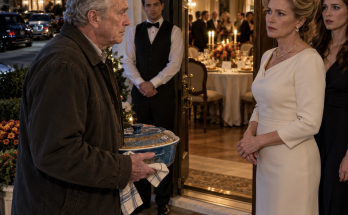
I Carried My Wife’s Thanksgiving Dish to My Son’s Door, Never Imagining I Would Be the Guest Asked to Leave
Part 13 of 28