I reached Harold’s office in twenty minutes.
Margaret Ellis was not there.
Her attorney was.
A woman named Celia Morton sat across from Harold with a document envelope between them.
Harold looked annoyed.
That reassured me.
When Harold looked frightened, I worried.
When he looked annoyed, it usually meant procedure had interfered with his preferred pace.
“What happened?”
Celia gestured toward the envelope.
“My client found this while clearing storage.”
“Why now?”
“Margaret is moving.”
“What is it?”
“The source document used to create the disputed Bennett consent.”
Harold lifted a hand.
“We have not opened it yet.”
I sat.
“Why not?”
“Because Celia insisted on recording chain of custody.”
“Excellent.”
“You mocked me for that two years ago.”
“I’ve grown.”
“Debatable.”
Celia photographed the envelope.
Harold recorded receipt.
Then we opened it.
Inside was a photocopy of an older Bennett Holdings authorization.
My real signature appeared at the bottom.
Above it:
Ruth Louise Bennett.
Her signature.
Real.
Margaret had apparently been given this document so she could copy my signature onto the false conversion consent.
That was simple enough.
Then I saw the handwritten note in the margin.
Ruth’s handwriting.
Do not use for any corporate conversion without separate written consent.
I stared.
“That sounds protective.”
Harold nodded.
But beneath it, another line appeared.
If Richard presents this as sufficient authorization, preserve the copy.
I looked at him.
“What?”
Celia handed us Margaret’s statement.
Margaret remembered Richard giving her the old authorization.
He said I had already approved the conversion but was traveling.
She reproduced my signature.
Then noticed Ruth’s handwritten warning.
Margaret became nervous.
She asked Richard whether a separate consent existed.
He told her yes.
It did not.
After signing, Margaret made a copy for herself.
“Why?” I asked.
Celia answered.
“Because Ruth had told her to.”
Silence.
“When?”
“Before Richard asked Margaret to reproduce your signature.”
I stared.
“That doesn’t make sense.”
Harold read ahead.
Then his expression changed.
“Actually, it does.”
I took the statement.
Months before the false consent, Ruth had called Margaret.
Not about any existing misconduct.
About process.
Ruth suspected Richard might attempt an administrative conversion using old authorization documents.
She told Margaret that if Richard ever asked her to copy or reproduce my signature, she should refuse and call Ruth.
Margaret did not refuse.
She was afraid of losing her job.
But she did preserve the evidence.
My anger shifted.
Not toward Margaret.
Toward Ruth.
She had known enough to warn the person Richard might use.
Why hadn’t she told me?
Again.
The recurring question.
Harold saw my face.
“Lucas.”
“She knew.”
“She suspected.”
“She knew enough.”
“Yes.”
“And still didn’t tell me.”
Celia remained silent.
This was family territory now.
I stood and walked toward the window.
For two years we had treated Ruth as the person who saw everything clearly.
But clarity without trust can become its own form of control.
Her own letter had admitted that.
Protection becomes control when the person being protected is never allowed to choose.
She had written those words later.
Perhaps because she learned them the hard way.
I asked, “Did Margaret ever tell Ruth what she did?”
Celia nodded.
“Yes.”
“When?”
“The next day.”
“What happened?”
“She expected Ruth to report her.”
“And?”
“Ruth didn’t.”
That surprised me.
“Why?”
“Margaret told her the instruction had come directly from Richard and gave her the copy.”
Harold looked toward me.
“That may be how Ruth first established deliberate direction.”
I sat again.
Celia continued.
“Margaret says Ruth told her she had made a serious mistake.”
Reasonable.
“Then Ruth said firing or destroying Margaret would help Richard avoid responsibility for using employees to do what he was unwilling to sign himself.”
That sounded like her.
“What did she ask Margaret to do?”
“Write down exactly what happened.”
“Did she?”
“Yes.”
“Where?”
Celia removed another page.
A handwritten statement.
Dated six years earlier.
Margaret admitted reproducing my signature at Richard’s instruction.
She admitted knowing afterward that separate consent had not been obtained.
Ruth signed as witness.
There it was.
Direct evidence.
Stronger than anything we had during the original investigation.
Harold looked stunned.
“Why didn’t Samuel have this?”
Celia answered.
“Margaret asked Ruth not to disclose her identity unless necessary.”
“And Ruth agreed?”
“Yes.”
I frowned.
“Why?”
Margaret’s statement included the answer.
Because she had two young children.
Because she depended on the job.
Because Ruth believed the conversion had been stopped and the immediate risk ended.
Because Ruth intended to preserve the evidence only if Richard repeated the conduct.
I sat back.
That choice was harder to judge.
She protected Margaret.
She also protected me.
But she kept facts from both of us to do it.
Harold read the final paragraph.
Ruth had written below Margaret’s statement:
I am preserving this because Richard must not be allowed to confuse employee obedience with shareholder consent.
I closed my eyes.
There it was.
The entire story in one sentence.
Obedience is not consent.
Not from employees.
Not from children.
Not from spouses.
Not from shareholders.
Not from family.
I asked Celia, “Why did Margaret keep this instead of giving it to Ruth?”
“She had the copy. Ruth kept another.”
“Where?”
“We don’t know.”
Harold searched his memory.
“Samuel’s affidavit may have relied on it.”
Possibly.
But then Celia said something that changed the meeting.
“Margaret also remembers Ruth saying she would not keep the evidence forever.”
“What does that mean?”
“She said if Richard genuinely changed, the document should never need to become a weapon.”
That word again.
Weapon.
Facts are not weapons merely because they hurt.
Ruth had carried that principle for years.
I looked at the statement.
“Does this change anything legally now?”
Harold considered it.
“The investigations are closed. Governance reforms stand. The extraordinary protections are terminated. Richard admitted directing the false consent. This corroborates established facts.”
“So no.”
“Not materially.”
“Then why do I feel like this matters?”
Harold looked at me.
“Because it changes Ruth.”
He was right.
For years, I had remembered my wife as the person who knew what to do.
After the crisis, we had almost turned her into architecture.
Every safeguard hers.
Every warning hers.
Every right answer hers.
But this document showed uncertainty.
Compromise.
Choices with costs.
She protected Margaret by withholding information.
Protected me by withholding information.
Protected Daniel by withholding information.
And eventually realized withholding itself could become the problem.
Ruth had grown too.
That mattered.
I took a copy home.
I did not show Daniel immediately.
Not because I was hiding it.
Because I wanted to decide whether the document belonged to him.
That distinction took me three days.
Then I called.
“Come over.”
He arrived alone.
I gave him Margaret’s statement.
He read.
Then sat quietly.
“Mom knew a lot earlier than we thought.”
“Yes.”
“Are you angry?”
“Yes.”
He nodded.
“I was too.”
“About what?”
“All the stuff she kept from us.”
I looked at him.
“You never said.”
“I didn’t want to criticize her.”
“Why?”
“She died.”
As though death erased a person’s mistakes.
Ruth would have hated that.
Daniel continued.
“Everyone kept saying Mom knew best.”
“She often did.”
“Often.”
“Yes.”
He smiled slightly.
Then his expression became serious.
“She didn’t trust us enough.”
“No.”
“Maybe she had reasons.”
“She did.”
“But still.”
“Yes.”
We sat with that.
Love becomes more durable when the dead are allowed to remain human.
That was another thing nobody teaches you.
Daniel looked at the last line.
“Employee obedience isn’t shareholder consent.”
“Yes.”
“That’s basically the whole Richard problem.”
“Yes.”
“And maybe some of Mom’s problem.”
I looked at him.
“What do you mean?”
“She thought because she was protecting us, she could make decisions for us.”
That hurt.
Because it was true.
“In gentler ways.”
“Yes.”
“But same instinct.”
“Different scale.”
“Definitely.”
Daniel folded the page.
“Have you shown Richard?”
“No.”
“Will you?”
I thought.
“Yes.”
Not because he needed further accusation.
Because this belonged to the history he had spent two years confronting.
I called him.
He came the next day.
I handed him Margaret’s statement.
He read standing.
Halfway through, he sat.
At the bottom, his hands stopped moving.
“She warned Margaret before I did it.”
“Yes.”
“So she knew what I might try.”
“Yes.”
Richard stared at the page.
“I was that predictable.”
“Apparently we both were.”
He almost smiled.
Then he saw Ruth’s line.
Employee obedience is not shareholder consent.
He whispered it.
Then leaned back.
“I told myself Margaret agreed.”
“She was your employee.”
“I know.”
“I told myself Caroline agreed to secrecy.”
“She was your daughter.”
“I know.”
“I told myself Victoria agreed.”
“She was your wife.”
His voice became softer.
“I know.”
“I told myself Daniel would eventually agree.”
“He wanted your approval.”
“Yes.”
“And I told myself the board agreed because nobody stopped me.”
“They worked for or with you.”
Richard closed his eyes.
“I built a world where silence sounded like yes.”
There.
That was the clearest thing he had ever said.
I nodded.
“Yes.”
He looked at the paper for a long time.
Then asked, “What are you going to do with it?”
“Nothing.”
He looked surprised.
“No board disclosure?”
“It confirms facts already established.”
“No public release?”
“No.”
“No lawsuit?”
“No.”
“Why?”
“Because Ruth preserved it to protect against repetition.”
I waited.
“You repeated it.”
“Yes.”
“We stopped it.”
“Yes.”
“The structure changed.”
“Yes.”
“Then it has done its job.”
Richard looked almost relieved.
I raised a finger.
“That is not forgiveness.”
“I know.”
“It is not erasure.”
“I know.”
“It is not secrecy.”
“What is it?”
“Closure.”
He stared at the document.
“I don’t know if I deserve that.”
“That isn’t how closure works.”
He looked at me.
“Then how?”
“I’m still learning.”
We returned the original to Margaret.
Her statement belonged to her.
She chose to keep it.
She also chose to write a letter to Caroline apologizing for her role in the old consent.
Caroline replied.
Not with absolution.
With understanding.
Two former employees—one direct, one hidden inside family—recognizing what it meant to comply with Richard because the cost of refusal felt too high.
Months later, Merritt created a formal consent-integrity policy.
Not because of legal obligation.
Caroline proposed it.
Luis strengthened it.
Patricia approved it.
No signature reproduction.
No presumed authority.
No family intermediary without written confirmation.
No executive verbal instruction sufficient for ownership actions.
Richard reviewed the draft.
He wrote one comment.
Good.
Nothing else.
Then, on the third anniversary of the Thanksgiving that started everything, Victoria called me.
Her voice sounded suspiciously cheerful.
“Lucas.”
“Yes?”
“Thanksgiving is at our house.”
“Which house?”
“The small one.”
“Good.”
“You are invited.”
“Formally?”
“I am sending it in writing.”
I laughed.
“You’re never going to let that go, are you?”
“No.”
“Who’s coming?”
“Everyone.”
“That sounds dangerous.”
“It probably is.”
I agreed.
A week later, an envelope arrived.
Heavy cream paper.
My name carefully printed.
Inside:
Lucas Bennett,
You are formally, specifically, unambiguously, and irrevocably invited to Thanksgiving dinner.
No acquisitions will be discussed.
No financing will be arranged.
No shareholder consents will be requested.
Sweet potatoes optional.
Signed,
Victoria Merritt
Below it, Richard had written:
Truck permitted.
I framed it.
Not because the apology needed preserving.
Because some jokes are earned only after people survive what made them painful.
Thanksgiving arrived cold and clear.
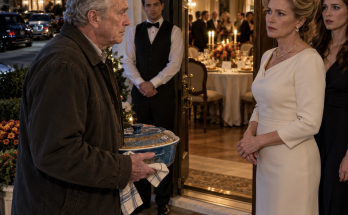
I carried Ruth’s blue casserole dish into the house.
This time Richard opened the door.
He looked at the dish.
“Any documents?”
“None.”
“Check?”
“Twice.”
He stepped aside.
“Come in.”
I paused at the threshold.
Three years earlier, he had stood in a doorway and allowed me to leave.
Now there was no guest list.
No calculation.
No useful or useless family.
Just a man holding the door.
I walked inside.
And for the first time, I understood that some stories do not end when people discover the truth.
They end when the truth stops needing to be discovered again.
Click here to continue reading: PART 28: At the Thanksgiving Table Where Everything Had Begun, My Family Finally Faced the Cost of Every Secret—and Chose What Came After
I Carried My Wife’s Thanksgiving Dish to My Son’s Door, Never Imagining I Would Be the Guest Asked to Leave
Part 27 of 28