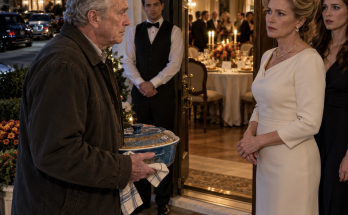
By the time I pulled into Daniel’s neighborhood, the sweet potatoes had warmed the towel wrapped around the old blue casserole dish enough that I could feel the heat through my coat. I parked my Ford behind a line of cars that looked as though they belonged outside a luxury hotel rather than a family Thanksgiving dinner. Black sedans. Two German SUVs. A silver sports car I recognized only because Richard had once spent twenty minutes explaining what it cost. My truck, eleven years old and still carrying a faint scratch from a lumber-yard cart, looked almost apologetic beside them.
I sat behind the wheel longer than I needed to. The house belonged to Richard and Victoria Merritt, my daughter-in-law’s parents, and every window glowed against the early November darkness. Through the front glass I could see people moving beneath chandeliers, holding stemmed glasses and leaning toward one another in the effortless way of people accustomed to being heard. Daniel had told me dinner began at five. It was 4:47. Ruth would have called that exactly on time and accused me of trying to arrive early without admitting it.
Thinking of her made me look at the dish on the passenger seat. Ruth had served sweet potatoes in that blue ceramic casserole every Thanksgiving for nearly thirty years. She had died four years earlier, and I had never bought another one. The glaze was scratched near one handle. A hairline crack ran underneath the base. Daniel had once suggested I replace it before it broke completely. I told him some things did not improve merely because they were new.
I carried the dish carefully up the stone walkway. Music drifted through the walls, something quiet and expensive-sounding. Before I reached the bell, the door opened. A young man in a white shirt and black vest smiled professionally and extended a hand toward the dish.
“I can take that, sir.”
“I’ve got it.”
His smile stayed in place, but his eyes moved briefly toward my truck.
“May I have your name?”
“Lucas.”
He waited.
“Lucas Bennett. I’m Daniel’s father.”
Something flickered across his face. Recognition, followed by uncertainty.
“One moment, Mr. Bennett.”
That should have warned me.
He stepped back inside and spoke quietly to someone I could not see. Less than a minute later, Victoria appeared in the entryway. She wore a cream-colored dress, a narrow gold necklace, and the careful expression she used whenever she wanted to make an insult sound like an unfortunate administrative necessity.
“Lucas.”
“Victoria.”
Her eyes dropped to the casserole.
“You brought something.”
“Ruth’s sweet potatoes.”
For half a second, her expression softened. Victoria had known Ruth only briefly, but even she had been affected by my wife’s ability to make people feel as though she had been expecting them all day.
Then the softness vanished.
“Oh.”
That one syllable told me more than an entire apology would have.
Behind Victoria I could see the dining room. The table was already set. Tall candles. White linen. Gold-edged plates. Small cards at every place.
I counted without meaning to.
There was no empty seat.
Victoria stepped partly through the doorway and lowered her voice.
“Lucas, I think there’s been some confusion.”
I looked at her.
“What confusion?”
She glanced inside before answering.
“This evening is rather carefully organized.”
“I can see that.”
“We’re hosting several business associates of Richard’s. There are people here connected with the Merritt acquisition, lenders, members of the board, their spouses. We had to finalize the guest list weeks ago.”
The heat from the casserole no longer reached my hands.
“Daniel told me Thanksgiving was here.”
“Yes.”
“He told me five o’clock.”
Victoria pressed her lips together.
“He may have assumed.”
“Assumed what?”
A voice sounded from behind her.
“Mom?”
Emily came toward us.
My daughter-in-law looked elegant and nervous. She stopped when she saw me.
“Oh. Lucas.”
The second person to say my name as though I had appeared at the wrong funeral.
I shifted the casserole against my palm.
“Happy Thanksgiving.”
Emily looked at her mother.
Victoria looked at Emily.
Neither woman looked at me.
Something cold settled behind my ribs.
“Is Daniel here?”
Emily nodded.
“Yes.”
“Would you ask him to come to the door?”
“Lucas—”
“I drove forty minutes. I’d like to speak to my son.”
Emily disappeared into the house.
Victoria folded her hands.
“I truly don’t want this to become uncomfortable.”
“It became uncomfortable before I got here.”
Her jaw tightened.
“I’m trying to handle this graciously.”
“Then we have different definitions of gracious.”
A man passing through the hall glanced toward us. Victoria immediately stepped farther onto the porch and pulled the door almost closed behind her.
That small movement hurt more than anything she had said.
She was hiding me.
My jacket suddenly seemed too old. My boots, polished that morning, suddenly seemed too heavy for the marble floor beyond the threshold. For one ridiculous moment I wondered whether I should have driven Ruth’s sedan instead of my truck.
Then I hated myself for wondering.
Daniel appeared.
He stopped behind his mother-in-law, and the expression on his face answered every question before I could ask one.
My son knew.
“Dad.”
I studied him.
He wore a charcoal jacket I had never seen, no tie, expensive shoes. When he was ten, he had refused to wear anything with buttons because Ruth told him buttoned shirts made him look handsome. At thirty-nine, he stood six feet away from me and could barely hold my gaze.
“Daniel.”
“I was going to call.”
“When?”
His mouth opened.
Nothing came out.
“Before or after dinner?”
“Dad, it’s complicated.”
“No. Complicated is an insurance policy. Complicated is wiring a house. This looks simple.”
Victoria shifted.
“Lucas, please.”
I kept my eyes on my son.
“Did you invite me here?”
Daniel inhaled.
“I mentioned Thanksgiving.”
“You told me Thursday. Five o’clock. Your in-laws’ house.”
“I know.”
“You asked whether I still had your mother’s recipe.”
His face tightened.
“I know.”
“So when did I stop being invited?”
Victoria spoke before he could.
“There was never a formal invitation.”
I turned toward her.
“We’re family. I didn’t know I needed embossed stationery.”
Her cheeks colored.
“Please don’t twist my words.”
“I’m trying to understand them.”
Daniel rubbed his forehead.
“Dad, Richard has important people here tonight.”
I waited.
He continued reluctantly.
“There are discussions happening about the company. Emily’s family has a lot riding on the next few months.”
“And my presence interferes with that how?”
“That isn’t what I said.”
“Then say what you mean.”
The front door opened wider behind him.
Richard stood there.
He was still carrying his drink.
Richard Merritt had the posture of a man who assumed every room belonged to him until someone proved otherwise. In his early sixties, he was fit, silver-haired and perfectly groomed. His company’s name was on half the construction fences in three counties.
“Lucas.”
“Richard.”
His gaze went immediately to the casserole.
“What’s this?”
“Food.”
He gave me the brief smile of someone accustomed to tolerating unhelpful answers.
“Victoria tells me there’s been a misunderstanding.”
“I’m beginning to suspect that word means something different in this house.”
Richard came onto the porch.
Inside, conversation continued. Someone laughed loudly.
Richard kept his voice low.
“We’ve invited a small group of people tonight because several significant business matters are converging. This isn’t a typical family dinner.”
“I was told it was Thanksgiving.”
“It is.”
“Then I’m confused again.”
His patience thinned.
“You weren’t on the guest list, Lucas.”
There it was.
No careful language.
No graceful explanation.
Just the sentence.
I turned to Daniel.
“Did you know that?”
His silence lasted three seconds.
Maybe four.
Long enough.
“Daniel?”
“Yes.”
The word was almost inaudible.
I looked past him into the house.
Years earlier, I had taught that boy to change a tire in freezing rain. Ruth and I had put money aside so he could graduate without student debt. I had sat beside his hospital bed after he broke his collarbone at sixteen. When Ruth died, Daniel had slept on my couch for three nights because he said the house felt too quiet when he went home.
Now he could not find room for me at a Thanksgiving table with at least twenty chairs.
“When did you find out?”
“Yesterday.”
“And you didn’t call?”
“I was going to.”
“You keep saying that.”
Emily stepped beside him.
“Lucas, Daniel was put in a terrible position.”
I looked at her.
“Was he?”
Her eyes moved away.
“My parents are hosting.”
“So?”
“They make the decisions here.”
That was when Daniel finally looked directly at me.
“Dad, they make the rules in this house.”
The words landed harder because his voice had no anger in it.
He seemed to believe they were reasonable.
I nodded once.
“They make the rules.”
“Dad—”
“No. I heard you.”
I held the casserole toward him.
“Take this.”
He hesitated.
“Dad.”
“Take your mother’s dish.”
He reached for it.
Our hands touched briefly on the handles.
When he was seven, those same hands had been small enough for me to cover both with one of mine.
Now he held the casserole between us like evidence.
“She made those every year,” I said.
“I know.”
“She would have wanted you to have them.”
His throat moved.
“Dad, please don’t do this.”
I looked at him for a long moment.
“Do what?”
“Make it bigger.”
That almost made me laugh.
I had been removed from Thanksgiving dinner at my own son’s in-laws’ house, and apparently my failure was allowing the event to occupy its actual size.
“I’m leaving, Daniel.”
“That isn’t what I meant.”
“No. It probably isn’t.”
Richard checked the hall behind him.
He wanted the situation finished.
That was obvious.
Victoria wanted the door closed.
Emily looked like she wanted to disappear through it.
Only Daniel seemed torn.
But being torn was not the same as choosing.
“Enjoy dinner,” I said.
I turned toward the steps.
Daniel followed me down the walkway.
“Dad.”
I kept walking.
“Dad, wait.”
I stopped beside the truck.
He came close enough that I could see the strain around his eyes.
“I’m sorry.”
“For what?”
“For this.”
“That isn’t an answer.”
He glanced toward the house.
“You know Richard. You know how he is.”
“I do.”
“He’s under pressure.”
“So am I, apparently.”
Daniel exhaled.
“This acquisition could change everything for us.”
“Us?”
“For Emily and me.”
There it was again.
I folded my arms.
“What does her father’s company have to do with you?”
Daniel hesitated.
“Nothing directly.”
The pause interested me more than the answer.
I had known my son too long.
“What does that mean?”
“It means exactly what I said.”
“No, it doesn’t.”
He looked toward the house again.
Richard stood inside the doorway watching.
I saw Daniel notice him.
My son’s shoulders changed.
Just slightly.
But I saw it.
“Dad, please go home. We’ll talk tomorrow.”
A dozen responses came to mind.
I used none of them.
“All right.”
Relief flashed across Daniel’s face so quickly that I almost missed it.
That hurt too.
I opened the truck door.
He remained beside me.
“I love you.”
I looked at him.
“I know.”
Those were the only words I trusted myself to say.
I drove away.
At the first traffic light, I realized my hands were trembling.
Anger would have been easier.
Anger had direction.
This was grief.
I drove past grocery stores crowded with last-minute shoppers, houses with cars packed into driveways, apartment windows where families moved behind curtains. At one intersection, a little girl pressed her face against the back window of a minivan while someone in the front seat handed her a dinner roll.
Ruth would have noticed that.
She noticed people.
She used to say holidays were dangerous because everyone carried a private idea of what family was supposed to look like, and reality rarely cooperated.
I used to tell her she overthought Thanksgiving.
She always replied that I underthought everything involving feelings.
The house was dark when I reached home.
I left the lights off for several minutes.
Then I went into the kitchen and opened the refrigerator.
On the middle shelf sat enough food for one person for three days.
I took out turkey slices, bread, mustard and a jar of pickles.
That became my Thanksgiving dinner.
I ate standing at the counter.
Ruth’s photograph rested on the bookshelf in the adjoining room.
“You’d have hated that,” I told her.
She smiled from the frame.
Of course she did.
She was laughing in the picture.
Daniel had taken it on our last Thanksgiving together.
I remembered the casserole dish in his hands.
For the first time that evening, anger pushed through the hurt.
Not because Richard had excluded me.
Richard’s opinion had never mattered much.
Not because Victoria had treated me like something that had been delivered to the wrong address.
Not even because Emily had gone along with it.
What angered me was Daniel.
He had known.
He had allowed me to cook Ruth’s recipe, drive across town, walk to that door and discover in public that my place in his life had been reduced to whatever his in-laws found socially convenient.
I rinsed my plate.
My phone lit up.
Daniel.
I watched it ring.
Then stop.
A text appeared.
Dad, I’m sorry. Let’s talk tomorrow.
I did not answer.
Another message arrived twenty minutes later.
Please don’t take tonight the wrong way.
I read that sentence twice.
Then I turned the phone face down.
At eleven, I went into my study looking for something unrelated—a property-tax folder I had meant to organize earlier in the week.
Instead, I saw the filing cabinet Ruth had managed.
She had labeled everything.
Utilities.
Insurance.
Taxes.
Retirement.
Investments.
Ruth believed chaos was simply paperwork that had not yet been given a folder.
One tab caught my eye.
MERRITT.
I stopped.
I had not opened that folder in years.
Most people in Daniel’s new social circle assumed I had spent my career as a modest operations manager and retired comfortably but ordinarily.
That was true.
It simply was not the whole truth.
Ruth and I had invested quietly for decades.
We bought boring things.
We reinvested.
We rarely sold.
Twenty-one years earlier, when Merritt Development was still young enough to need outside investors, Richard had been looking for capital.
I had written a check.
Then another.
Ruth had insisted that every document be reviewed independently and every ownership right preserved.
I had almost forgotten how large that position had eventually become.
Almost.
I pulled open the drawer.
The Merritt folder was thicker than I remembered.
On top sat a note in Ruth’s handwriting.
Lucas — if you ever need the original papers, do not trust the summary statements. Check the agreements.
I stared at those words.
Then my phone began vibrating in the kitchen.
Once.
Twice.
Again.
I did not move.
Something about Daniel’s hesitation beside my truck returned to me.
This acquisition could change everything for us.
Nothing directly.
Richard watching from the doorway.
Daniel changing the moment he saw him.
I pulled the folder free.
Under the first group of statements lay an envelope I had never opened.
Across the front, Ruth had written four words.
Richard Merritt — keep everything.
I sat down at my desk.
And for the first time that night, being excluded from Thanksgiving stopped feeling like the most important thing that had happened.
Click here to continue reading: PART 2: Before Sunrise My Phone Filled With Calls, and One Name in Ruth’s Files Changed What I Thought Thanksgiving Had Been About
I Carried My Wife’s Thanksgiving Dish to My Son’s Door, Never Imagining I Would Be the Guest Asked to Leave
Part 1 of 28