Patricia had never seen the original ownership register.
Neither had Gordon.
That worried Harold.
Companies did not normally misplace foundational ownership records accidentally.
We returned to Merritt headquarters the next morning.
Internal audit had already begun searching archives.
Digital copies went back fifteen years.
Paper ledgers existed for earlier periods.
But the first register—the one created when Merritt Development accepted its original outside investors—was absent.
“Where should it be?” I asked.
The corporate secretary answered.
“Fireproof archive.”
“Is it?”
“No.”
“Who last checked it out?”
She looked uncomfortable.
“Richard.”
“When?”
“Eleven years ago.”
Harold stared at her.
“And nobody requested its return?”
“There’s a scanned version.”
“Complete?”
“We assumed so.”
“Stop assuming.”
She nodded.
I almost apologized.
Harold was becoming contagious.
Patricia called Richard.
He answered immediately.
She put him on speaker.
“Where is the original register?”
“At the house.”
“Why?”
“My father gave it to me with other founding documents.”
“That belongs to Merritt.”
“I know.”
“Bring it.”
“No.”
Patricia stared at the phone.
“Richard.”
“Lucas should come.”
I closed my eyes.
He had apparently decided every disclosure required a pilgrimage to his house.
“Why?”
“Because I want him to see something before the board turns it into another accusation.”
Patricia looked at me.
I shook my head.
“No more private discoveries.”
I leaned toward the phone.
“Bring it to Merritt.”
Richard was silent.
“Today.”
Another pause.
“Fine.”
He arrived an hour later carrying a leather-bound ledger inside a document case.
Independent counsel took custody immediately.
Richard did not object.
That alone told me the register mattered.
The book contained handwritten entries from Merritt’s earliest years.
Arthur Merritt.
Richard.
Charles.
Several early executives.
Outside investors.
Then Bennett Holdings.
My original contribution appeared beside the date.
I remembered writing that check.
Ruth and I had sat at the kitchen table for two nights debating whether we were foolish.
Below our entry was another.
RLB Trust.
I frowned.
“What’s that?”
Richard said nothing.
Harold turned the page.
The trust had received a small founding interest.
Not huge.
But meaningful.
Beneficiary information was coded.
Patricia looked toward Richard.
“Who is RLB?”
Richard stared at the ledger.
“Ruth.”
My breath stopped.
“What?”
“Ruth Louise Bennett.”
I looked at him.
“My wife owned separate Merritt shares?”
“Through a trust.”
“I didn’t know.”
“I know.”
Anger rose immediately.
“Why?”
“Ask the documents.”
I stepped toward him.
“She’s dead.”
Richard flinched.
Harold put a hand on my arm.
“Lucas.”
I stopped.
Facts.
We searched.
The RLB Trust had been created shortly after our initial investment.
Settlor: Arthur Merritt.
Beneficiary: Ruth Louise Bennett.
That made even less sense.
“Why would your father create a trust for my wife?”
Richard looked uncomfortable.
“He didn’t create it for her personally.”
“Her name is there.”
“She was acting as nominee.”
“For whom?”
Richard looked toward Caroline.
She had joined the meeting because her trust interests were being reviewed.
Her face changed.
“No.”
Nobody had said anything.
Yet she knew.
Richard looked at her.
“Caroline.”
“No.”
Emily stood beside her.
“What?”
Caroline backed away.
“No.”
Richard lowered his voice.
“The beneficial interest was intended for you.”
Silence.
Caroline stared at him.
“I was a child.”
“Yes.”
“You put shares in Ruth’s name?”
“Arthur did.”
“Why?”
“Because he knew about you.”
Victoria sat down.
Apparently that was new even to her.
Richard continued.
“My father insisted that if you were mine, you should have something protected outside my control.”
Caroline laughed bitterly.
“Grandfather cared?”
“In his way.”
“The man everyone says stole from the company?”
Richard winced.
“He was complicated.”
Harold muttered, “That family word should be prohibited.”
I almost smiled.
Caroline looked at me.
“Did Ruth know?”
I stared at the register.
“I don’t know.”
Mara searched the flash-drive archive.
RLB Trust.
Several files appeared.
Ruth knew.
Of course she did.
A letter from Arthur explained the arrangement.
He feared Richard might never publicly acknowledge Caroline.
He wanted a small ownership interest preserved for her until adulthood.
Ruth had agreed to act as independent nominee because Arthur did not trust Richard to administer it without conditions.
Richard looked humiliated.
“My father believed the worst of me.”
Caroline answered.
“Was he wrong?”
Richard said nothing.
Ruth’s letter to Arthur was short.
I will hold the interest for the child, not for Richard, and I will release it only when the legal structure permits her to control it independently.
Caroline covered her mouth.
I understood why Richard had warned me.
Ruth had not only protected Bennett Holdings.
She had protected his hidden daughter.
The original interest had changed through reorganizations.
Dividends had apparently been reinvested.
Harold and Mara began tracing it.
The numbers grew.
Not enormous compared with Richard’s holdings.
But far larger than Caroline’s current trust.
Emily looked toward her.
“You own more.”
Caroline whispered, “I didn’t know.”
Richard did.
His expression told me.
“You knew,” I said.
“Yes.”
“For how long?”
“Since Ruth died.”
“How?”
“I found a reference in Arthur’s papers.”
“Did you tell Caroline?”
“No.”
She turned toward him.
“Why?”
“Because the nominee structure became legally complicated after Ruth’s death.”
Harold looked up sharply.
“That’s not a reason to conceal beneficial ownership.”
“I was trying to resolve it.”
“For four years?”
“Yes.”
Caroline laughed.
“You were trying to resolve me again.”
“No.”
“That’s what you always call hiding me.”
Richard stood.
“I created your other trust because I knew this existed.”
She stared at him.
“You gave me shares I already had.”
“No.”
“You acted generous with something that was supposed to compensate for something you were withholding.”
Richard’s face tightened.
“It wasn’t that simple.”
“It never is with you.”
Mara traced the ownership.
The RLB interest had survived.
The current custodian showed it under an unresolved nominee account pending estate clarification.
Dividends remained held.
Voting rights had been dormant since Ruth’s death.
Patricia leaned forward.
“How many votes?”
Mara calculated.
Enough to matter.
Not enough to control Merritt.
But combined with Caroline’s acknowledged trust, her total beneficial interest was significant.
More importantly, those votes were not Richard’s.
They had never been his.
The family-control calculations were even more inaccurate than we thought.
Gordon stared at the screen.
“How many versions of ownership have we been operating with?”
Patricia answered.
“Too many.”
Independent counsel requested an immediate beneficial-ownership review across every Merritt family entity.
Richard looked exhausted.
I looked at the register.
“Why did you tell Daniel I needed to see this?”
Richard answered.
“Because if your misconduct clause activates, the dormant RLB votes may reactivate under the same governance reset.”
Harold checked.
He was right.
The temporary governance provision restored voting rights for protected original-investor interests affected by disputed restructurings.
Ruth had negotiated that too.
I stared at the old signature.
She had protected Caroline without telling me.
At first, that hurt.
Then I imagined the circumstances.
A child born from an affair.
A powerful family desperate for secrecy.
Arthur trying, perhaps imperfectly, to protect his granddaughter.
Ruth agreeing because a child had done nothing wrong.
I knew exactly why she had kept the confidence.
I would have objected.
Not because I disliked Caroline.
Because I would have feared being dragged into Merritt family secrets.
Ruth had seen it differently.
The child came first.
Caroline sat beside me.
“Did she ever talk about me?”
I searched my memory.
Then remembered something.
Years ago, Ruth had once mentioned “a girl Richard should be kinder to.”
I had assumed she meant an employee.
“Maybe.”
Caroline looked at me.
“She knew me?”
“I think she watched from a distance.”
Tears filled Caroline’s eyes.
“She sent me graduation flowers.”
I stared.
“What?”
“College.”
“What did the card say?”
Caroline smiled through tears.
“Build something that belongs to you.”
That was Ruth.
No signature needed.
Caroline began crying.
Emily put an arm around her.
Richard watched both daughters.
He looked devastated.
But for once, nobody moved to comfort him.
Patricia returned to the governance issue.
“If the misconduct clause activates, Caroline’s dormant interest may become voteable.”
Harold nodded.
“Subject to confirmation.”
“Who exercises it?”
“Caroline, once beneficial ownership is formally recognized.”
Richard looked at her.
That was when I understood his fear.
He had spent decades controlling the conditions under which Caroline existed inside his world.
Ruth’s structure had done the opposite.
It had created a piece of Merritt that belonged to Caroline independently.
No permission.
No secrecy requirement.
No father deciding when she was allowed to matter.
Caroline looked toward Richard.
“You knew Ruth gave me that.”
“Yes.”
“And you never told me.”
“I thought it would complicate everything.”
She wiped her face.
“No.”
Her voice steadied.
“It complicated things for you.”
Richard looked down.
Independent counsel collected the register.
The meeting ended two hours later.
Outside the conference room, Caroline caught my arm.
“Lucas.”
“Yes?”
“If the interest is really mine…”
“It looks that way.”
“What should I do with it?”
I smiled.
“That sounds like something Ruth would tell me not to answer.”
Caroline laughed softly.
“Probably.”
“Get your own lawyer.”
“Not Merritt’s?”
“Especially not Merritt’s.”
She nodded.
Then her expression changed.
“There’s something else.”
I waited.
“When Ruth died, Richard asked me to search her nominee account.”
My smile disappeared.
“For what?”
“A letter.”
“What letter?”
“He said Arthur had written instructions about what should happen if the family ever lost control of Merritt.”
Harold, walking behind us, stopped.
“Did you find it?”
“No.”
“Did Richard?”
“I don’t know.”
I thought of Ruth’s boxes.
Her flash drive.
Samuel’s package.
The original ownership register.
If Arthur had written instructions, Ruth would have kept them.
The question was where.
My phone rang.
Daniel.
“Dad?”
“Yes.”
“I’m at your house.”
“Why?”
“I came to fix the gutter.”
Normal life.
For one second, I almost laughed.
Then his voice changed.
“I found something in Mom’s things.”
My stomach tightened.
“What?”
“There’s a letter taped underneath the blue casserole dish.”
I stopped breathing.
“The dish?”
“Yes.”
“I noticed the bottom felt uneven when I washed it.”
Of course.
The ordinary object Ruth knew I would never throw away.
Daniel continued.
“It’s sealed.”
“What does it say?”
“Only one thing on the front.”
“What?”
“If Merritt ever belongs to one person again, open this.”
I looked through the glass wall at Richard.
Then at Caroline.
Then at the original register being carried into evidence storage.
Arthur’s warning had been sitting beneath our Thanksgiving sweet potatoes for years.
And none of us had known.
Click here to continue reading: PART 16: The Letter Hidden Beneath Ruth’s Thanksgiving Dish Revealed Arthur’s Final Warning, and Richard Realized His Father Had Planned for This Day
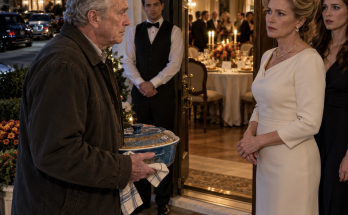
I Carried My Wife’s Thanksgiving Dish to My Son’s Door, Never Imagining I Would Be the Guest Asked to Leave
Part 15 of 28