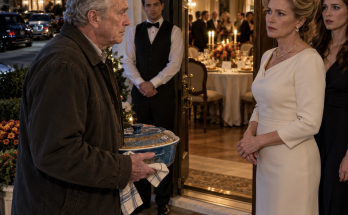
Victoria’s new dining room seated ten comfortably.
Twelve if people were willing to touch elbows.
She had invited eleven.
No extensions.
No second table.
No staff waiting in the hall.
Richard complained that the table was too small.
Victoria told him that was the point.
I arrived early with the sweet potatoes.
Daniel and Emily came next.
Caroline arrived with Nina Park, which surprised everyone until Caroline announced they had become friends after two years of legal work.
Nina clarified that “friends” was generous.
Charles and his wife drove in from two counties away.
Patricia came last, carrying wine.
Richard looked at the bottle.
“You still buying that vineyard?”
Patricia stared at him.
“No business.”
“Right.”
Victoria pointed toward the kitchen.
“Put it down.”
He obeyed.
That alone justified the meal.
We gathered around the table before sunset.
No place cards.
I noticed immediately.
Victoria saw me noticing.
“People can choose.”
“That must have hurt.”
“Immensely.”
Richard sat beside Caroline.
Not Emily.
That felt deliberate.
Perhaps some old imbalance required correction.
Daniel sat beside me.
Emily across from him.
Charles near Patricia, which seemed dangerous.
Dinner began awkwardly.
Large family meals often do.
Everyone had too much shared history and too little agreement about which parts were safe to mention.
Richard solved that by dropping a roll.
It hit the floor.
His chair caught the tablecloth when he bent to retrieve it.
A wineglass tipped.
Patricia grabbed it.
Charles laughed.
Victoria closed her eyes.
The tension broke.
For twenty minutes, conversation stayed harmless.
Daniel’s latest project.
Caroline’s board committee.
Emily’s nonprofit work.
Charles’s repayment schedule was almost complete, though Patricia silenced him before he turned it into financial reporting.
Then Victoria brought out the sweet potatoes.
Ruth’s casserole dish sat in the center.
Everyone stared.
Richard leaned away.
“I’m not touching it.”
Caroline laughed.
“Why?”
“Every time someone lifts that thing, a thirty-year-old legal problem appears.”
“There is nothing under it,” I said.
Daniel raised his hand.
“Confirmed.”
Emily looked suspicious.
“You two checked together?”
“Yes.”
“That somehow makes me less confident.”
Everyone laughed.
The dish moved around the table.
When it reached Richard, he held it carefully.
His expression changed.
“Ruth would hate this.”
“What?” I asked.
“All of us talking about her while the food gets cold.”
I smiled.
“Yes.”
“She’d tell us to eat.”
So we did.
After dinner, Victoria refused help until everyone ignored her and helped anyway.
Richard dried plates.
Badly.
Daniel loaded the dishwasher.
Caroline put leftovers into containers.
I stood by the counter with Charles.
He looked toward his brother.
“He changed.”
“Yes.”
“Enough?”
I considered the question.
“Enough for what?”
“To forgive him.”
“That isn’t measurable.”
Charles nodded.
“I’m still angry.”
“You can be.”
“He almost destroyed both companies.”
“Yes.”
“He spent years acting like I was irresponsible.”
“Were you?”
Charles laughed.
“Sometimes.”
“Then perhaps both things can be true.”
He looked at me.
“You always talk like this?”
“No.”
“Ruth?”
“Mostly.”
He smiled.
Later, we returned to the table for pie.
That was when Richard stood.
Everyone immediately became suspicious.
Victoria said, “Sit down.”
“I want to say something.”
“No speeches.”
“It’s not a speech.”
Patricia whispered, “That’s how speeches begin.”
Richard ignored her.
He remained standing.
“I owe everyone at this table something.”
Charles groaned.
“Please don’t say money.”
“No.”
Richard looked toward me first.
“Lucas.”
I hated being first.
“I excluded you from Thanksgiving because I believed you were inconvenient.”
No euphemism.
No misunderstanding.
“I knew Daniel had invited you.”
Victoria looked at me.
We already knew her part.
Richard continued.
“I knew you expected to be there.”
That detail still hurt.
“I let Victoria take responsibility for the guest list because I didn’t want to admit the real reason.”
“What was the real reason?” Daniel asked.
Richard looked at me.
“I had spent years thinking about Lucas as a shareholder problem.”
The table became quiet.
“When Patricia mentioned Bennett Holdings at dinner before Lucas arrived, I believed those rights were obsolete.”
I had not known Patricia mentioned them before my arrival.
She nodded slightly.
Richard continued.
“I didn’t want Lucas in a room where the acquisition might be discussed because I thought he would complicate things if he heard too much.”
There it was.
The original motive.
Not class embarrassment alone.
Not the truck.
Not the social guests.
Control of information.
“After he left, Patricia told me the protections might still be active.”
Patricia corrected him.
“I told you to verify them.”
“Yes.”
Richard smiled faintly.
“Even now.”
“Facts matter.”
“They do.”
He continued.
“That is why the calls started.”
Fifty-five missed calls.
Not remorse.
Panic.
At least initially.
Richard looked at me.
“You were not excluded because you did not belong.”
He stopped.
“You were excluded because I was afraid of what would happen if you knew enough to say no.”
That was the cleanest description yet.
I nodded.
“Thank you.”
He turned toward Daniel.
“I offered you money because I believed wanting success made you available.”
Daniel’s face tightened but he listened.
“I was wrong to treat ambition like consent.”
Then Caroline.
“I treated financial support as proof that secrecy was fair.”
Her eyes filled.
“It wasn’t.”
Victoria.
“I let you carry explanations for choices I made.”
She looked down.
Emily.
“I taught you that keeping peace was more important than asking what the peace cost.”
Emily wiped her eyes.
Charles.
“I called you irresponsible when what I often meant was difficult to control.”
Charles laughed softly.
“That one I’ll frame.”
Richard almost smiled.
Then Patricia.
“I treated boards as obstacles whenever they disagreed quickly enough to inconvenience me.”
Patricia nodded.
“That is accurate.”
Finally he looked around the table.
“I spent most of my life believing protection meant making sure nothing fell apart.”
He sat slowly.
“I understand now that sometimes things need to fall apart enough for everyone to see what they actually are.”
No applause.
Thank God.
That would have ruined it.
Victoria reached for his hand.
He took hers.
Caroline leaned back.
Daniel looked toward me.
I knew what he was thinking.
Was that enough?
Not enough to erase.
Enough to acknowledge.
I spoke.
“My turn.”
Richard sighed.
“I knew this was contagious.”
I ignored him.
“I owe apologies too.”
That surprised people.
Good.
I looked at Daniel.
“Your mother and I protected you without always trusting you.”
His eyes filled.
“We called it preparation.”
I thought of the hidden beneficial interest.
The conditional proxy.
The delayed disclosure.
“She had reasons.”
I paused.
“So did I.”
“But reasons do not make every choice right.”
Daniel nodded.
“I also used work with Bennett Holdings to keep you closer after the crisis.”
He started to object.
I raised my hand.
“Not consciously.”
That mattered.
“But I liked needing you.”
His face changed.
“That’s not terrible.”
“No.”
“It becomes terrible if I make your leaving feel like betrayal.”
He understood.
I looked at Emily.
“I judged your family as a unit when I was angry.”
She nodded slightly.
“I had reasons.”
Richard muttered, “Many.”
“Quiet.”
He smiled.
I continued.
“But you were not responsible for every decision your parents made.”
Emily whispered, “Thank you.”
Then Caroline.
“I almost treated you as evidence that Richard was bad instead of as a person.”
She looked surprised.
“When?”
“Early.”
I thought about the moment we discovered her.
Secret daughter.
Hidden trust.
Corporate significance.
For a while, Caroline had existed in my mind primarily as proof of Richard’s secrecy.
“I’m sorry.”
She nodded.
“Accepted.”
Then Richard.
“I wanted you punished.”
The room became very quiet.
Richard did not move.
“Not forever.”
I smiled bitterly.
“But long enough that you understood how humiliation felt.”
He held my gaze.
“That’s fair.”
“No.”
I shook my head.
“Understandable is not always fair.”
Ruth again.
Facts are not weapons merely because they hurt.
“I’m glad I didn’t make company decisions from that feeling.”
“So am I,” Patricia said.
Everyone laughed softly.
I continued.
“I don’t forgive everything because everything turned out better.”
Richard nodded.
“Good.”
“I forgive what I am able to forgive because carrying it no longer protects anything.”
He looked down.
That was the closest I could come.
Perhaps forgiveness is not one decision.
Perhaps it is a series of releases.
Some complete.
Some partial.
Some never.
Victoria brought coffee.
No one announced dessert ended.
People simply remained.
That was the difference between a formal dinner and family.
Eventually chairs turned away from the table.
Caroline showed Emily photographs from a recent board trip.
Charles argued with Richard about football.
Patricia cornered Daniel about a zoning issue despite the no-business rule.
Nina quietly stole the last piece of pie.
I saw her.
Said nothing.
Around nine, snow began.
Light.
Unexpected.
Victoria stood by the window.
“If this sticks, everyone stays.”
Richard protested.
“My car can handle snow.”
Victoria looked at him.
“You have a cardiac device and terrible night vision.”
He sat down.
Caroline laughed.
For a moment, the room felt full in a way the old Merritt dining room never had.
Not because of wealth.
Not because of importance.
Because nobody was performing belonging.
They simply belonged.
I went into the kitchen.
The blue casserole dish sat soaking in the sink.
I picked it up.
Richard appeared in the doorway.
“Don’t.”
“What?”
“Turn it over.”
I smiled.
“I wasn’t going to.”
“Yes, you were.”
I dried the bottom.
Nothing.
No note.
No envelope.
No warning.
Just ceramic.
Richard leaned against the counter.
“Strange.”
“What?”
“That everything started with you carrying that dish to my door.”
“No.”
He frowned.
“What do you mean?”
“Everything started long before.”
Arthur.
Ruth.
The transfers.
The first false records.
Caroline.
Daniel’s hidden interest.
Years of secrecy.
“Thanksgiving only opened the door.”
Richard nodded.
“Fair.”
We stood quietly.
Then he asked, “Do you ever wish you had just gone home and answered my first call?”
“No.”
“Why?”
“Because you would have tried to fix the immediate problem.”
He laughed.
“Yes.”
“And I might have let you.”
“Probably.”
“We would have patched the acquisition.”
“Possibly.”
“Daniel might have transferred the shares later.”
His smile disappeared.
“Yes.”
“Caroline’s ownership might have remained hidden.”
“Yes.”
“Charles’s loans might have stayed buried.”
“Yes.”
“Thomas would have learned more of the same.”
Richard looked toward the dining room.
“So being rude saved everyone.”
“No.”
He smiled.
“You really won’t give me that.”
“No.”
“Why?”
“Because the lesson isn’t to be cruel and hope consequences improve people.”
“Fair.”
“The lesson is that when someone finally says no, pay attention.”
Richard considered that.
“I wish I had learned sooner.”
“Most useful lessons arrive late.”
“That sounds like Ruth.”
“Stop.”
He laughed.
The snow thickened.
Everyone stayed.
We found blankets.
Victoria assigned rooms.
Patricia complained about sleeping in a house with three Merritts.
Caroline told her she had survived the board.
Daniel took the couch despite Victoria’s protests.
I ended up in the guest room.
Before bed, I stood by the window.
Snow covered the street.
My phone showed no missed calls.
For some reason, that made me smile.
Three years earlier, the morning after Thanksgiving began with nineteen missed calls and grew into fifty-five.
Richard.
Victoria.
Daniel.
Everyone desperate for me to answer because suddenly I mattered.
That had been the ugliest part.
Not that they needed me.
That they noticed my value only when they needed something.
Now nobody needed anything.
Yet I was here.
That was better.
The next morning, Richard made coffee.
It was terrible.
I told him.
He blamed the machine.
Victoria told me he had always blamed equipment for operator error.
Caroline burned toast.
Charles shoveled the walkway.
Daniel scraped snow off my truck.
Emily found a broom.
Patricia left first because apparently CEOs enjoy proving roads are passable.
By ten, everyone began leaving.
I stood beside my truck.
Richard walked out.
Hands in his coat pockets.
“Lucas.”
“Yes?”
“Next Thanksgiving?”
“What about it?”
“My house.”
I looked toward Victoria through the window.
“Ask your wife.”
He sighed.
“Right.”
He started back.
Then stopped.
“Lucas.”
“What?”
“You’ll come?”
There was no strategy beneath the question.
No board vote.
No shares.
No acquisition.
Just Richard asking.
“Yes.”
He nodded.
“Good.”
I climbed into the truck.
Before starting the engine, I looked toward the house.
Three years earlier, I had left a Merritt Thanksgiving carrying nothing.
Not even Ruth’s casserole dish.
I thought I had lost my place in my son’s life.
Instead, the exclusion exposed a network of secrets none of us could keep living around.
Richard lost control of Merritt and became useful to it.
Caroline lost secrecy and gained a family she could choose.
Victoria lost the marriage she had protected and built a different one.
Emily lost certainty about her parents and learned she did not need certainty to love them.
Daniel lost Richard’s approval as a measure of success and built something of his own.
And I lost the comforting belief that protecting people always meant keeping them close.
Ruth had prepared nearly everything except the ending.
That belonged to us.
I drove home.
The house was quiet when I entered.
Ruth’s photograph remained on the shelf.
I placed the framed Thanksgiving invitation beside it.
“You’d enjoy this too much,” I told her.
Her photograph continued smiling.
I sat in the chair opposite.
For years after Ruth died, I had talked to her whenever I did not know what to do.
During the Merritt crisis, that habit became almost constant.
What would Ruth do?
What would Ruth say?
What did Ruth mean?
Eventually, I realized grief can become another kind of permission.
Permission to avoid your own answer.
So I looked at her photograph and said something I had never said before.
“I think I’m okay without instructions now.”
The room remained quiet.
I waited.
Nothing.
Good.
I smiled.
Then I took the old Merritt folder from the filing cabinet.
Not to inspect it.
Not to search for another clue.
I carried it downstairs.
Daniel had helped me arrange long-term document storage after Samuel died.
The records would be preserved.
Accurately.
Accessible to people who needed them.
Not hidden under cookware.
Not guarded by one person.
I placed Ruth’s original notes inside.
Her warning about Richard.
The old agreements.
Copies of Arthur’s letter.
The termination agreement.
Margaret’s statement.
The entire history.
On top, I added one page of my own.
Not legal language.
Just a note.
These records exist so nobody has to rely on one person’s memory, authority, or version of events.
Read them if needed.
Question them if necessary.
Then make your own decisions.
I signed my name.
My real signature.
No one else’s hand.
No reproduction.
No assumption.
Mine.
I closed the folder.
That evening, Daniel called.
“How was the drive?”
“Fine.”
“You home?”
“Yes.”
“Need anything?”
“No.”
“Okay.”
He paused.
“I’ll call you this weekend.”
“If you want.”
Another pause.
“I do.”
“Good.”
We hung up.
No hidden meaning.
No test.
No obligation.
A son calling his father.
That was enough.
I went into the kitchen and opened the cabinet.
The blue casserole dish sat on the top shelf.
I considered checking underneath.
Then laughed.
“No.”
I closed the door.
Some things had finally become exactly what they appeared to be.
A dish.
A family.
A company.
A choice.
And a seat at the table that did not need to be earned by being useful.
The End
Read more original stories on Feel Every Story.
I Carried My Wife’s Thanksgiving Dish to My Son’s Door, Never Imagining I Would Be the Guest Asked to Leave
Part 28 of 28