I told Daniel not to open the letter.
He protested immediately.
“It says open it.”
“It says if Merritt belongs to one person again.”
“Doesn’t it?”
“Not yet.”
“Dad.”
“Wait for Harold.”
Harold nodded approvingly.
Daniel sighed.
“You two are becoming unbearable.”
“We’re coming home.”
I ended the call.
The drive felt longer than usual.
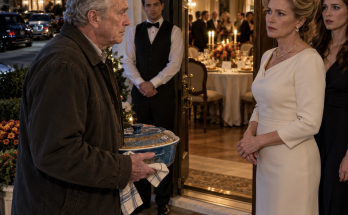
The casserole dish.
Of all places.
Ruth had spent years building systems around people’s habits.
She knew I would preserve documents because she told me to.
She also knew there were some things I might accidentally lose.
But not that dish.
It had belonged to her mother.
Then her.
Every Thanksgiving it came out.
Every year I handled it carefully.
Even after Ruth died, I used it.
Not because I needed that particular dish.
Because memory sometimes requires objects.
When we reached the house, Daniel had placed it on the kitchen table.
The blue ceramic looked completely ordinary.
Harold examined the underside.
A thin felt pad had been attached beneath the base years ago.
Daniel had noticed one corner lifting while drying it.
Under the felt was a shallow recessed area.
Inside, protected by waxed paper, sat a cream envelope.
Arthur Merritt’s handwriting appeared across the front.
If Merritt ever belongs to one person again, open this.
Harold photographed everything.
Then we opened it.
The letter was addressed to Ruth.
Not me.
Not Richard.
Ruth.
Arthur wrote with surprising clarity.
He admitted what he had done.
The transfers.
The manipulated reporting dates.
The pressure he placed on Richard to hide problems until they could be repaired.
He did not excuse himself.
That surprised me.
I had expected an old man’s justification.
Instead, Arthur wrote:
The worst thing I taught Richard was not how to move money. It was how to believe that being responsible for everyone gave him permission to decide what everyone was allowed to know.
I read that sentence twice.
Harold said nothing.
Daniel sat opposite me.
“That’s Richard.”
“Yes.”
Arthur continued.
He had watched Richard become more capable than he ever was.
More disciplined.
More successful.
But he feared Richard had inherited the same instinct.
When frightened, control information.
When threatened, control people.
When exposed, call it protection.
I felt Ruth in every safeguard she later negotiated.
Perhaps Arthur’s letter had helped her understand what she was dealing with.
Then came Caroline.
Arthur wrote that his granddaughter’s existence had forced him to confront the damage secrecy created.
Richard believed hiding Caroline protected Victoria and Emily.
Arthur believed it protected Richard from consequences.
He had created the RLB Trust because he wanted at least one part of Caroline’s future beyond Richard’s discretion.
Daniel whispered, “Grandpa Merritt knew exactly what his son was.”
“Arthur wasn’t your grandfather.”
“You know what I mean.”
I did.
Arthur then described his concern about ownership.
Merritt had begun as a family company.
That was useful while the family was accountable to one another.
It became dangerous when authority concentrated in a single person.
Arthur wrote that no Merritt should ever possess enough unilateral control to treat the company as personal property.
Harold leaned forward.
“That’s why the original structure was divided.”
“Yes.”
Arthur had intentionally spread interests among Richard, Charles, original investors and independent trusts.
Not because he disliked Richard.
Because he knew himself.
And saw himself in his son.
Then came the line from the envelope.
If Merritt ever belongs to one person again, the company will eventually become that person’s excuse for anything.
I sat back.
That sentence explained decades.
Richard believed every compromise was justified because Merritt had to survive.
Every secret protected Merritt.
Every manipulated record stabilized Merritt.
Every family member became a tool because Merritt needed something.
Arthur’s final instructions were not legally binding.
Harold made that clear.
“This is not a corporate agreement.”
“I know.”
“It does not change ownership.”
“I know.”
“It may have historical relevance, but it doesn’t create authority.”
“Harold.”
“Yes?”
“I understand.”
“Good.”
He looked slightly disappointed.
Arthur’s letter ended with a request to Ruth.
If Richard ever attempted to consolidate control beyond the limits established in the original structure, Ruth should reveal the letter to the other shareholders.
Not to destroy him.
To remind them why the limits existed.
Ruth had never needed to.
Until now.
Daniel stared at the casserole.
“Mom hid it here.”
“Yes.”
“Why not with the other records?”
“Maybe because Richard knew she kept records.”
Harold nodded.
“And he searched for this letter.”
“He did?”
“Caroline said he asked her to.”
Right.
Ruth had hidden the one document Richard knew existed somewhere he would never think to search.
My kitchen.
My Thanksgiving dish.
I laughed softly.
Daniel looked at me.
“What?”
“Your mother won.”
Harold corrected me.
“This is not a competition.”
“I know.”
But somewhere, Ruth would have enjoyed the irony.
We scanned the letter.
The original went into secure storage.
Then I called Richard.
He answered quickly.
“I found Arthur’s letter.”
Silence.
Not surprise.
Recognition.
“Where?”
“Ruth’s casserole dish.”
A sound escaped him.
Almost laughter.
“Of course.”
“You knew it existed.”
“Yes.”
“Why were you looking for it?”
“Because my father told me he had written something to Ruth.”
“What did you think it said?”
“That I shouldn’t control Merritt.”
“You were right.”
Richard was silent.
“Do you want to read it?”
Another pause.
“Yes.”
“Come here.”
Harold looked at me.
I shrugged.
This time Richard would come to my table.
He arrived forty minutes later.
Alone.
No suit.
No driver.
No lawyer.
He stood in my kitchen while I placed a copy of Arthur’s letter before him.
For several minutes, he read without moving.
Then he sat.
His hands trembled.
I had never seen that before.
“He wrote this near the end.”
“Yes.”
“I know the handwriting.”
Richard touched one line.
“He never said this to me.”
“Maybe he didn’t know how.”
“He could write it to Ruth.”
“Ruth was easier to talk to.”
Richard laughed.
“That is absolutely false.”
I smiled.
“Fair.”
He continued reading.
When he reached the paragraph about Caroline, his eyes closed.
“He loved her.”
“Arthur?”
“Yes.”
“He met her?”
“Several times.”
“Did Victoria know?”
“No.”
“Emily?”
“No.”
“Caroline?”
“She remembers an older man who brought her books. She didn’t know who he was until later.”
Richard stared at the letter.
“My father was terrible at apologies.”
“Sounds familiar.”
He looked at me.
“I deserved that.”
“Yes.”
No argument.
That was new.
Daniel entered from the living room.
He stopped when he saw Richard.
Neither man spoke.
Finally Richard said, “Daniel.”
“Richard.”
“I owe you an apology.”
“Yes.”
Richard looked at me.
I shook my head.
“Don’t look at me.”
He turned back.
“I used your ambition.”
Daniel’s jaw tightened.
“Yes.”
“I knew you wanted a larger role.”
“Yes.”
“I made you believe it depended on helping me with Lucas.”
“Yes.”
“I should not have.”
“No.”
Richard waited.
Daniel offered nothing else.
No absolution.
No reassurance.
The silence forced Richard to continue.
“The three million was real.”
“That makes it worse.”
Richard looked surprised.
Daniel explained.
“If it was fake, you were lying. If it was real, you actually put a price on getting me to sell something that wasn’t mine.”
Richard looked down.
“You’re right.”
Daniel’s face changed slightly.
Perhaps he had never heard Richard say those words to him.
“I’m not asking you to forgive me.”
“Good.”
“I’m asking you not to blame Emily.”
“I don’t.”
“Or Caroline.”
“I don’t.”
“Victoria knew some things.”
“I know.”
Richard nodded.
That was as far as the conversation could go.
He returned to Arthur’s letter.
“My father thought splitting control would save the company.”
“Do you disagree?”
“I used to.”
“And now?”
Richard looked exhausted.
“I don’t know.”
That was perhaps the most honest answer he had given.
I poured coffee.
Three cups.
Richard looked surprised when I placed one before him.
“Don’t mistake coffee for forgiveness.”
“I won’t.”
We sat at the kitchen table.
The same table where Ruth and I had debated our first Merritt investment.
Life has an irritating sense of symmetry.
Richard asked, “Are you going to activate the clause?”
“If the process establishes the trigger.”
“You could waive it.”
“Yes.”
“Will you?”
“No.”
He nodded.
No argument.
“If it activates, what will you do?”
“Stabilize the company.”
“And then?”
“Give the power away.”
Richard looked at me.
“To whom?”
“Not a person.”
He frowned.
“I want a governance structure.”
Harold had helped me sketch it during the drive.
Independent directors.
Limits on related-party transactions.
Transparent beneficial ownership.
No single shareholder able to dominate extraordinary decisions.
Protection for minority investors.
And eventually, once the crisis passed, expiration or restructuring of the extraordinary Bennett rights too.
Richard listened.
“You’d weaken your own position.”
“Yes.”
“Why?”
I pointed toward Arthur’s letter.
“Because apparently both your father and my wife spent twenty years trying to teach us the same thing.”
“What?”
“Power should have witnesses.”
Richard stared at me.
“That was Ruth.”
“Yes.”
“She said that?”
“In her notes.”
He smiled faintly.
“Of course.”
His phone rang.
Patricia.
He answered.
Listened.
Then his expression changed.
“What?”
He stood.
Daniel and I looked at each other.
Richard listened for another thirty seconds.
Then ended the call.
“What happened?” I asked.
He stared at me.
“The independent reviewer reached a preliminary determination.”
Harold stepped into the kitchen.
“And?”
Richard’s voice was quiet.
“The disputed consent and archive manipulation satisfy the misconduct trigger.”
Nobody spoke.
“When effective?” Harold asked.
“Immediately, subject to final confirmation.”
Richard looked toward me.
“My voting rights are suspended.”
I felt no victory.
Just weight.
“And Bennett?”
Richard swallowed.
“You are now the largest active voting shareholder.”
Daniel sat down.
Harold immediately began calling Patricia.
Richard remained standing in my kitchen.
The company he had spent his life controlling had just shifted beyond his control.
Not permanently.
But long enough to change everything.
He looked at me.
“What are you going to do first?”
I thought about employees worried about payroll.
Caroline’s hidden ownership.
Charles’s loans.
Victoria’s silence.
Daniel’s mistake.
The bank.
The board.
And Ruth’s instruction.
Protect what needs protecting.
Then stop.
I answered.
“Make sure nobody can ever do this again.”
Before Richard could respond, Harold returned.
His face was tense.
“What?”
“The determination triggered more than Richard’s suspension.”
“What else?”
“Ruth’s dormant nominee position.”
Caroline.
“Yes.”
“Her votes are active?”
“Once beneficial ownership is confirmed.”
Richard sat slowly.
Harold continued.
“And Charles’s original investor protections may also reactivate because his interests were affected by the same restructuring.”
I stared at him.
“So I’m not the only one gaining power.”
“No.”
That should have relieved me.
Instead, Harold’s expression worried me.
“What aren’t you saying?”
He placed his phone on the table.
“The governance reset requires an election.”
“What election?”
“A new board.”
“When?”
“Within thirty days.”
Richard looked up sharply.
Harold continued.
“All directors elected under the affected voting structure must stand for confirmation or replacement.”
Patricia.
Gordon.
Everyone.
The entire board would be reset.
Daniel whispered, “Who votes?”
Harold looked at me.
“Bennett Holdings.”
Then toward the absent Caroline.
“Caroline’s restored interest.”
“Charles?”
“If his rights qualify.”
“And Richard?”
“His affected votes are suspended.”
Richard stared at Arthur’s letter.
For decades, he had built Merritt around himself.
Now the old protections created by the people who distrusted concentrated power were doing exactly what they had been designed to do.
They were forcing the company to choose its leadership again.
And whether I wanted it or not, I would have one of the loudest voices in that choice.
Click here to continue reading: PART 17: The Board Reset Put Merritt’s Future Up for a Vote, and Caroline Refused the One Thing Richard Assumed She Would Always Give Him
I Carried My Wife’s Thanksgiving Dish to My Son’s Door, Never Imagining I Would Be the Guest Asked to Leave
Part 16 of 28