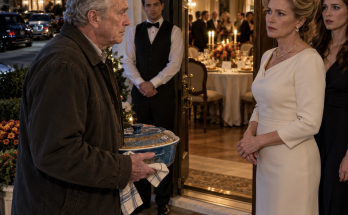
The announcement went out to Merritt’s directors before sunset.
A formal governance reset had been triggered.
Existing directors would continue only in caretaker capacity until a new election could be completed under the restored voting structure.
Richard’s affected voting rights were suspended.
Bennett Holdings became the largest active voting position.
Caroline’s dormant beneficial interest would vote once ownership confirmation was completed.
Charles’s protections were under review.
Every sentence was written in the dry language of corporate procedure.
None of it captured the reality.
A company Richard had controlled for decades was being forced to ask, almost from the beginning, who should be trusted with power.
Richard remained at my kitchen table long after Harold finished speaking to Patricia.
He had not touched his coffee.
Daniel stood by the sink, arms folded.
I sat across from Richard.
For the first time since I had met him, he seemed to understand that no argument available to him could change what had already happened.
“The board election,” I said. “How long?”
Harold answered.
“Within thirty days. Possibly sooner if the stakeholders agree on procedure.”
Richard looked toward him.
“They’ll rush it.”
“They should move efficiently.”
“That isn’t what I said.”
“No. It’s what I said.”
Richard ignored the distinction.
His attention returned to me.
“You’ll nominate Patricia.”
“I haven’t decided.”
“You will.”
“Stop deciding what I’ll do.”
He pressed his lips together.
Even now, correction came slowly.
Daniel shifted near the sink.
Richard looked toward him.
“What about you?”
“What about me?”
“If your father ends up determining the board, you should understand what kind of leadership Merritt needs.”
Daniel almost smiled.
“You’re asking me to influence him?”
“I’m asking your opinion.”
“No.”
Richard stared.
Daniel continued.
“I’m not being your route to Dad anymore.”
“That isn’t what I meant.”
“It doesn’t matter.”
The answer was firm without being cruel.
I was proud of him.
Not absolved.
Not repaired.
But proud.
Harold packed his papers.
“We need independent review of all eligible voting interests before any election.”
Richard looked annoyed.
“We know the cap table.”
“No,” Harold said. “We have learned repeatedly that you know a version of the cap table.”
Richard looked away.
That was fair.
The next morning, Merritt announced internally that temporary liquidity access had been restored.
Payroll would continue.
Critical projects would remain funded.
The message did not name me.
I asked Patricia to keep it that way.
She agreed.
By noon, reporters had begun asking why Richard remained on leave.
The board issued a minimal statement.
Governance review.
Transaction reevaluation.
No comment regarding individuals.
Richard hated it.
I knew because he called.
“This makes it look worse.”
“It may be worse.”
“Lucas.”
“Richard.”
“We need to manage the story.”
“No.”
“You don’t understand.”
“I understand enough.”
“Silence creates speculation.”
“So does speaking before facts are established.”
He exhaled.
“That sounds like Ruth.”
“Good.”
He hung up.
At three, Caroline came to my house with an attorney.
Her attorney’s name was Nina Park, early forties, direct, and entirely unimpressed by the Merritt name.
I liked her before she had finished introducing herself.
Caroline carried a thin folder.
“The custodian confirmed the nominee interest.”
Harold stood from the kitchen table.
“How much?”
Nina answered.
“Enough that Caroline becomes the third-largest active voting holder during the reset, assuming Charles’s rights are restored.”
Caroline sat.
Her hands trembled.
I poured coffee.
She shook her head.
“Tea?”
“Yes.”
I made tea.
Sometimes crisis still permits hospitality.
When I placed the mug before her, she looked at Ruth’s blue casserole dish on the counter.
“Is that the one?”
“Yes.”
“The letter was under there?”
“Yes.”
She smiled faintly.
“She was unbelievable.”
“That is one word.”
Caroline looked at the folder again.
“I have to decide how to vote.”
“Eventually.”
“Soon.”
“Yes.”
Nina looked toward me.
“Caroline wants to understand whether Bennett Holdings intends to coordinate with her.”
I shook my head.
“I intend to talk to her. Coordination is Harold’s vocabulary.”
Harold sighed.
“Unfortunately, my vocabulary prevents lawsuits.”
Caroline gave the first genuine laugh I had heard from her.
Then she became serious.
“My father called me.”
I waited.
“He asked whether I planned to vote with him.”
Daniel, sitting at the far end of the table, looked up.
“With his suspended votes?”
“He says the suspension may be challenged.”
Harold nodded.
“That’s possible.”
“What did you tell him?”
Caroline looked at me.
“I told him I hadn’t decided.”
“Good.”
“He said I should remember who made sure I had anything at all.”
The room went silent.
Daniel whispered, “Of course he did.”
Caroline stared at the tea.
“For years, that sentence would have worked.”
“What changed?” I asked.
“She did.”
Her eyes moved toward Ruth’s dish.
“Ruth?”
“Yes.”
Caroline’s voice became unsteady.
“I keep thinking about those graduation flowers.”
Build something that belongs to you.
“She gave me the thing Dad kept telling me he had given me.”
I understood.
The shares were not the only inheritance Ruth preserved.
She had preserved proof that Caroline’s place in Merritt did not originate as Richard’s reward.
Her ownership predated his generosity.
Arthur created it.
Ruth protected it.
Richard concealed it.
Caroline looked toward Nina.
“I want my interest separated from every trust Dad controls.”
Nina nodded.
“We’re working on that.”
“I want all voting authority in my own name.”
“Once legally available.”
“And I don’t want him as trustee of anything belonging to me.”
Richard would experience that as betrayal.
That did not make it wrong.
Daniel asked, “Have you told him?”
“No.”
“Will you?”
“Yes.”
The answer was immediate.
She looked toward me.
“Would you come?”
“To where?”
“His house.”
I almost laughed.
“I’m spending too much time there.”
“I don’t want to go alone.”
That changed it.
“Yes.”
Nina said she would come too.
Harold insisted on joining because apparently no member of the Bennett family could now cross the Merritt driveway without legal representation.
That evening, the four of us drove there.
Caroline sat in my truck.
She looked at the scratched dashboard.
“Dad hates your truck.”
“I know.”
“He once said it made you look unsuccessful.”
“I suspected.”
“Ruth told him anyone who judges a man by a truck probably deserves a repair bill.”
I laughed so hard I nearly missed the turn.
Richard was waiting.
He did not look pleased to see Harold and Nina.
“This is a private family conversation.”
Caroline answered.
“Nina is my attorney.”
His face changed.
“Since when?”
“Today.”
“You don’t need independent counsel.”
“Yes, I do.”
“Caroline.”
“No.”
She said it quietly.
That seemed to unsettle him more than shouting would have.
We went into the same study where he had shown us Arthur’s ledger.
Richard closed the door.
Caroline remained standing.
“I want you removed from my trust.”
He stared at her.
“What?”
“You heard me.”
“I’m the trustee.”
“Yes.”
“I created the trust.”
“Yes.”
“I funded it.”
“With shares you gave me because you had hidden shares that were already mine.”
Richard looked at me.
I raised both hands.
“She arrived at that herself.”
He turned back.
“The nominee position was legally complicated.”
“That doesn’t explain why you didn’t tell me.”
“I was trying to simplify it.”
“For whom?”
“Everyone.”
Caroline shook her head.
“No.”
She placed Ruth’s ownership confirmation on his desk.
“I want this separated from every entity you control.”
“Caroline, that could have tax consequences.”
“Nina will advise me.”
“Nina doesn’t understand the family structure.”
Nina spoke for the first time.
“That is exactly why I’m useful.”
Richard ignored her.
“You’re angry.”
“Yes.”
“You shouldn’t make permanent decisions while angry.”
Caroline almost smiled.
“That’s interesting advice from the man who built a six-year strategy around being afraid of Lucas’s shares.”
Richard flinched.
She continued.
“I’m not doing this because I hate you.”
His expression softened slightly.
“I know.”
“I’m doing it because I finally understand that loving you and trusting you are not the same decision.”
The softness disappeared.
He sat down.
That sentence had reached somewhere none of the corporate accusations had.
Caroline’s voice trembled.
“I loved the parts of you I got.”
Richard looked at her.
“The lunches. The birthdays when you came late and left early. The books you bought me. The job.”
His face tightened.
“I tried.”
“I know.”
“And it wasn’t enough.”
“No.”
Silence.
She wiped her eyes.
“The worst part is that you knew that.”
Richard’s own eyes filled.
He looked away.
“I didn’t know how to fix it.”
“You didn’t try the one obvious thing.”
“What?”
“Tell the truth.”
He had no answer.
Caroline sat.
“I’m voting independently.”
“For whom?”
“I don’t know yet.”
“Patricia?”
“Maybe.”
“Lucas?”
“He doesn’t want to be a director.”
Richard looked toward me.
“You shouldn’t.”
“Finally, agreement.”
He ignored that.
“Caroline, if the board becomes too independent, they will dismantle everything.”
“What?”
“The company.”
“No.”
She shook her head.
“They might dismantle your control.”
He stood.
“You think there’s a difference?”
“Yes.”
That answer came from three people at once.
Caroline.
Nina.
Me.
Richard looked at us.
For a second, I saw how isolated he had become.
Not because everyone abandoned him.
Because he had spent years treating disagreement as disloyalty.
Caroline stood.
“I’m done.”
Richard moved around the desk.
“Wait.”
She stopped.
He seemed to search for words.
Then he said something unexpected.
“I’m proud of you.”
Caroline’s face tightened.
“Don’t.”
“I mean it.”
“That’s why I’m asking you not to.”
He looked hurt.
She explained.
“I’ve spent my whole life treating your approval like evidence I made the right choice.”
Richard stared at her.
“I need to learn how to make one without it.”
He lowered his hands.
“All right.”
The words barely came out.
Caroline walked toward the door.
Then Richard said, “I’m sorry.”
She stopped.
This apology sounded different from the others.
No explanation afterward.
No “but.”
No warning about consequences.
Just:
“I’m sorry.”
Caroline turned.
“I believe you.”
Richard looked almost relieved.
Then she added:
“I’m still removing you from the trust.”
The relief vanished.
I almost smiled.
Outside, Caroline stood beside the truck and breathed deeply.
“You okay?”
“No.”
“Good answer.”
She laughed weakly.
Then her phone rang.
Patricia.
Caroline answered.
Her face changed during the call.
“What?”
We waited.
She ended it.
“The voting review found another protected interest.”
Harold frowned.
“Whose?”
Caroline looked at me.
“Daniel’s.”
He was not with us.
For a moment, none of us spoke.
“That doesn’t make sense,” I said.
Caroline nodded.
“Apparently Ruth created something before she died.”
My chest tightened.
Of course she had.
Harold asked, “What kind of interest?”
“Not ownership yet.”
“Then what?”
Caroline stared at the phone.
“A voting proxy.”
“For whose shares?”
She looked directly at me.
“Yours.”
Click here to continue reading: PART 18: Ruth’s Secret Proxy Gave Daniel a Voice in the Board Election, but the Conditions She Attached Forced Him to Confront What He Had Almost Done
I Carried My Wife’s Thanksgiving Dish to My Son’s Door, Never Imagining I Would Be the Guest Asked to Leave
Part 17 of 28