“No.”
Daniel’s answer came through the phone broken by a breath.
“I didn’t take the money.”
I watched Harold across the conference table.
He gave no sign of relief.
Neither did I.
“Did you agree to anything?”
Daniel hesitated.
“That depends what you mean.”
My chest tightened.
“It means exactly what it sounds like.”
“I signed something.”
Harold’s hand moved instantly toward his legal pad.
“What?”
Daniel swallowed audibly.
“An acknowledgment.”
“Of what?”
“That if you eventually transferred the shares to me, I intended to sell them to Richard.”
For several seconds, I heard nothing except the faint electrical hum from Harold’s lights.
“You signed an agreement to sell something you didn’t own.”
“It wasn’t supposed to be binding.”
“That makes it intelligent?”
“No.”
“When?”
“Six months ago.”
“The same time Richard offered you three million?”
“Yes.”
I rubbed my forehead.
“Why?”
“I thought…”
He stopped.
I waited.
“I thought it was an opportunity.”
“For you.”
“Yes.”
“Not for me.”
“No.”
“For you.”
His voice cracked.
“Yes.”
Harold extended a hand toward the phone.
“Put him on speaker.”
I did.
“Daniel,” Harold said, “this is Harold Mercer, your father’s attorney.”
“I know who you are.”
“I need you to answer carefully. Do you have a copy of what you signed?”
“I don’t know.”
“Did anyone give you one?”
“Richard’s attorney emailed documents.”
“To your personal account?”
“Yes.”
“Do not delete anything. Do not forward anything. Do not alter the files.”
Daniel sounded frightened.
“Am I in trouble?”
Harold glanced at me.
“That depends on the document and what representations were made. For now, preserve everything.”
I leaned toward the phone.
“Where are you?”
“At home.”
“Emily there?”
“Yes.”
“Richard?”
“No.”
“Victoria?”
“No.”
“Come to my house at noon.”
“Dad, the closing—”
“I do not care about the closing.”
“They’re saying the company could lose millions.”
“Then Richard should have thought about that before building a transaction on shares that did not belong to him.”
Daniel did not answer.
“Do you understand me?”
“Yes.”
“Noon.”
I ended the call.
Harold leaned back.
“You’re calmer than I expected.”
“I’m not calm.”
“No?”
“No. I’m old.”
He almost smiled.
“There is a difference.”
“My anger gets tired faster.”
“That may be the wisest thing you’ve ever said.”
“Don’t write it down.”
He turned the legal pad toward himself.
“We need the agreement Daniel signed.”
“I understand.”
“We also need to determine whether Richard represented to lenders that he had a committed path to your shares.”
“What would that mean?”
“It depends. At minimum, potentially serious disclosure problems.”
“And at maximum?”
“I’m not speculating before I see documents.”
I nodded.
That was why I trusted Harold.
Ruth had trusted facts.
Not moods.
Not impressions.
Not stories people told about themselves.
Facts.
I looked at the ownership chart again.
“Explain this to me like I’m not a lawyer.”
“That requires imagination.”
“Try.”
Harold tapped my name.
“You are one of Merritt’s largest individual outside shareholders.”
“How did that happen?”
“You invested early, retained your position and acquired additional shares during two capital raises.”
“Ruth did.”
“You both did.”
“Ruth made the decisions.”
“You signed the checks.”
“Usually after she told me where.”
Harold smiled.
“The important part is that your holdings carry protections negotiated during the restructuring.”
“And Richard doesn’t know the full extent.”
“He appears not to.”
“How is that possible?”
“Different entities. Old records. Custodial structures. Reporting changes. Your position is disclosed where legally required, but Richard evidently relied on simplified internal schedules.”
“That sounds careless.”
“It is.”
“Does his board know?”
“Some members may.”
“Patricia Sloan?”
“Likely.”
I remembered Daniel saying Patricia had corrected Richard at dinner.
“She knew who I was?”
“She may have known Bennett Holdings. Whether she knew you controlled it is another question.”
“So someone told them after I left.”
“Yes.”
I thought of Richard standing inside his enormous doorway, drink in hand, watching me leave.
Hours later he discovered the old man with the dented Ford had rights his acquisition needed.
The irony was almost too neat.
That made me distrust it.
Life rarely arranges itself for satisfaction.
“Why would Richard need my shares if he only needs my approval?”
Harold grew serious.
“That is the question.”
He pulled another file closer.
“There are two possibilities.”
“I’m listening.”
“First, he wanted control. Your position, combined with his family holdings, could have strengthened his voting bloc after the acquisition.”
“And second?”
“He expected something to happen that made your shareholder protections dangerous to him.”
“What kind of something?”
“Related-party transfers. Debt restructuring. A change in voting control. Transactions involving family-owned entities.”
I stared at him.
“You’re saying he might have wanted my shares gone because I could challenge what he was doing.”
“I’m saying we need documents.”
Again.
Facts.
Ruth would have approved.
By nine thirty, Merritt’s outside counsel had called Harold twice.
Richard called my phone seven more times.
Victoria sent a message.
Lucas, whatever happened yesterday should remain separate from business. Please do not act emotionally.
I showed Harold.
He read it.
“That’s remarkable.”
“What?”
“She manages to accuse you of being emotional while asking you for help.”
“I noticed.”
“Are you replying?”
“No.”
I turned off the phone.
We spent another hour reviewing the old records.
That was when Harold found the first irregularity.
It was buried in an agreement from twenty-one years earlier.
Merritt Development had transferred money to another company owned by Richard’s father.
The transfer was described as a short-term intercompany loan.
Harold frowned.
“What?”
“This was repaid.”
“Then what’s wrong?”
“The timing.”
He placed two pages beside each other.
“The loan occurred immediately before your first investment closed.”
“So?”
“So the financial statements provided to investors should have disclosed it.”
“Did they?”
“No.”
I stared at the numbers.
“Richard was young then.”
“In his forties.”
“That feels young now.”
“Lucas.”
“I’m not defending him. I’m trying to understand whether this matters.”
“It matters because Ruth questioned it.”
He pointed to a handwritten note attached to the agreement.
The handwriting was unmistakable.
Ask Richard why his father’s company receives money before investor close. Get answer in writing.
I could see Ruth at our kitchen table making that note.
She wrote hard when she was irritated, pressing the pen into the paper.
Below it was another sentence.
He says temporary. Watch.
One word.
Watch.
My skin prickled.
“She knew.”
“She suspected.”
“What happened?”
“I need the old correspondence.”
“Where is it?”
“Possibly in your files.”
I remembered the unopened envelope.
The one marked Richard Merritt — keep everything.
We left Harold’s office shortly after eleven and drove separately to my house.
My phone remained off.
Daniel’s car was already in the driveway when I arrived.
He stood beside it with Emily.
Neither had come inside.
Daniel looked as though he had not slept.
Emily wore no makeup and held her coat closed with both hands.
“Dad.”
“You’re early.”
“We didn’t know where else to go.”
I unlocked the door.
Inside, Daniel glanced toward the living room.
Ruth’s photograph sat where it always had.
His eyes lingered on it.
Emily remained near the entryway.
“Lucas.”
“Yes?”
“I’m sorry about yesterday.”
I took off my coat.
“Which part?”
Her face reddened.
“All of it.”
“That’s broad.”
“I know.”
She looked toward Daniel.
“My parents told us you knew the dinner was limited.”
“I did not.”
“I believe you.”
“You didn’t yesterday.”
She lowered her eyes.
“No.”
Harold came in carrying his briefcase.
Emily stiffened.
“This is legal now?”
“It became legal six months ago,” Harold said, “when Daniel signed a document involving property he did not own.”
Daniel flinched.
I almost felt sorry for him.
Almost.
We went to the living room.
Daniel emailed the agreement to Harold.
While Harold read, I watched my son.
He kept rubbing the same spot on his thumb.
He had done that since childhood whenever he was afraid.
“You should have told me.”
“I know.”
“When Richard approached you.”
“I know.”
“When he offered the money.”
“I know.”
“When you signed.”
“I know.”
I leaned forward.
“Stop saying you know.”
He looked up.
“What do you want me to say?”
“The truth.”
“I’m telling you.”
“No. You’re giving me facts because you got caught. I’m asking why.”
Daniel’s face tightened.
He looked toward Emily.
Then at the floor.
“Because I wanted him to respect me.”
No one moved.
Emily closed her eyes.
I had expected greed.
Fear.
Pressure.
Not that.
“Richard?”
Daniel nodded.
“He always treated me like I was temporary.”
“You married his daughter.”
“That didn’t change it.”
“What would?”
“Success.”
“According to him?”
“Yes.”
I studied my son.
The explanation did not excuse him.
But suddenly I understood the shape of the wound.
Richard had wealth, influence, buildings with his name on them.
Daniel had spent years entering rooms where everyone knew who his father-in-law was and almost no one cared who his father was.
I had mistaken his ambition for independence.
Perhaps some of it had been hunger for approval.
“He said if I became part of Merritt, I’d finally have something substantial.”
“You have a career.”
“He called it middle management.”
“You own a house.”
“He helped us buy it.”
That surprised me.
I looked at Emily.
She nodded miserably.
“Part of the down payment.”
“How much?”
Daniel answered.
“Two hundred thousand.”
I leaned back.
“And you never told me.”
“I knew what you’d say.”
“What?”
“That money with conditions isn’t a gift.”
Daniel looked toward Ruth’s picture.
“That was Mom’s line.”
“Yes.”
He swallowed.
“She told me that too.”
The room went quiet.
Harold suddenly looked up from his laptop.
“Lucas.”
His tone changed everything.
“What?”
“This agreement is worse than Daniel described.”
Daniel stood.
“What do you mean?”
Harold turned the screen.
“The acknowledgment includes a representation that Daniel has a reasonable expectation of receiving your shares.”
I looked at my son.
“Based on what?”
Daniel stared at the paragraph.
“I didn’t notice that.”
Harold’s expression hardened.
“You signed it.”
“I know, but Richard said—”
“Never tell a lawyer you signed something because someone told you what it said.”
Daniel sat down again.
Harold continued.
“There’s also a side letter.”
Daniel shook his head.
“I never saw that.”
“It was in the package.”
“What does it say?”
Harold read silently.
Then his jaw tightened.
“It indicates Merritt intended to use Daniel’s expected acquisition of Lucas’s holdings to satisfy a post-closing control requirement.”
I frowned.
“English.”
“They told someone financing the acquisition that your shares were expected to become available.”
“Without asking me.”
“Yes.”
Emily covered her mouth.
Daniel went pale.
“Richard told me it was hypothetical.”
Harold looked at him.
“Did he tell you the lenders were relying on it?”
“No.”
“Did he tell you your signed acknowledgment would be included in transaction materials?”
“No.”
I looked toward the filing cabinet in the hall.
Ruth had warned Daniel about Richard years before this agreement existed.
Why?
I stood.
“Harold.”
“Yes?”
“The envelope.”
We went to the study.
I removed it from the desk.
Richard Merritt — keep everything.
The seal resisted slightly before opening.
Inside were copies of correspondence, old bank records and several handwritten pages.
On top was a letter addressed to me.
Not mailed.
Not dated recently.
Written in Ruth’s hand.
Lucas,
If you are reading this because something has happened involving Merritt, read everything before you decide what to do.
I stopped.
Behind me, Daniel whispered, “Mom wrote that?”
I turned.
He had followed us into the study.
His face looked younger suddenly.
Frightened.
I looked back at the page.
The next line made my hand tighten around the paper.
Richard once asked me to keep something from you.
I read it twice.
Daniel stepped closer.
“What?”
I did not answer.
There were six more pages beneath it.
And clipped to the back was a photocopy of a bank transfer carrying the name of Richard Merritt’s father.
The amount was large.
Even by current standards.
I looked at Harold.
He looked at the paper.
Then at me.
“Lucas,” he said quietly, “do not call Richard.”
I folded Ruth’s letter closed.
“Why?”
“Because before you speak to anyone, we need to understand what your wife knew.”
For the first time since Thanksgiving, Daniel’s betrayal was no longer the only secret in the room.
My dead wife had been protecting something for more than twenty years.
And Richard Merritt had just spent six months trying to obtain the one asset she had warned our son never to discuss with him.
Click here to continue reading: PART 4: Ruth’s Letter Explained Why She Never Trusted Richard, Then a Twenty-Year-Old Record Connected His Family to the Crisis Happening Now
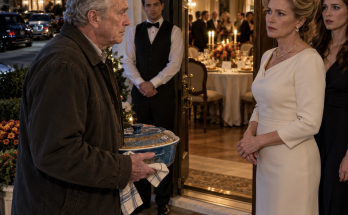
I Carried My Wife’s Thanksgiving Dish to My Son’s Door, Never Imagining I Would Be the Guest Asked to Leave
Part 3 of 28