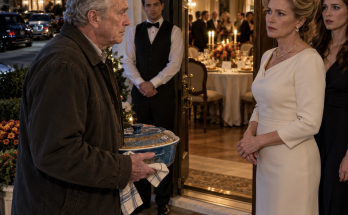
Richard remained in the doorway.
Nobody invited him in.
He entered anyway.
That seemed appropriate.
For most of his life, Richard had treated boundaries as things that existed only until he decided they were inconvenient.
He looked at the screens.
The trust chart.
The debt schedules.
The Bennett strategy files.
Then he looked at Caroline.
“How much did you give them?”
“Everything on the working drive.”
His face hardened.
“You had no right.”
Caroline laughed softly.
“No right?”
“Those were confidential company materials.”
“You told me to delete them.”
“That does not make them yours to distribute.”
Harold intervened.
“She preserved records potentially relevant to a board investigation.”
Richard looked at him.
“I wasn’t speaking to you.”
“That has been one of your recurring mistakes.”
I almost told Harold not to enjoy himself.
I decided he had earned a little.
Patricia stepped forward.
“Richard, Charles has withdrawn from the acquisition.”
His face changed.
“When?”
“Within the last half hour.”
“Why?”
“He learned about Caroline’s trust and the source of bridge financing.”
Richard looked toward Victoria.
“I didn’t tell Charles,” she said.
His eyes moved to me.
“Neither did I.”
Patricia answered.
“You did.”
Richard frowned.
“During your call.”
Something passed across his face.
Memory.
Regret.
Then calculation.
“He misunderstood.”
“No,” Patricia said. “He understood enough to terminate.”
Richard walked toward the table.
“That can be fixed.”
Gordon stared at him.
“No.”
Richard stopped.
Gordon continued.
“We have undisclosed financing, disputed representations to lenders, questionable classification of related-party loans and a five-year strategy document aimed at eliminating shareholder protections.”
“Strategy is not misconduct.”
“Using a shareholder’s presumed inheritance to support financing?”
“An assumption.”
“Offering the shareholder’s son three million dollars?”
“A potential transaction.”
“Booking loans to a company we don’t own as intercompany receivables?”
Richard’s voice sharpened.
“Temporary classification.”
Gordon laughed.
“Do you hear yourself?”
Richard looked around the table.
“I kept this company alive.”
Nobody answered.
He repeated it.
“I kept it alive.”
There was something different in his voice.
Not authority.
Desperation.
Patricia folded her arms.
“Explain.”
Richard looked at her.
“You think this started with Charles?”
“Didn’t it?”
“No.”
The room quieted.
He moved to the window.
“The commercial portfolio has been under pressure for three years.”
Patricia frowned.
“Occupancy is stable.”
“Occupancy, yes. Refinancing isn’t.”
“Why?”
“Variable-rate debt.”
Gordon stared.
“We refinanced most of that.”
“Not all.”
“How much?”
Richard gave a figure.
Patricia went still.
“That exposure was not in the last treasury report.”
“It was hedged.”
“Was?”
“The hedge expired.”
“When?”
“Eight months ago.”
Gordon pushed his chair back.
“You concealed that.”
“I was renegotiating.”
“You concealed it.”
Richard turned.
“I prevented panic.”
“No.”
Patricia’s voice was quiet.
“You prevented oversight.”
Richard looked at me.
As if somehow I were responsible for everyone in the room choosing words he disliked.
I said nothing.
He continued.
“When rates moved against us, cash flow tightened. Then two redevelopment projects ran over budget.”
Patricia asked, “How far?”
Another number.
More silence.
Gordon whispered something I could not hear.
Richard pressed on.
“Charles had assets with stable industrial income. Combining the companies solved both problems.”
“So the acquisition was a rescue,” Patricia said.
“A strategic consolidation.”
“A rescue.”
Richard ignored her.
“It would have stabilized Merritt and given Charles liquidity.”
“Then why hide the problem?”
“Because the market would punish us.”
“We’re private.”
“Lenders would punish us.”
Patricia stared at him.
“They may now punish us more.”
“I had a solution.”
“You had a plan that depended on false assumptions.”
“I had a solution.”
His voice rose.
The insistence finally revealed something I had missed.
Richard did not see himself as reckless.
He saw himself as the only adult in every room.
Rules were obstacles because he believed the result justified whatever he did to reach it.
Ruth had understood this decades ago.
I spoke.
“When Arthur used Merritt money for his other business, did you think he had a solution too?”
Richard turned sharply.
The old name struck him.
“You’ve been reading ancient files.”
“Yes.”
“That has nothing to do with this.”
“It looks similar.”
“It is nothing like it.”
“Why?”
“My father stole from the company.”
Silence.
Even Victoria looked surprised.
Richard realized what he had said.
Too late.
Harold leaned forward.
“Stole?”
Richard’s face closed.
“Poor word choice.”
“No,” I said.
“It sounded precise.”
Richard looked at me.
“Arthur moved money without authorization.”
“And you?”
“I had authority.”
“From whom?”
No answer.
Patricia asked the same question.
“From whom, Richard?”
“I was chief executive.”
“That does not authorize related-party transfers outside approved limits.”
“The money was going to be repaid.”
I heard Ruth’s old note in my head.
Temporary.
Watch.
I said it aloud.
“Temporary.”
Richard’s face changed.
“What?”
“That’s what you told Ruth about Arthur’s transfers.”
He said nothing.
“She wrote it down.”
Richard looked toward Harold’s briefcase.
“You think keeping records makes her right?”
“No.”
I paused.
“The records make the records right.”
He looked away.
Emily stood beside Victoria.
“Dad, why Caroline?”
Richard frowned.
“What?”
“Why put her in the middle of all this?”
Caroline looked toward her sister.
Richard answered.
“She worked for me.”
“That’s not what I asked.”
“Then be clear.”
Emily stepped closer.
“Why keep her secret for thirty-four years?”
Richard’s expression tightened.
“This is not relevant.”
“It is to us.”
“Emily.”
“You built a trust for her. You gave her shares. You brought her into the company. You let her work outside your office every day.”
Richard looked toward Caroline.
Something softened.
Only slightly.
“I took care of her.”
Caroline flinched.
Emily saw it.
“You hid her.”
“I protected everyone.”
There was the phrase again.
Protected.
Victoria spoke from the table.
“From what?”
Richard turned.
She had stopped crying.
Now she looked exhausted.
“From scandal,” he said.
“Thirty years ago?”
“Yes.”
“We survived the affair.”
“That’s different.”
“How?”
“An affair is one thing. A child changes everything.”
Caroline’s face went white.
Richard realized what he had said.
He moved toward her.
“That’s not what I meant.”
She stepped back.
“It’s exactly what you meant.”
“No.”
“You could admit you cheated.”
“Caroline.”
“But admitting me meant living with evidence.”
Richard stopped.
She wiped her face.
“You liked me privately.”
“That isn’t fair.”
“You paid for school.”
“Yes.”
“You gave me a job.”
“Yes.”
“You gave me shares.”
“Yes.”
“You just never gave me a place at Thanksgiving.”
Nobody moved.
The sentence landed differently because of me.
The excluded guest.
The hidden daughter.
Two forms of the same instinct.
Control the table.
Control who belongs.
Richard looked at Caroline.
“You never asked.”
She laughed through tears.
“I was waiting for my father to ask me.”
He had no answer.
Emily reached for Caroline’s hand.
This time Caroline took it.
Victoria watched them.
Her expression broke.
Then she looked at Richard.
“You made me part of it.”
Richard shook his head.
“You chose.”
“Yes.”
Victoria’s voice strengthened.
“I chose to stay.”
She pointed toward Caroline.
“But you asked me to pretend she didn’t exist.”
“I asked for discretion.”
“You asked me to host Christmas dinners knowing your daughter was across town.”
Richard closed his eyes.
“Victoria.”
“No.”
She stood.
“I spent thirty years believing silence was the price of keeping our family together.”
“You wanted the same thing.”
“I wanted Emily protected.”
“And she was.”
Emily laughed.
“Was I?”
Richard turned.
“I gave you everything.”
She shook her head.
“No. You arranged everything.”
That hurt him.
I saw it.
Perhaps because it was true.
Richard looked around the room.
Every relationship he had treated as manageable had become a person with a voice.
He seemed suddenly older.
Patricia returned the discussion to business.
“We need full access to the treasury records.”
Richard did not answer.
“Richard.”
“You’ll have it.”
“All email archives.”
“You’ll have them.”
“Personal devices used for company business.”
He hesitated.
Then nodded.
“Fine.”
“The board will engage independent counsel.”
Martin’s firm was no longer acceptable.
Richard looked annoyed but did not object.
“Until the review is complete, we need to discuss your role.”
The room tightened.
Richard looked at her.
“My role.”
“Yes.”
“I founded this company.”
“With investors.”
“I built it.”
“With employees, directors and capital.”
His eyes moved toward me.
I understood the point.
Merritt had become Richard’s identity.
But ownership was never as simple as identity.
Gordon spoke.
“You need to step aside temporarily.”
Richard laughed once.
“No.”
Patricia said, “This is not optional if the board votes.”
“Then vote.”
He said it like a challenge.
They did.
The motion placed Richard on temporary administrative leave pending an independent investigation.
The vote passed.
Not unanimously.
But comfortably.
Richard remained standing while Patricia read the result.
I expected him to explode.
Instead, he sat down.
For the first time that day, he looked tired.
Not defeated.
Not redeemed.
Just tired.
He stared at the table.
“I was trying to keep it from collapsing.”
Patricia responded quietly.
“You should have told us it was in danger.”
“And watched everyone panic?”
“You mean participate.”
He looked at her.
“Yes.”
The answer was so honest that no one immediately knew what to do with it.
Richard continued.
“Every time this company survived something, it was because I moved before everyone else finished talking.”
Gordon replied.
“That doesn’t mean every move was right.”
“No.”
Richard rubbed his face.
“But when enough of them are right, people stop questioning you.”
That was the closest thing to self-awareness I had heard from him.
He looked toward me.
“Ruth questioned everything.”
“Yes.”
“I hated that.”
“I know.”
“I thought she wanted leverage.”
“She wanted records.”
“She thought I was my father.”
“No.”
I waited.
“She was afraid you might become him.”
Richard stared at me.
That hurt him more.
Arthur had apparently been the one comparison he never wanted.
After several seconds he asked, “Did she write that?”
“No.”
“Then how do you know?”
“Because I knew her.”
He looked toward the city.
The anger drained out of him.
Patricia asked everyone except directors, counsel and necessary witnesses to leave while they addressed immediate governance steps.
I stood.
Daniel and Emily followed.
Caroline hesitated.
Richard looked at her.
“Caroline.”
She stopped.
For one second I thought he might say something useful.
Instead he asked, “Did you give them access to my personal folder?”
Caroline’s face closed.
“No.”
Then she left.
Emily waited for her.
Victoria remained.
Richard noticed.
“Are you staying?”
She looked at him.
“I don’t know.”
He seemed confused.
“I mean in the room.”
“I know what you meant.”
She picked up her handbag.
“No.”
She walked out.
In the corridor, nobody spoke for several minutes.
Then Caroline turned toward Emily.
“There’s something you should know.”
Emily looked exhausted.
“What else?”
Caroline hesitated.
“Richard didn’t create my trust alone.”
“Who helped?”
“Your mother.”
Emily turned toward Victoria.
Victoria stopped walking.
“What?”
Caroline looked at her.
“You signed the original acknowledgment.”
Victoria’s face went blank.
“I signed what Richard put in front of me.”
“Mom.”
Emily’s voice was quiet.
“Did you know the trust gave Caroline Merritt shares?”
Victoria stared at Caroline.
“I knew he was providing for you.”
“That’s not what she asked.”
Victoria’s shoulders dropped.
“Yes.”
Emily stepped back.
“So you knew she owned part of the company.”
“Yes.”
“And you still let Dad tell the board the family ownership model without disclosing her?”
“I didn’t know what the board had been told.”
“But you knew the secret.”
“Yes.”
Emily looked between both women.
Then toward the closed boardroom.
“I can’t do this today.”
She walked toward the elevator.
Daniel followed.
I started after them.
Then Caroline said my name.
“Lucas.”
I turned.
She looked frightened.
“There’s one more thing on the drive.”
Harold stopped beside me.
“What?”
Caroline lowered her voice.
“A file Richard never told the board about.”
“What file?”
“It’s labeled Bennett contingency.”
My stomach tightened.
“What’s inside?”
“I only saw part of it.”
Harold asked, “What part?”
Caroline looked directly at me.
“A draft petition.”
“For what?”
“To have you declared unable to manage Bennett Holdings.”
Nobody moved.
The company problem suddenly became personal again.
Richard had not only planned for Daniel to receive my shares after death.
He had explored a way to take control of them while I was still alive.
Click here to continue reading: PART 12: Richard’s Last Contingency Targeted My Ability to Control My Own Assets, and Daniel Found the One Document That Could Destroy His Plan
I Carried My Wife’s Thanksgiving Dish to My Son’s Door, Never Imagining I Would Be the Guest Asked to Leave
Part 11 of 28