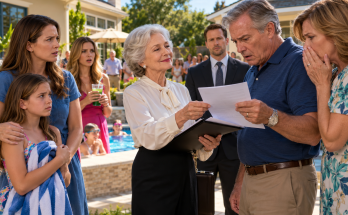
Nathan Vale had been in prison for years when Sophie chose to see him.
Claire did not like the idea.
That did not make it her decision.
“You don't owe him a visit.”
“I know.”
“He may manipulate you.”
“I know.”
“You can leave.”
“I know.”
Sophie looked at her.
“Mom.”
Claire stopped.
“Sorry.”
Sophie smiled faintly.
“You're doing nervous breathing.”
Daniel, from the kitchen, said, “She does.”
Claire told both of them to be quiet.
The meeting took place through secure video first.
Sophie refused to travel until she knew whether speaking to Nathan was useful.
He appeared older than she remembered from photographs.
Gray hair.
Thin face.
Prison uniform.
No white coat.
That mattered more than she expected.
Nathan looked at her for several seconds.
“Sophie.”
She did not return the greeting immediately.
“Did you know the cells came back into me?”
“Yes.”
Claire's jaw tightened.
Nathan continued.
“Not immediately.”
“When?”
“Within months.”
“And you didn't tell my parents.”
“No.”
“Why?”
“Because Samuel would have eliminated them.”
Sophie stared.
“You're sure?”
“I believed it.”
“That's not what I asked.”
Nathan paused.
“No.”
Good.
At least he corrected himself.
Sophie held Caleb's recovered letter.
“You said the tolerance cells weren't an accident anymore.”
“Yes.”
“What does that mean?”
Nathan explained.
The original reverse-flow error during Sophie's infant exchange returned a tiny number of labeled cells.
He detected them later.
Instead of disappearing, they persisted.
More importantly, they began expressing regulatory pathways associated with neonatal tolerance.
Nathan realized they might counteract Samuel's increasingly aggressive vector.
He chose not to remove them.
He also adjusted one later supportive treatment to favor their survival.
Claire leaned forward.
“You treated Sophie again.”
Nathan looked toward her.
“Indirectly.”
“No.”
Claire's voice sharpened.
“You don't get to make the word smaller.”
Nathan nodded.
“I administered immune-support medication that I believed would preserve that population.”
“Without telling me.”
“Yes.”
Sophie asked, “Did it hurt me?”
“I don't know.”
“Did it help?”
“I believe it did.”
“Not the same question.”
Nathan closed his eyes.
“No. I cannot prove what would have happened otherwise.”
Sophie leaned back.
Years earlier, she might have wanted a villain.
Now she had learned people could save you while violating you.
Those truths did not cancel each other.
“Why didn't you tell Samuel?”
“Because he hated uncontrolled biology.”
Nathan almost smiled.
“He wanted every protective effect attributable to his vector. If a naturally selected cell population interfered, he would have considered it contamination.”
Samuel later confirmed that.
Not proudly.
“If Nathan had shown me those cells at the time,” he said through a separate approved interview, “I probably would have eliminated them.”
Sophie stared.
“So Nathan was right about you.”
“Yes.”
“And still wrong to hide it from Mom.”
“Yes.”
Samuel did not add anything.
Sophie appreciated that.
Nathan described another reason for secrecy.
Miriam.
He had contacted her after discovering the tolerance population.
She refused involvement.
But she sent one reply.
Do not destroy what the child's body created merely because it complicates the experiment.
Claire stared at the sentence.
“Mom knew?”
“Only that the population existed.”
“Did she know you were giving supportive medication?”
“No.”
Nathan had hidden that from Miriam too.
Because he feared she would report him.
Sophie laughed without humor.
“So everybody trusted secrecy more than people.”
Nathan lowered his eyes.
“Yes.”
The recovered Kern box contained more correspondence.
Nathan had tracked Sophie's tolerance cells at ages three and six using leftover samples.
No direct contact.
Still unauthorized monitoring.
He saw the population gradually stabilize.
At age six, he wrote:
The cells are learning restraint faster than Samuel is.
Sophie hated how much she liked the sentence.
“That doesn't make him less wrong,” Claire said later.
“I know.”
“You can think something he wrote is smart.”
“I know.”
Claire smiled.
“Sorry.”
“Nervous talking.”
Yes.
The important document came last.
A protocol Nathan never used.
TEMPORARY TOLERANCE AMPLIFICATION.
It proposed collecting Sophie's own regulatory cells, expanding them outside her body, and returning them only during periods of vector crisis.
No permanent genetic modification.
No self-renewal.
A treatment designed to fade.
Rebecca read it three times.
“This is almost Miriam's later philosophy.”
Claire frowned.
“Did he steal it?”
Possibly inspired by her.
Possibly independent.
The records were unclear.
Nathan said he designed it after seeing Sophie's cells.
Rebecca refused to take his word alone.
They reconstructed dates.
Miriam's temporary-cell notes predated Nathan's protocol.
He likely saw some of her work.
Nathan admitted that too.
“Then it isn't yours,” Sophie said.
“No.”
“Whose?”
Nathan thought.
“Miriam's idea, modified by what your cells showed.”
“And my cells?”
“Yes.”
Sophie nodded.
“Then write all that down.”
He did.
Formally.
Under oath.
That statement became important when researchers later evaluated intellectual-property claims.
No one person got to turn the stolen history into a private fortune.
Sophie did not become excited about the science.
She remained focused on one question.
“If you knew a temporary treatment might work, why didn't you tell Mom?”
Nathan's answer was painful because it sounded familiar.
“I thought she would refuse.”
Sophie closed her eyes.
Of course.
Everyone's favorite justification.
“What if she did?”
Nathan looked at her.
“Then you might have lost the protective population.”
“And?”
“And perhaps died.”
Sophie sat forward.
“You don't know that.”
“No.”
“So you picked for her.”
“Yes.”
“Would you do it again?”
Nathan took a long time.
Claire expected rationalization.
Instead he said, “No.”
Sophie studied him.
“Because you got caught?”
“Partly.”
Unexpected honesty.
“And because?”
“Because I have had years to understand that a good outcome does not turn an unauthorized act into consent after the fact.”
Sophie nodded.
That was enough.
Not forgiveness.
Enough.
She ended the call.
Claire asked how she felt.
“Hungry.”
That answer delighted her.
They ate burgers.
No debrief until Sophie wanted one.
Two days later, she did.
“I think Nathan helped me.”
“Yes.”
“I think he did something wrong.”
“Yes.”
“Those can both stay true.”
“Yes.”
Sophie looked relieved.
The world had become easier when she stopped requiring every person to fit one moral box.
Not simpler.
Easier to describe accurately.
The temporary-tolerance protocol went to Rebecca's independent review board.
Not directly into research.
First provenance.
Consent.
Ownership.
Scientific validity.
Risk.
Nathan's unauthorized data could not simply be treated as ordinary research material.
The board separated information that could ethically be used from material requiring new permissions.
Where surviving subjects could be contacted, they were asked.
Where they could not, the data was excluded unless legal and ethical standards supported limited use.
Slow.
Annoying.
Necessary.
Sophie followed the process with interest.
“You could go faster.”
Rebecca nodded.
“We could.”
“But?”
“We decided speed isn't the only value.”
“Good answer.”
Sophie's own expanding blood clone remained stable.
No treatment needed.
She turned eighteen before the next major decision.
That changed paperwork.
At her first appointment as a legal adult, the receptionist handed consent forms directly to her.
Claire reached automatically.
Then stopped.
Sophie noticed.
“Growth.”
Claire rolled her eyes.
Sophie signed her own treatment authorization.
Her own research renewal.
Her own privacy preferences.
She listed Claire and Daniel as people clinicians could discuss medical information with.
Eric too, with narrower administrative access because he lived farther away.
Claire felt unexpectedly emotional.
Sophie saw.
“Don't cry over HIPAA.”
“I'm not.”
“You are.”
“It's allergies.”
“Eric says that.”
“Family technique.”
College decisions arrived.
Sophie was accepted into several schools.
She chose one close enough to Dr. Shah's hospital for continuity but far enough that Claire could not appear without warning.
Daniel called that hostile planning.
Sophie called it healthy boundaries.
She chose a combined program emphasizing molecular biology and bioethics.
Not medicine.
Not yet.
Rebecca was thrilled.
Sophie warned her not to become unbearable.
Before college, she requested a complete copy of her medical and research records.
Not just summaries.
Everything legally available.
The files filled encrypted drives.
Thousands of pages.
Claire asked why she wanted them.
“Because they're mine.”
Fair.
Sophie did not read everything.
She created categories.
Medical care.
Research.
Legal.
Family.
Unknown.
The last folder bothered her.
Documents with unclear provenance.
Unverified claims.
Fragments.
She refused to let uncertainty become fact merely because someone had typed it.
One document stood out.
A scanned handwritten page from Miriam.
No date.
No signature.
The text described a future patient carrying both the Hale risk mutation and Morgan protective regulator.
If such a child exists, do not correct the genome permanently. The contradiction may be the protection.
Sophie stared.
It sounded prophetic.
Too prophetic.
Claire felt the same unease.
“Could be later.”
Rebecca examined the paper.
Ink dating was inconclusive.
The scan had passed through NorthStar.
Original missing.
Arthur did not remember it.
Samuel claimed he had never seen it.
Ward said Miriam wrote similar things late in life.
Not enough.
Sophie moved it to UNKNOWN.
Claire smiled.
“What?”
“Nothing.”
“You're proud.”
“A little.”
“For not believing Grandma?”
“For not needing her to have predicted everything.”
Sophie looked at the folder.
Miriam had become almost mythic inside the family.
The one who learned.
The one who warned.
The one whose temporary treatments offered a path forward.
But Miriam had also made embryos for research.
Donated reproductive material.
Trusted bad collaborators.
Stayed too long in dangerous systems.
She did not need to become a saint for her later principles to matter.
Sophie closed the file.
Then another message arrived from Caleb.
Dr. Kern's belongings contained one final audio cassette.
Label:
FOR MIRIAM—IF SOPHIE REACHES ADULTHOOD.
Nathan's handwriting.
Sophie stared.
Maya called.
“Same rule.”
“Ask first?”
“Yes.”
Sophie thought.
Then answered.
“Send it.”
The recording was digitized.
Nathan's younger voice filled Sophie's laptop.
Miriam, if you're hearing this, then either I failed to reach you or you refused to answer, both of which would be reasonable.
Sophie smiled faintly.
The recording described the tolerance cells.
The accidental return.
The unauthorized supportive treatment.
Everything Nathan later admitted.
Then he said something new.
I preserved one sample outside Samuel's network.
Claire froze.
Sophie leaned closer.
Not Sophie's sample.
A culture derived from the tolerance cells at age three.
Stored with Kern under an anonymous code.
Nathan continued.
If Sophie reaches adulthood, it belongs to her. Not Samuel. Not me. Not any institution. Destroy it unless she explicitly asks for it.
Sophie stopped the recording.
Claire looked at her.
Somewhere, after all these years, a living culture derived from three-year-old Sophie might still exist.
Not under federal evidence control.
Not at Rebecca's center.
Possibly in Dr. Kern's old private storage.
Sophie stared at the paused audio.
For the first time, an old secret had arrived with instructions that put the decision exactly where it belonged.
With her.