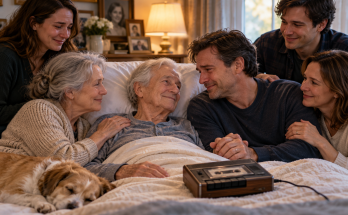
Discharge planning began with arguments about stairs.
Daniel wanted Sophie’s bedroom moved downstairs temporarily.
Sophie refused.
Claire supported Daniel.
Sophie accused them both of becoming old.
Eric suggested a compromise involving a temporary rail and supervised climbing.
Sophie approved because it preserved her room.
Daniel complained that Eric had become popular by agreeing with the child.
Eric said that was called strategy.
Claire told both men to stop.
Sophie smiled.
It felt almost normal.
Dr. Shah’s team scheduled outpatient visits.
Blood counts twice weekly at first.
Tumor markers.
Endocrine monitoring.
Neurological examination.
Repeat MRI.
Immune-vector assays.
Sophie stared at the printed schedule.
“This is not boring. This is too much boring.”
Daniel folded it.
“We’ll color-code it.”
“That makes it worse.”
Claire packed hospital belongings accumulated over what felt like years.
Cards from classmates.
Purple markers.
Socks Sophie hated but kept wearing.
The photograph of Daniel’s shaved head she had printed and labeled POTATO.
Maya’s dragon drawing.
Lucas’s astronomy book.
A copy of Miriam’s letter.
Not medical records.
Not evidence.
Just the letter.
Arthur visited under supervision.
Thomas joined by video from his treatment center.
His clinical trial enrollment was moving forward.
No miracle.
But his pain was better controlled.
He looked less haunted.
“Gertrude behaved?” Sophie asked.
Arthur groaned at the name.
Thomas smiled.
“She is safely frozen.”
“Good.”
“You know she was a tumor.”
“She was mine.”
Thomas nodded.
“Yes.”
He understood the important part now.
Eric spent more time at the hospital too.
Not as Daniel’s rival.
Not exactly as friend.
Something awkwardly in between.
He had begun therapy through a family support service organized for research victims.
Sophie thought the phrase research victims sounded “too dramatic.”
Maya liked it.
Lucas hated it.
Caleb said labels were useful only if people could choose whether to use them.
That ended the debate.
Rebecca remained deeply involved in the legitimate scientific review of Miriam’s temporary-treatment platform.
But she no longer treated Sophie’s room like a conference space.
Claire enforced that.
“No lab meetings here.”
Rebecca once arrived holding a folder.
Sophie pointed at the door.
Rebecca turned around without argument.
Five minutes later she returned with cookies.
Approved.
Samuel’s role had changed most.
Federal prosecutors charged him with multiple offenses related to illegal experimentation, fraud, conspiracy, and unauthorized treatment.
He continued cooperating medically under strict supervision.
No access to patients.
No independent decisions.
His knowledge became evidence and consultation rather than authority.
Sophie asked whether he was going to prison.
Claire said probably.
“Good?”
Claire thought.
“Consequences.”
Sophie nodded.
“Different.”
“Yes.”
Adrian faced broader charges.
His decision to accelerate Sophie’s illness, hide Christopher, activate Cascade in Lucas, and operate NorthStar’s human research system created a much darker record.
Maya had stopped taking his calls entirely.
Christopher did too.
Lucas never wanted one.
Lydia cooperated after her surrender.
Amelia did the same.
Ward’s prenatal registry became the subject of national investigations.
Hospitals and universities began reviewing old data-sharing practices.
Families were being notified.
Slow work.
Important work.
Sophie did not ask for details every day.
That felt healthy.
On the morning before expected discharge, Rebecca found something in Miriam’s blue archive.
She did not bring it into Sophie’s room.
She called Claire into a conference room.
Arthur was there.
Dr. Shah.
Bell.
An independent genetics specialist.
Claire saw the arrangement and immediately disliked it.
“What?”
Rebecca pointed toward a scanned notebook.
Miriam had left instructions regarding descendants who carried her protective regulatory profile.
Claire sat.
“What kind of instructions?”
Not treatment.
A choice.
Miriam had collected preserved blood-forming stem cells from herself during one of the periods when her temporary therapy was functioning well.
Some remained viable in the archive.
Genetically, they carried Miriam’s natural protective modifier.
No permanent engineered construct.
No Samuel vector.
No Cascade.
Just Miriam’s own cells.
Dr. Shah explained why that mattered.
Sophie had undergone multiple interventions.
Her immune system remained altered.
Long-term risks were uncertain.
In the future—only if medically necessary—a stem-cell transplant might replace portions of her blood-forming system with donor cells carrying a more stable protective regulatory pattern.
Claire stared.
“You want to give Sophie Mom’s cells.”
“No.”
Dr. Shah answered firmly.
“I want you to know they exist.”
Good answer.
Rebecca explained compatibility was uncertain.
Miriam was Sophie's great-grandmother biologically through Claire.
Not an ideal donor relationship.
There could be rejection risks.
The cells might never be useful.
But new technologies could potentially allow derived or matched approaches later.
Arthur looked at Claire.
“Miriam wanted descendants told.”
Claire read the notebook entry.
If my preserved cells remain viable, they may someday provide information or therapy for my family. No descendant should receive them merely because a physician believes the biology is promising. Tell them what exists. Let them decide when they are old enough, unless an immediate life-threatening emergency removes the luxury of time.
Claire exhaled.
Miriam had learned.
Maybe late.
But clearly.
Rebecca said, “There’s more.”
Claire gave her a look.
“Of course.”
Miriam also instructed that if no descendant wanted the cells used, they should be destroyed.
Not indefinitely stored.
Not converted into a family research asset.
Not inherited automatically.
Sophie was the only living descendant currently facing a directly relevant medical risk.
Claire understood.
“You want to tell her.”
“Yes.”
Claire looked toward Dr. Shah.
“Now?”
“Not necessarily.”
The cells were not needed today.
Sophie was recovering.
No immediate transplant indication existed.
They could wait until she was older.
That was the obvious answer.
Then Bell explained the legal complication.
The federal government now held the blue archive as evidence.
Eventually biological materials would need disposition.
Keeping Miriam’s cells indefinitely required an authorized custodian.
Destroying them was possible once legal holds ended.
Claire could act as Sophie's guardian regarding future potential use.
But Miriam’s own instruction placed moral weight on Sophie's choice.
Claire smiled faintly.
“Mom managed to leave us one decision that isn't an emergency.”
Rebecca smiled too.
“Apparently.”
Claire returned to Sophie’s room.
She did not immediately mention the cells.
Sophie was trying to beat Daniel at a card game.
Daniel claimed she cheated.
Sophie said observation was not cheating.
Eric backed her.
Daniel accused Eric of corruption.
Claire sat and watched.
Ten minutes.
Twenty.
Ordinary time.
Then Sophie noticed her.
“What?”
“Nothing.”
“You have information face.”
Daniel put down the cards.
“She does.”
Claire sighed.
“Everybody stop reading me.”
“No,” Sophie said.
Claire looked at her daughter.
Miriam’s instructions did not require urgency.
But secrecy had caused enough damage.
“I learned something about Grandma’s archive.”
Sophie groaned.
“Is there another person in a freezer?”
Daniel choked.
“No.”
“Good.”
Claire explained.
Slowly.
Miriam’s preserved stem cells.
What they were.
What they might someday be used for.
What nobody knew.
Sophie listened.
“Do I need them now?”
“No.”
“Maybe later?”
“Maybe.”
“Could they hurt me?”
“Yes.”
“Could they help?”
“Possibly.”
“Do we have to decide now?”
“No.”
Sophie smiled.
“Then don't.”
Claire blinked.
“That’s it?”
“Yes.”
Rebecca, standing near the door, laughed.
Sophie looked confused.
“What?”
“Nothing.”
Claire kissed her forehead.
“Good decision.”
“I didn't decide.”
“Exactly.”
Arthur closed his eyes.
That distinction hit him hard.
Not deciding was allowed.
Waiting was allowed.
Uncertainty did not have to be solved immediately.
The cells were placed under temporary legal preservation until Sophie was older or a genuine medical need arose.
No experimentation.
No transfer.
No secondary research.
No one touched them without consent.
The next morning Sophie was discharged.
She wore jeans that felt too loose after weeks in the hospital.
A purple sweatshirt Maya gave her.
A cap she did not need yet but liked anyway.
Daniel carried three bags.
Eric carried two.
Claire carried nothing because everyone kept taking things from her.
“I have arms,” she complained.
Daniel shook his head.
“Medical advice.”
“Whose?”
“Mine.”
“You’re not a doctor.”
“Correct.”
Sophie walked instead of using the wheelchair for the final corridor.
Slowly.
Dr. Shah stayed beside her.
At the elevator, Sophie stopped.
The same hospital architecture that once meant hidden cameras and fake doctors now held people she trusted.
Not because hospitals were magically safe.
Because trust was no longer automatic.
It had been tested.
Earned.
Questioned.
The doors opened.
In the lobby, several people waited.
Rebecca.
Arthur under supervision.
Maya.
Lucas in a wheelchair.
Emily.
Caleb on a tablet held by Maya because travel arrangements were not ready.
Thomas on another screen.
Even Amelia had sent a written apology Sophie had not decided whether to read.
Sophie looked around.
“This is too many people.”
Daniel smiled.
“Family?”
“Some.”
Maya pointed at him.
“Accurate.”
Arthur stepped forward but stopped several feet away.
“May I hug you?”
Sophie looked at Claire.
Then back at him.
“Yes.”
Arthur hugged her carefully.
When he stepped back, Sophie said, “Don't fake die again.”
Arthur laughed and cried.
“I won't.”
Eric approached next.
Sophie hugged him without asking.
Then Daniel.
Longer.
Claire noticed.
Eric did too.
He did not look wounded this time.
Parenthood was not a competition Sophie needed to manage for adults.
Outside, cameras waited beyond federal security.
The case had become public.
Not every detail.
Enough.
Journalists knew children had been subjected to illegal genetic research.
NorthStar executives had been arrested.
Hospitals were under investigation.
The public wanted names.
Bell had protected the children's identities as much as legally possible.
Sophie asked whether she had to talk.
“No,” Claire said.
“Ever?”
“No.”
“Good.”
They left through a private exit.
Home looked smaller than Claire remembered.
The kitchen counter held unopened mail.
A plant had died.
Daniel blamed Eric.
Eric said he had not been responsible for plants.
Sophie climbed the stairs slowly.
Daniel hovered behind her.
“Stop breathing on me.”
“I am not breathing on you.”
“You're breathing nervous.”
Claire laughed.
Sophie's room remained exactly as she left it.
Soccer poster.
Books.
Stuffed rabbit she claimed not to care about.
School backpack in the corner.
On her desk sat the drawing of the exploding sun she had made months earlier to describe her headaches.
Claire stared at it.
Sophie saw.
“We should throw that away.”
Claire hesitated.
Sophie picked it up.
Then changed her mind.
“No.”
She pinned it above the desk.
Claire raised an eyebrow.
“Why keep it?”
“Because I knew my head hurt.”
Simple.
Her body had been telling the truth even when adults misunderstood it.
That mattered.
That evening Sophie ate half a bowl of pasta.
Complained it tasted weird from treatment.
Watched television with Daniel.
Texted Maya.
Asked Claire whether she could visit soccer practice someday even if she couldn't play.
“Yes.”
“Tomorrow?”
“No.”
“Day after?”
“We’ll ask Dr. Shah.”
Sophie groaned.
Boring medicine.
Before bed she looked at Claire.
“Is it over?”
Claire knew better than to answer simply.
“Which part?”
“The people doing stuff to me without asking.”
Claire sat beside her.
“I think the people we know about have been stopped.”
“That's not the same.”
“No.”
“Could somebody else do something later?”
“Maybe.”
Sophie thought.
“But we'd ask questions.”
“Yes.”
“Read labels.”
“Yes.”
“Check badges.”
“Yes.”
“Tell people no.”
“Yes.”
“Tell people yes if we want.”
Claire smiled.
“Yes.”
Sophie pulled the blanket up.
“Then okay.”
Claire turned off the lamp.
From the doorway, she looked back.
Her daughter was home.
Kevin was not entirely gone.
The cancer treatment was not entirely finished.
The genetic history inside Sophie's cells remained complicated.
Trials would come.
Courtrooms.
Scans.
Appointments.
Fear.
Recovery.
Maybe recurrence.
Maybe none.
No one could promise a clean ending yet.
But there was something they had recovered that mattered as much as any laboratory result.
The right to stop.
The right to ask.
The right to wait.
The right to choose.
Sophie’s life would not belong to the people who discovered interesting things inside her.
For the first time since before she was born, no hidden program was scheduled to decide what happened next.