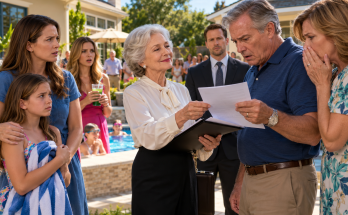
Claire remembered holding Sophie's backpack in the fake clinic while Nathan Vale prepared the nasal spray.
She remembered asking whether it was necessary.
Vale had told her Sophie's headaches might be caused by sinus inflammation.
Two sprays.
One in each nostril.
Sophie had complained about the bitter taste afterward.
Claire had bought her hot chocolate on the way home.
The memory was so ordinary that its horror took time to fully arrive.
“What did they give her?”
Maya looked toward Dr. Shah.
“I don't know the formulation. But they used something similar on me.”
Bell immediately summoned Dr. Morris by secure video.
She appeared on a laptop from a federal safe location.
When Claire described the amber bottle, Morris closed her eyes.
“That was an activation compound.”
Daniel’s chair scraped backward.
“Activation of what?”
“The vector.”
Claire stepped toward the screen.
“You told us the vector became unstable naturally.”
“It did.”
“That isn't what I'm asking.”
Morris looked exhausted.
“The regulatory system was designed to respond to specific inflammatory and hormonal signals. Samuel originally included that feature so the modified cells could become more aggressive when precancerous activity appeared.”
Dr. Shah understood first.
“They stimulated the signal artificially.”
Morris nodded.
“In some subjects.”
Claire nearly shouted.
“Sophie was not a subject.”
Morris flinched.
“No.”
“You knew they gave it to her?”
“Not until later.”
“When?”
“After Westbrook closed.”
Daniel stared at the screen.
“What was in the spray?”
Morris listed several compounds.
Most meant nothing to Claire.
One meant something to Dr. Shah.
She turned sharply toward Bell.
“That could explain the endocrine changes.”
Sophie’s early puberty had not merely been an incidental sign.
The spray may have altered the very hormonal pathways Samuel’s vector was engineered to monitor.
Dr. Shah said the mechanism remained theoretical.
Morris corrected her.
“It was intentional.”
Silence.
Claire felt something inside her settle into a colder shape than panic.
Adrian had not merely watched Sophie become sick.
He had pushed her toward it.
Bell asked whether the act could have accelerated tumor growth.
Morris said yes.
“How much?”
“No way to know.”
Claire thought of Sophie's headaches becoming worse after that appointment.
The nausea.
The light sensitivity.
The mornings when she begged for five extra minutes before school because her head hurt.
Claire had given her water.
Children's pain reliever.
A darker bedroom.
All while the adults responsible for causing it collected data.
Eric had remained near the window.
Now he turned toward the screen.
“My brother ordered this?”
Morris hesitated.
“Yes.”
Eric walked out.
Daniel started after him.
Claire stopped him.
“I'll go.”
She found Eric in the stairwell.
He was sitting two steps below the landing with his face buried in his hands.
Claire stayed standing.
“I defended him.”
Eric's voice echoed faintly.
“When?”
“When we were kids.”
Claire waited.
Eric said Adrian had always been the reckless one.
Samuel pushed them both relentlessly—grades, science competitions, athletics, everything.
Eric rebelled.
Adrian adapted.
“He became exactly what Samuel wanted.”
Then came the accident.
Adrian had stolen a car.
Another teenager was with him.
There was a crash.
Fire.
Samuel told the family Adrian had died.
Eric was sixteen.
He believed it.
“He let me mourn my brother while helping him disappear.”
Claire sat several steps above him.
“Why would Samuel do that?”
“Because Adrian had already started working on illegal research with him.”
Bell's investigators later confirmed Eric’s suspicion.
The teenager who died in the crash had been identified as Adrian because Samuel manipulated records.
Adrian received a new identity.
Years later he rebuilt his professional existence through shell companies.
NorthStar eventually became the perfect infrastructure.
Medical samples moving quietly.
Hospitals accustomed to couriers.
Research contracts nobody examined too closely.
A logistics company capable of transporting not only blood but secrets.
When Claire returned to Sophie’s room, Maya was still beside the bed.
Sophie looked at her mother.
“That spray made Kevin?”
Claire chose her answer carefully.
“It may have helped cause the changes that let Kevin grow.”
“So somebody made me sicker on purpose.”
Claire sat beside her.
“Yes.”
Sophie stared at the blanket.
“Why?”
Maya answered before Claire could.
“Because my dad wanted results.”
Sophie looked at her cousin.
“Your dad is awful.”
Maya gave a tiny nod.
“Yeah.”
“Do you still love him?”
The question silenced the room.
Maya stared toward the window.
“Sometimes.”
Sophie frowned.
“You can do that?”
“Apparently.”
“Love someone who's awful?”
“Yes.”
“That's stupid too.”
Maya almost smiled.
“Also yes.”
Dr. Shah returned to the immediate medical crisis.
Sophie's inflammatory markers were still rising.
Kidney function showed early stress.
The unstable genetic switch remained active.
Waiting was becoming dangerous.
The team had three possible paths.
Continue supportive treatment and hope activation slowed naturally.
Use aggressive immune suppression, which carried major risks during cancer treatment.
Or administer a modified version of Samuel's rescue vector based on Maya’s long-term data.
Daniel asked which one Dr. Shah preferred.
“None.”
“That wasn't the question.”
“I know.”
She believed the rescue vector offered the strongest theoretical chance of directly stopping the activation.
But no controlled human evidence existed.
Maya was one person.
One result.
One deeply complicated result.
Claire looked toward Sophie.
“What does the rescue treatment actually do?”
Morris explained through the secure call.
The vector introduced a genetic off-switch targeting the unstable regulatory system.
In Maya, it worked.
Too broadly.
It shut down not only the malfunctioning pathway but several related immune functions.
Samuel’s newer version was more precise.
At least on paper.
“Has it ever been used?”
“No.”
Daniel laughed bitterly.
“So Sophie would be the first again.”
Morris said nothing.
Sophie watched the adults.
“Can Kevin kill me?”
Dr. Shah answered.
“Yes.”
“Can this thing happening in my blood kill me?”
“Yes.”
“Can Grandpa’s rescue medicine kill me?”
A longer pause.
“Yes.”
Sophie nodded as though arranging information in columns.
“Great.”
Claire nearly broke at the dry sarcasm.
Instead she took Sophie's hand.
Dr. Shah suggested they wait six more hours while conducting rapid laboratory testing with Sophie’s cells.
They could expose cultured cells to the rescue vector and measure whether it deactivated the unstable pathway.
Not proof of safety.
But useful evidence.
Claire agreed.
Maya volunteered blood for comparison.
Sophie did too.
Daniel objected when he saw how many tubes were required.
Sophie told him, “I have more blood.”
He sat down.
The samples went to the secure laboratory.
For the next four hours everyone waited.
Maya slept in the chair.
Sophie watched cartoons without really watching.
Claire and Daniel spoke quietly in the bathroom because it was the only place where Sophie couldn't easily hear them.
“What if this kills her?” Daniel whispered.
“What if we do nothing?”
“I know.”
“We keep choosing between terrible things.”
Daniel rubbed his shaved scalp.
“I keep thinking there has to be a correct choice.”
Claire looked at him.
“Maybe there's only the best choice we can make with what we know.”
“That sounds like something people say before forgiving themselves.”
“Maybe we'll need that.”
He looked away.
Claire touched his face.
“We don't get to require certainty before helping her.”
He nodded.
When Dr. Shah finally returned, she carried results.
The rescue vector had worked in Sophie's cultured cells.
Activation dropped sharply.
Normal cell survival remained significantly better than in comparable tests using the older version given to Maya.
Daniel asked the question.
“Does that mean it's safe?”
“No.”
“Does it mean it might work?”
“Yes.”
Claire looked at Sophie.
Sophie looked back.
“I want it.”
Claire's throat tightened.
“You understand—”
“I understand enough.”
“You don't have to decide alone.”
“I know.”
Sophie reached for Maya.
“Would you do it?”
Maya thought carefully.
“If I had what you have right now, yes.”
That settled something in Sophie.
“Then I want it.”
Claire signed the emergency consent paperwork.
This time she read every line.
Every word.
Every page.
Daniel read beside her.
Sophie asked questions whenever she wanted.
At 4:16 in the morning, the rescue vector arrived under armed guard.
The vial looked insultingly small.
Clear liquid.
Ordinary glass.
Years of illegal science reduced to a few milliliters.
Before administration began, Bell entered.
“Wait.”
Dr. Shah turned.
“What?”
Bell held up his phone.
“We found Adrian.”
Claire stood.
“Where?”
“NorthStar's old research campus.”
“Is he in custody?”
“Not yet.”
Bell’s expression told her there was more.
“He contacted us.”
“Why?”
“He wants to trade.”
Eric entered behind Bell.
His face was pale.
“What does he want?”
Bell looked toward Sophie.
“The rescue vector.”
Claire stared at him.
“He already had access to Samuel's research.”
“Not this version.”
Samuel had completed the final modification privately.
The vial in Sophie's room might be the only functional dose.
Daniel moved protectively beside the IV pole.
“Then he doesn't get it.”
Bell nodded.
“That’s what I told him.”
“What does he have to trade?”
Bell hesitated.
“Dr. Morris wasn't his only leverage.”
Claire felt dread before he said the next words.
Adrian had another child from the original experiment.
Subject 07.
The one investigators had been unable to locate.
And according to Adrian, that child had developed the same activation crisis.
He would provide the child’s location only if Sophie’s rescue dose was surrendered.
Sophie stared at the tiny vial.
Then at Bell.
“Is the kid dying?”
Bell answered carefully.
“Adrian says yes.”
Sophie looked at Claire.
For the first time since the nightmare began, saving herself might mean refusing medicine to someone else.