
PART 2: THE NAME ON THE TITLE
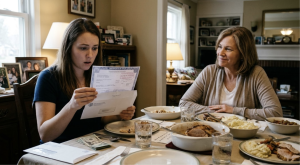
Jillian stared at the paper for so long that I began to wonder whether she had forgotten how to read.
Her fork was still resting beside the last bite of apple pie on her plate.
The dining room had gone quiet.
Mitchell sat across from her, looking from the paper to my face.
My son-in-law, David, leaned forward in his chair.
“Mama, what’s this supposed to mean?” Jillian finally asked.
I folded my hands in my lap.
“Well, honey, it means exactly what it says.”
She looked down again.
The paper had come straight from the credit union. There wasn’t anything fancy about it.
Just a vehicle identification number, the make and model of a gray SUV, and one name listed as the legal owner.
Edith Margaret Wilson.
Mine.
Jillian gave a little laugh.
Not a happy laugh.
The kind people make when they realize everyone else in the room knows something they don’t.
“Okay, Mama. I know you helped me buy the car.”
“Helped?” I repeated.
“Yes. You helped me get approved because my credit was bad.”
I nodded slowly.
“That’s what you remember?”
She shifted in her chair.
“Well, yes.”
I reached for my glass of water.
“Then I suppose we ought to clear a few things up.”
David put his napkin on the table.
“Jill, maybe you should listen.”
She shot him a look.
“David, please. This is between me and my mother.”
“No, honey,” I said. “This is about a car that’s been sitting in my name for three years.”
I could hear the clock ticking above the kitchen doorway.
It was the same clock my late husband, Walter, had hung there thirty-four years earlier.
He always said a house ought to have at least one clock loud enough to remind people when they were wasting time.
That afternoon, I understood what he meant.
“Jillian,” I said, “do you remember the day you came here after your divorce?”
Her expression changed.
“Mama, that was years ago.”
“Three years and four months.”
She looked annoyed.
“I don’t see what that has to do with anything.”
“I remember because you sat right where you’re sitting now.”
I looked at the chair beneath her.
“You were crying so hard I had to get you a wet washcloth.”
She pressed her lips together.
“You’d been turned down for another car loan,” I continued. “You said you couldn’t get to work. You were afraid you’d lose your job.”
“Mama—”
“And you asked me what you were supposed to do.”
Mitchell didn’t move.
He had been seventeen at the time.
I doubted he remembered every detail.
But I did.
I remembered Jillian’s mascara running down her cheeks.
I remembered the pile of rejection letters she’d spread across my kitchen table.
And I remembered the words she’d said when I told her I would help.
I swear I’ll never forget this, Mama.
Funny how a person can forget something while they’re still enjoying the benefit of it.
“I went to the credit union the next morning,” I said.
Jillian looked away.
“I put the down payment on that SUV. I signed the loan papers. Every month, four hundred and twelve dollars came out of my pension.”
David turned toward her.
“Wait. Your mother made all the payments?”
Jillian didn’t answer.
I did.
“Every single one.”
David frowned.
“Jill, you told me you were paying off that car.”
“I paid the insurance!” she snapped.
“Yes, you did,” I said. “And I appreciated that. Insurance isn’t cheap.”
I wasn’t trying to embarrass her.
I had raised that girl from the time she weighed seven pounds and six ounces.
I had held her through ear infections, school disappointments, and a marriage that ended with more shouting than either family deserved.
I knew her good qualities.
I also knew the look she wore when she’d been caught saying something that wasn’t quite true.
And she was wearing it now.
“How much did you pay altogether?” Mitchell asked softly.
I smiled at him.
“Enough, sweetheart.”
But David had already taken out his phone.
“Four hundred and twelve a month for three years?”
“David, stop,” Jillian said.
He looked at her.
“Jill, that’s almost fifteen thousand dollars.”
“More, with the down payment,” I said.
Jillian pushed her chair away from the table.
“Are you seriously bringing this up because I asked for gas money?”
I shook my head.
“No, honey.”
“Then why?”
“Because I wanted to understand something.”
She folded her arms.
“What?”
“How a person can accept thousands of dollars without a word and then send her own mother a bill for three hundred and forty.”
Her face turned red.
“That’s not fair.”
“Maybe not,” I said. “But I paid the bill, didn’t I?”
I pointed toward her purse.
“Twenties, just like you requested.”
She stared at me.
I had imagined this conversation several times while washing dishes that morning.
In some versions, I was angry.
In others, I cried.
But sitting there, looking at my daughter, I mostly felt tired.
Tired of pretending every favor she did for me was a burden.
Tired of apologizing for getting old.
Tired of feeling as though needing a ride to keep my eyesight was something shameful.
Then Jillian said something that surprised even me.
“Well, technically, Mama, you bought that car for me. So it’s mine.”
I tilted my head.
“Technically?”
“Yes.”
I tapped the title with one finger.
“That’s an interesting word to use while looking at paperwork with somebody else’s name on it.”
Mitchell lowered his head.
I think he was trying not to smile.
David wasn’t smiling at all.
“Jill,” he said, “you really should have told me about this.”
She ignored him.
“So what do you want, Mama? You want me to say thank you again? Fine. Thank you.”
I looked at her for a moment.
Then I picked up the title.
“You’re welcome, honey.”
I placed it back inside the brown envelope.
“But I don’t want another thank-you.”
She frowned.
“Then what do you want?”
I took a breath.
“I want you to understand that I am not charging you for being my daughter. And I don’t intend to keep paying for the privilege of being your mother.”
Nobody spoke.
I could hear my little dog, Buster, scratching at the back door.
Outside, the November wind was rattling the bare branches against the kitchen window.
I had spent twenty-six years driving school buses through Iowa winters.
I knew what it meant to be responsible for people who couldn’t get somewhere on their own.
Sometimes the roads were icy.
Sometimes children were sick.
Sometimes the bus wouldn’t start until I’d coaxed it along for twenty minutes.
But I never thought a child owed me gratitude for every mile.
You took care of people because they needed taking care of.
At least, that’s what I had always believed.
Jillian reached for her purse.
“Well, if you’re going to make a big production out of this, we should probably go.”
“Before you do,” I said, “there’s one thing we need to arrange.”
She stopped.
“What now?”
“The SUV.”
Her eyes narrowed.
“What about it?”
“I’ve decided I can’t afford to keep providing a vehicle without an agreement.”
She laughed again.
“You can’t afford it? Mama, the loan is paid off.”
“That’s right.”
“So what’s the problem?”
“The car belongs to me, Jillian. And I need to decide what happens to it next.”
Her mouth opened.
Then closed.
Mitchell looked at me.
“Grandma?”
I turned toward him.
“Yes, sweetheart?”
“Are you okay?”
It was such a simple question.
He didn’t ask what he would get.
He didn’t ask whether I’d give him money.
He just wanted to know whether I was all right.
I reached over and patted his hand.
“I’m fine.”
Jillian stood.
“You can’t seriously be thinking of taking my car.”
I looked up at her.
“Your car?”
“The car I’ve driven for three years!”
“The car I’ve paid for.”
She shook her head.
“I can’t believe this.”
“Neither could I when I got your bill.”
David rubbed his forehead.
“Jillian, sit down.”
“No!”
She grabbed her purse.
“She’s punishing me for asking her to contribute to gas.”
I could have argued.
I could have reminded her that she had never once paid for an oil change without complaining about it afterward.
I could have mentioned the tires I’d bought the previous winter because she said she couldn’t afford them.
I could have brought up the time I paid her registration renewal after she forgot the deadline.
But none of those things seemed necessary.
I had kept receipts for years.
Not because I intended to use them against my daughter.
Because Walter had taught me to keep good records.
He used to say, “Edith, paperwork remembers what people don’t.”
I had never appreciated that advice more.
“Jillian,” I said, “I’m not asking you to hand me the keys tonight.”
She stopped beside the doorway.
“Then what are you saying?”
“I’m saying we’ll need to talk about the car before you continue using it.”
She looked relieved for half a second.
Then I added, “And I want everything written down this time.”
Her expression hardened again.
“You don’t trust me?”
I considered the question.
“I trusted you to tell me if you needed gas money.”
She said nothing.
“I trusted you to remember who helped you when you had no way to get to work.”
Still nothing.
“And I trusted you to care whether your mama could get to the doctor.”
That one landed.
Her eyes moved toward the folded legal-pad bill sitting beside my plate.
She looked away quickly.
David stood.
“Edith, thank you for dinner.”
“You’re welcome, David.”
He looked embarrassed.
I didn’t blame him.
He’d married Jillian only eleven months earlier, and I suspected he was learning several things about our family that afternoon.
Mitchell got up to help clear the table.
Jillian waited by the front door.
“Come on, David.”
He picked up his coat.
Before leaving, he leaned toward me.
“I’m sorry about all this.”
I touched his sleeve.
“You didn’t make that bill, honey.”
He nodded.
Then he followed my daughter outside.
I heard the front door shut.
A moment later, the gray SUV started in the driveway.
Mitchell stood at my kitchen window watching it back out.
“Grandma, are you really going to take the car away?”
I looked at the envelope.
“Maybe.”
He turned.
“But what will Mom drive?”
“That’s something she may need to figure out.”
He hesitated.
“Are you mad at her?”
I thought about that.
“Yes,” I said finally. “I suppose I am.”
He nodded.
“But mostly,” I added, “I’m disappointed.”
Mitchell came back to the table.
He picked up the plates and carried them to the sink.
“Grandma, you know I’ll take you to every appointment, right?”
My throat tightened.
“Sweetheart, you’ve got classes.”
“I can work around them.”
“And your truck barely runs.”
He grinned.
“Well, it still runs better than it sounds.”
I laughed.
Then he said something that stayed with me.
“You shouldn’t have to pay somebody to act like they love you.”
I looked at my grandson.
Twenty years old.
Still wearing the work boots he’d bought secondhand for his lineman program.
His hands were rough from training.
His little pickup had a cracked dashboard and a heater that worked only when it felt like it.
Yet every Saturday morning, he showed up at my house before nine.
He never sighed when I needed to stop at the pharmacy.
He never complained when I spent too long comparing prices at the grocery store.
He simply waited.
Sometimes he bought me a doughnut on the way home.
I wiped my eyes with my napkin.
“Your grandpa would have been proud of you.”
Mitchell looked down.
“Thanks, Grandma.”
After he finished the dishes, he carried the trash outside.
Then he came back in and sat beside me.
“Can I ask you something?”
“Of course.”
“Why did you ask about my truck the other day?”
I smiled.
“Because I can hear it coming from three houses away.”
He laughed.
“No, really.”
“Really, sweetheart.”
He studied my face.
There was something of Walter in that boy.
The same thoughtful eyes.
The same habit of waiting quietly when he suspected somebody wasn’t telling the whole story.
“Grandma?”
“Yes?”
“You’re planning something.”
I put the brown envelope in my lap.
“Maybe I am.”
He shook his head, smiling.
“You’re getting sneaky.”
“No, honey. Just old enough to stop explaining every decision before I make it.”
That evening, after Mitchell left, I sat at the kitchen table with my magnifier and a fresh yellow legal pad.
I wrote down three things.
The first was the amount I’d paid toward the SUV.
The second was what I would need to do before allowing anyone else to take permanent ownership of it.
And the third was the name of the person I wanted to help next.
I underlined that name twice.
Mitchell.
Then I folded the paper and slipped it into the brown envelope with the title.
I wasn’t going to rush.
I wasn’t going to make an angry decision that I’d regret the next morning.
I needed to speak with the credit union, check the insurance, and make sure everything was done properly.
Walter had always believed that being right wasn’t enough.
You had to be careful, too.
Monday morning, I called the credit union.
I spoke to a woman named Marlene who had known me since before I retired from driving the school bus.
“Edith Wilson! How are those grandbabies?”
“Growing up faster than I can keep track of.”
We chatted about the weather and her husband’s knee replacement.
Then I told her I had a question about my SUV.
“I received the title last week,” I said. “I’d like to understand my options if I decide to transfer ownership.”
Marlene explained what the credit union could confirm and which paperwork I would need to handle through the county treasurer’s office.
“Are you selling it?” she asked.
“Not exactly.”
“Giving it to family?”
I looked toward the photograph of Walter on the windowsill.
“Possibly.”
She paused.
“Well, Edith, before you sign anything, make sure the insurance and registration arrangements are clear.”
“I intend to.”
After we hung up, I called the insurance agency.
Then I called the county office.
By lunchtime, I’d filled two pages with notes.
My eyes were tired, and the letters had begun to blur.
So I set everything aside and made myself a grilled cheese sandwich.
That was when my phone rang.
Jillian.
I let it ring three times before answering.
“Hello, honey.”
“Mama, we need to talk.”
“All right.”
“David says you’re going to take my car.”
I frowned.
“I never said that was decided.”
“Well, that’s what he thinks.”
“Then perhaps he misunderstood.”
She took a sharp breath.
“Mama, I have to get to work.”
“I know.”
“I can’t just buy another car.”
“I know that too.”
“So what exactly are you expecting me to do?”
I looked at the legal pad.
“First, I’d like you to tell me something.”
“What?”
“Why did you really send me that bill?”
She sighed.
“Not this again.”
“Yes, this again.”
There was silence.
Then she said, “Because I felt like you were taking advantage of me.”
I sat very still.
“Taking advantage?”
“Yes! Every month, the doctor. Sometimes the pharmacy. Sometimes you need something from Walmart.”
I thought of all the Saturdays Mitchell had taken me shopping.
Most months, Jillian drove me only to the eye clinic.
“And you think that’s too much?”
“I have a life, Mama.”
“I know you do.”
“I have work, responsibilities, a husband.”
“Yes, honey.”
“I can’t spend all my free time driving you around.”
I looked at the calendar above my toaster.
Seventeen medical trips over nearly two years.
Seventeen.
Some of those appointments had lasted less than an hour.
Two of the trips she’d counted were because she’d forgotten to pick me up.
“Jillian,” I said, “did you ever consider telling me you couldn’t drive me?”
She paused.
“What do you mean?”
“I could have asked Mitchell. Or called the clinic about transportation services. There are other arrangements.”
“Well, I didn’t think of that.”
“No,” I said quietly. “You thought of a bill.”
She didn’t answer.
Then her tone changed.
“So is this about giving the car to Mitchell?”
I gripped the phone.
“Why would you ask that?”
“Because he was acting awfully pleased with himself yesterday.”
“Mitchell washed my dishes and carried out my trash.”
“He’s always trying to make himself look like the good grandson.”
That hurt me more than the bill.
“Don’t you speak that way about your son.”
“Mama—”
“No, Jillian. Whatever disagreement you have with me, leave that boy out of it.”
She made an impatient noise.
“Fine.”
I heard her moving around.
A door closed on her end.
Then she lowered her voice.
“Look, Mama. I know you’re upset. But you bought that SUV for me. You can’t just change your mind because you’re angry.”
I looked at Walter’s picture again.
“Perhaps you’re right about one thing.”
“What?”
“I shouldn’t make decisions just because I’m angry.”
She sounded relieved.
“Exactly.”
“That’s why I’m looking into the proper arrangements.”
Her relief disappeared.
“What arrangements?”
“The ones concerning my vehicle.”
“Mama!”
“Goodbye, Jillian.”
I hung up before I could say something unkind.
For a while, I just sat there.
Then Buster came over and rested his chin on my slipper.
I bent down and rubbed his ears.
“Well, old fellow,” I told him, “I think we’ve got ourselves a problem.”
He wagged his tail.
Dogs have a wonderful way of agreeing without asking for details.
That afternoon, Mitchell came by unexpectedly.
He was carrying a small paper sack from the bakery.
“Got you cinnamon rolls, Grandma.”
I smiled.
“What’s the occasion?”
“No occasion.”
He set them on the counter.
Then he noticed the paperwork spread across my table.
“Are you doing taxes already?”
“No, sweetheart.”
He looked closer.
His expression changed when he saw the vehicle title.
“Grandma, what are you doing?”
I took off my magnifying glasses.
“Trying to make a sensible decision.”
He pulled out a chair.
“About Mom’s car?”
“About my car.”
He nodded slowly.
Then he said, “Grandma, I don’t want you and Mom fighting because of me.”
I looked at him.
“You’re not the reason we’re fighting.”
“But if you’re thinking of giving me the SUV—”
I raised my hand.
“Listen to me, Mitchell.”
He stopped.
“I haven’t promised you a car.”
“I know.”
“And I don’t intend to promise anything until I’ve settled what needs settling.”
“Okay.”
“But there’s something I do want to ask.”
He leaned forward.
“What?”
“If you had a dependable vehicle, would it help you finish school and get to your training sites?”
His face changed.
“Are you kidding? Yeah.”
He explained that his program sometimes required early travel to training locations outside town.
His old pickup had already left him stranded twice.
He’d been saving money for repairs, but every time he fixed one thing, something else started rattling.
“I’ll figure it out,” he said. “I always do.”
I smiled.
“That’s what your grandfather used to say.”
He looked down at his hands.
Then he said something I hadn’t expected.
“Grandma, even if you don’t give me the SUV, I’m still taking you to the grocery store Saturday.”
I laughed.
“I should hope so. We’re almost out of dog food.”
He grinned.
We shared a cinnamon roll.
And for the first time since Jillian handed me that yellow paper in the clinic parking lot, I felt peaceful.
Not because I had won anything.
Not because I had found a way to hurt my daughter.
But because I was beginning to see a difference between helping somebody and allowing myself to be taken for granted.
Two days later, another envelope arrived.
This one wasn’t from the credit union.
It was from Jillian.
My name was written across the front in her familiar looping handwriting.
Inside was a single sheet of paper.
No greeting.
No apology.
Just a typed statement.
I, Edith Margaret Wilson, acknowledge that the gray SUV was purchased as a gift for my daughter, Jillian, and agree to transfer ownership to her without further conditions.
At the bottom was a line for my signature.
I read it twice.
Then I sat back in my chair.
My daughter hadn’t called to ask how my eyes were doing.
She hadn’t asked whether I needed groceries.
She hadn’t offered to return the $340.
Instead, she’d sent me a paper asking me to give away a vehicle I’d spent three years paying for.
I placed the document beside her original bill.
The two papers looked almost alike in the afternoon light.
One asked for money.
The other asked for a car.
And neither one asked how I was feeling.
I picked up the telephone.
Not to call Jillian.
Not to call Mitchell.
I called Marlene at the credit union.
“Marlene,” I said, “I think I’d better come in and speak with you in person.”
“Of course, Edith. Is something wrong?”
I looked at the unsigned paper.
“Not yet,” I said. “But I want to make sure I don’t sign away something I haven’t decided to give.”
Then I reached for my calendar.
Because my daughter had made one thing very clear.
She wasn’t finished asking.
And neither was I finished deciding.
END PART 2
