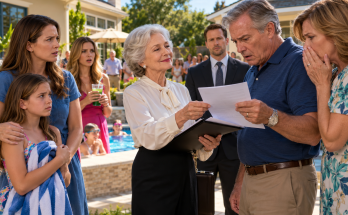
The courtroom was smaller than Sophie expected.
“That’s it?”
Claire looked toward the polished benches.
“What were you expecting?”
“TV court.”
Daniel whispered, “Less dramatic budget.”
Claire elbowed him.
Sophie wore a dark blue dress she had chosen herself and purple sneakers because the formal shoes Claire suggested were “cruel.”
Her hair had begun growing back in soft uneven patches.
She refused a cap.
Maya sat two rows behind them.
Lucas was not medically ready to travel but watched through a protected video connection.
Caleb chose not to attend.
Emily came with Margaret only after making clear she did not want reporters approaching her.
Rebecca sat beside Arthur.
Arthur’s legal situation remained unresolved.
He attended under permission and supervision.
Eric sat on Sophie’s other side.
Not because court recognized him differently from Daniel.
Because Sophie asked.
Adrian entered wearing a dark suit.
No handcuffs visible.
Sophie stared.
For months he had existed through screens.
Now he looked ordinary.
That annoyed her.
Maya refused to look at him.
The hearing concerned a set of criminal counts Adrian had agreed to plead guilty to as part of a broader federal case.
Unauthorized experimentation.
Medical fraud.
Conspiracy.
Assault-related charges tied to deliberate disease activation.
Data theft.
Obstruction.
The rest of the litigation would continue.
Claire did not care about the procedural vocabulary.
She cared that Sophie could speak if she wanted.
When her name was called, Claire stood automatically.
Sophie touched her hand.
“I can walk.”
Claire sat.
Sophie crossed the courtroom slowly.
Adrian watched her.
She stood at the lectern.
The judge reminded her she could stop at any time.
Sophie nodded.
She unfolded one page.
Then did not read it.
“I wrote something.”
A few people smiled gently.
“I don't like it anymore.”
The judge said that was fine.
Sophie looked toward Adrian.
“You made me sick on purpose.”
Adrian lowered his eyes.
“You watched when my headaches got worse.”
No answer.
“You knew about Kevin before my mom did.”
Still nothing.
“You made Maya think her brother was dead.”
Maya looked down.
“You kept Lucas sick because you wanted to see what Cascade did.”
Adrian closed his eyes.
“You used Caleb first.”
Sophie’s voice shook slightly.
Claire gripped Daniel’s hand.
“You said it was for medicine.”
Adrian finally looked at her.
Sophie continued.
“Maybe some of the science could help people someday.”
The prosecutors shifted.
Claire held still.
“That doesn't mean you were right.”
Adrian’s face changed.
“Because if medicine needs somebody not to get a choice, maybe you have to make better medicine.”
Silence.
Sophie looked at the judge.
“I don't know what sentence he should get.”
Claire felt proud of that sentence more than any demand for punishment.
“I’m ten.”
A faint ripple of laughter moved through the courtroom.
Sophie did not smile.
“I want adults who know the law to decide.”
She looked at Adrian again.
“But I don't want him to say what happened to me was worth it.”
Adrian’s eyes filled.
“It wasn't his thing to decide.”
Sophie folded the page.
Then added one last sentence.
“And I don't want this to be the most important thing that ever happens to me.”
Claire began crying.
Sophie walked back.
Daniel hugged her carefully.
Eric kissed the top of her head.
Maya reached forward and squeezed her shoulder.
Adrian did not speak to Sophie.
Good.
His attorney later read a statement.
He accepted responsibility for several acts but still described the research as medically consequential.
Maya almost stood.
Claire grabbed her hand.
“Don't.”
Maya whispered, “He still doesn't get it.”
Maybe not.
The court did not require understanding before accountability.
That mattered too.
The judge imposed a substantial sentence on the counts before the court, with additional proceedings still pending.
Sophie did not ask how many years until they were outside.
Then she did.
Claire told her.
Sophie calculated.
“I’ll be old.”
Daniel looked offended.
“You'll be younger than me.”
“Exactly.”
He pretended injury.
The joke broke something open.
They laughed on courthouse steps where reporters waited behind barriers.
Sophie did not speak to them.
Her victim-impact statement belonged to the court.
Not television.
Maya gave a short statement through her attorney.
Lucas declined.
Caleb declined.
Emily declined.
All valid choices.
Samuel’s hearing happened two weeks later.
Sophie chose not to attend.
Instead she watched a portion from home because Samuel had asked permission to address her indirectly.
Claire said she could switch it off at any point.
Samuel stood in court looking older than he had during detention calls.
His statement began without science.
That surprised Claire.
“I treated fear as evidence of urgency.”
He paused.
“I treated urgency as permission.”
Sophie looked toward Claire.
“That's good.”
Claire nodded.
Samuel continued.
He described watching family members die of cancer.
His brother.
His father.
His sister.
Patients.
Children.
He believed medicine failed whenever disease could return.
So he chased permanence.
He removed biological safeguards because they made treatments weaker.
Ignored regulators because they slowed him.
Used family access because it was available.
Treated consent as an obstacle when frightened people said no.
Then he looked toward the camera allowed by the court.
“I told myself I was preventing suffering.”
Sophie sat very still.
“I caused it.”
No qualification.
No but.
Claire felt something loosen.
Samuel named Aaron.
Maya.
Christopher.
Sophie.
Lucas.
Others.
He named Miriam too.
Not as a collaborator.
As someone whose work he took after she withdrew permission.
Rebecca cried quietly.
Samuel continued.
“I cannot return what I took.”
He did not ask forgiveness.
Claire noticed.
“I can provide evidence, relinquish intellectual-property claims derived from unauthorized research, and accept judgment.”
His lawyers looked unhappy.
Good.
Samuel had agreed to assign his interests in several disputed patents and datasets into court-supervised processes designed to prevent exclusive commercial use of illegally obtained subject material.
The legal details were complicated.
Sophie asked one question.
“Does that mean he doesn't own my cells?”
Claire answered.
“He never did.”
“I know. But papers?”
“The papers are being fixed.”
Sophie nodded.
“Good.”
Samuel received a long prison sentence.
Not as long as Adrian’s combined exposure might become.
Not symbolic.
Real.
Sophie turned off the broadcast before sentencing commentary began.
“I heard enough.”
Claire closed the laptop.
Samuel later sent one letter.
Not through secret channels.
Through his attorney.
Approved.
Addressed to Sophie.
She opened it.
One page.
No scientific advice.
No requests.
He wrote that prison physicians had suggested he teach basic science classes through an education program someday.
He had declined for now.
He needed to learn how to teach without believing knowledge gave him authority over other people.
Sophie read that line twice.
“He's dramatic.”
Daniel nodded.
“Family trait.”
She kept the letter.
Not pinned beside Miriam’s.
In a drawer.
Her choice.
The prosecutions continued.
Evelyn Cross pleaded guilty to several charges.
Ward faced regulatory and criminal consequences tied to unauthorized registries and disclosure of genetic information.
Lydia’s case reflected her later cooperation and the fact that she surrendered before human use of her vector.
Amelia’s liability was narrower, though her shell structures and unauthorized possession of biological materials created consequences.
Nathan and Margaret’s cases were complicated by the life-saving effect of the infant exchange and the lack of consent.
Nothing about beneficial outcome erased the act.
Nothing about the act required denying the outcome.
Courts could hold both.
Claire liked that.
Arthur’s position was hardest personally.
He had not directly performed the genetic experiments.
He did facilitate hidden transfers.
Ordered the reciprocal infant cell exchange.
Faked his death.
Obstructed investigations while gathering evidence.
Conducted surveillance.
Withheld warnings.
Then later helped expose everything.
Prosecutors offered an agreement.
Reduced charges in return for full cooperation, forfeiture of unlawfully held research materials, and formal acknowledgment of his role.
Arthur asked Claire what she thought.
She stared at him.
“You're asking me?”
“Yes.”
“Why?”
“I don't trust myself to decide what other people should think anymore.”
Claire almost smiled.
“That's progress.”
Then she answered.
“I don't know what sentence you deserve.”
Arthur nodded.
“But?”
“You need to stop treating consequences like something that would interfere with your useful work.”
He absorbed that.
“You don't get to say you need freedom because you can still help.”
Arthur looked down.
“That was exactly what I was thinking.”
“I know.”
He signed the agreement.
He would serve time.
Less than Samuel.
Far less than Adrian likely would.
Enough that it hurt.
Enough that Claire did not have to pretend evidence gathering erased harm.
Before reporting to custody, Arthur visited Sophie.
He asked permission first.
She allowed it.
They sat on the porch.
Claire watched from the kitchen but did not listen initially.
Later Sophie told her part of the conversation.
Arthur apologized again.
Sophie told him repeating sorry did not make it more sorry.
He laughed.
Then he asked whether she wanted him to write.
She said yes.
“But normal letters.”
“What is normal?”
“Tell me what food is bad. Tell me if you read anything good. Don't tell me secret research.”
Arthur agreed.
On his final evening outside, Claire sat beside him.
“You missed almost my entire adult life.”
“I know.”
“You didn't have to.”
“I know.”
“I am not going to make your prison sentence into another abandonment you chose for noble reasons.”
Arthur looked at her.
“What do you mean?”
“You are going because of things you did.”
“Yes.”
“Not because you're protecting me.”
He nodded slowly.
“Yes.”
“Good.”
Precision again.
He reached for her hand.
Claire let him hold it.
Not forgiveness.
Relationship.
Different.
At home, Sophie's medical life gradually became less dramatic.
Scans every few months rather than every few days.
Blood tests spaced farther apart.
School attendance increased.
Soccer remained off-limits for competition but she began attending practices.
Coach let her sit on the bench and criticize everyone.
She considered that almost as good.
Kevin's residual mass became barely measurable.
Dr. Shah eventually used the word Sophie had demanded for months.
“Remission.”
Sophie stared.
“Official?”
“Yes.”
“Like actual remission?”
“Yes.”
“Write it down.”
Dr. Shah printed the report.
Sophie carried it home.
Daniel bought a cake.
The bakery wrote KEVIN LOST.
Claire objected.
Sophie loved it.
They invited Maya, Lucas, Emily, Rebecca, Eric, and a few school friends.
Caleb joined by video.
Thomas was too sick from treatment to travel but sent a message.
No reporters.
No doctors except Dr. Shah, who arrived in normal clothes and refused to discuss lab values.
For one evening, medicine stayed outside.
Claire watched Sophie laugh with Noah Patterson.
Apparently he had become marginally less annoying.
Progress everywhere.
Then, after most guests left, Rebecca joined Claire on the porch.
“I got an offer.”
Claire looked at her.
“What kind?”
A university wanted Rebecca to lead a new research center focused on reversible gene and cell therapies.
Independent ethics governance.
Patient representatives with voting authority.
No private access to NorthStar data unless subjects consented individually.
Claire stared.
“You want it.”
“Yes.”
“You're scared.”
“Yes.”
“Good.”
Rebecca laughed.
Claire continued.
“Fear doesn't decide. But maybe it makes you check yourself.”
Rebecca looked toward Sophie through the window.
“Would you let her participate someday?”
Claire answered immediately.
“Ask her someday.”
Rebecca smiled.
“Right.”
Months later, Sophie herself asked about the research.
Not because anyone recruited her.
Because biology class covered genes badly.
She came home irritated.
“My textbook says mutations are mistakes.”
Claire looked up.
“Some are.”
“It makes it sound like normal is one thing.”
Rebecca, visiting, nearly choked on tea.
Sophie pointed.
“See?”
Eventually she asked to tour Rebecca’s legitimate research center once it opened.
Claire said yes.
No samples.
No enrollment.
Just a tour.
Sophie saw labs through glass.
Researchers labeled everything.
Consent documentation stored openly.
A patient advisory room was larger than Rebecca’s office.
Sophie approved that.
Then she asked a scientist what happened if participants changed their minds.
The scientist showed her the withdrawal process.
Sophie smiled.
“Good.”
Claire realized that was what recovery looked like for them.
Not avoiding science.
Not worshiping it.
Making it answerable.
On the drive home Sophie asked whether she might become a doctor.
Claire kept her face neutral.
“Maybe.”
“Or lawyer.”
“Also maybe.”
“Or soccer player.”
“Potentially.”
“Can I be all three?”
Daniel, driving, said, “Terrifying.”
Sophie smiled.
Claire looked out the window.
The story was not over.
But the experiment was no longer writing it.