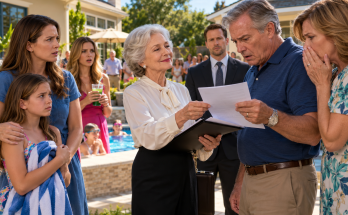
Margaret Vale’s house stood in a quiet residential neighborhood Claire had driven through hundreds of times.
Four miles.
Eleven years of ordinary distance.
Claire could have passed Margaret at a grocery store.
A traffic light.
A pharmacy.
She might have stood behind her in line without knowing this woman once carried Sophie away from her hospital crib.
Federal agents reached the house before Claire did.
Margaret was gone.
Bell called from the property.
“No signs of forced entry.”
“When did she leave?”
“Neighbor saw her yesterday afternoon.”
“With luggage?”
“One suitcase.”
“She knew.”
“Probably.”
Nathan Vale was already in custody for his role in the fake Westbrook clinic.
Until now he had denied knowing anything about Sophie’s newborn intervention.
Bell re-interviewed him.
Vale asked for an attorney.
That was all.
Claire wanted to drive to the house.
Daniel said no.
Not because she lacked the right.
Because Sophie had undergone neurosurgery less than twenty-four hours earlier.
Claire knew he was right.
She hated him for thirty seconds.
Then apologized.
He accepted.
Bell sent photographs instead.
Margaret’s home looked painfully normal.
Family photographs.
Houseplants.
Books.
A blue ceramic bowl filled with keys.
Then agents entered a locked storage room.
Inside were boxes.
Medical files.
Old photographs.
Children's drawings.
Birthday cards.
Sophie stared at the screen.
“Those aren't mine.”
“No.”
Most belonged to other children.
The seven original subjects.
Margaret had followed them for years.
Not officially.
Personally.
There were school photographs of Maya.
An image of Aaron at a baseball game.
Lucas as a toddler.
Sophie leaving kindergarten with Claire.
Daniel saw that photograph and went still.
“I was there.”
He appeared in the background holding Sophie's backpack.
Someone had watched them.
Claire reached for his hand.
Agents opened another box.
Hospital photographs.
The night Sophie received Samuel’s vector.
Cross.
Samuel.
Rebecca.
Margaret.
Then the unexplained twenty-seven-minute gap.
One image showed Margaret carrying infant Sophie down a corridor.
Another showed her entering a neonatal research room.
Then a third photograph.
Claire stared.
Two bassinets.
Sophie lay in one.
Another infant lay beside her.
Both had monitoring leads.
Both wore hospital identification bands.
Rebecca leaned toward the screen.
“Who is that?”
Samuel said nothing.
Cross claimed through investigators she had never seen the second infant.
Bell checked the photograph metadata.
Same night.
Same research room.
Claire zoomed in.
The second baby’s identification band was partly visible.
Initials.
E.V.
Daniel looked at Bell.
“Who?”
Investigators searched birth records from the hospital.
No infant with matching initials officially occupied that room.
Then Rebecca whispered, “Eleanor.”
Claire turned.
“Who?”
“Margaret had a daughter.”
Bell looked at her.
“When?”
“Years before.”
“No. Nathan and Margaret had no children in public records.”
Rebecca frowned.
“I remember Samuel mentioning a pregnancy.”
Samuel looked away.
Eric spoke from the doorway.
“I remember too.”
Everyone turned.
He had joined them after another medical check.
“When I was seventeen. Nathan called the house. Margaret had a baby.”
Samuel’s face tightened.
Eric stared at him.
“You told Mom the child was sick.”
Samuel remained silent.
“How old would she be now?” Daniel asked.
Eric calculated.
“About nineteen.”
“But the baby in the photograph is newborn the same night Sophie was six weeks old,” Claire said.
Rebecca examined the metadata.
“Then that can't be the same child.”
Unless E.V. meant someone else.
Bell’s analysts searched NorthStar records.
One hidden identifier appeared.
E.V.
No full name.
Not part of the seven-subject cohort.
Designation:
REFERENCE INFANT.
Claire felt sick.
“What does that mean?”
Samuel finally spoke.
“A control.”
Daniel turned toward the monitor.
“You said you didn't know another baby was there.”
“I didn't.”
“But you know the term.”
“It was standard experimental language.”
Sophie frowned.
“Babies aren't controls.”
“No,” Samuel said quietly.
The photo sequence continued.
Margaret placed Sophie beside the second infant.
A technician appeared.
Face obscured.
Blood was drawn from both.
Then something stranger.
A small transfusion line connected equipment between the bassinets.
Dr. Shah leaned closer.
“What is that?”
Rebecca’s face drained of color.
“Cell transfer.”
Claire stood.
“What?”
“If the photograph shows what I think—”
“Say it.”
Rebecca swallowed.
“Someone may have transferred cells from the other infant into Sophie.”
Samuel stood abruptly on the detention feed.
“No.”
Claire stared at him.
“You didn't know.”
“No.”
“Could it happen?”
“Yes.”
Daniel paced once.
“Why would anyone do that?”
Rebecca searched the recovered files.
Maybe to compare engraftment.
Maybe to provide normal immune cells after Samuel’s vector.
Maybe to create a biological reference inside Sophie.
Then Dr. Shah remembered something.
Sophie's genetic testing occasionally showed tiny populations of cells that did not perfectly match her genome.
Claire stared.
“You saw that?”
“We assumed technical contamination or maternal microchimerism.”
Rebecca shook her head.
“Not maternal.”
Claire turned.
“How do you know?”
“Because Claire’s DNA was marked negative on Cross’s list.”
They tested.
Stored samples were reanalyzed.
The mismatched cell population remained tiny.
But real.
Someone else's cells had lived inside Sophie for ten years.
Sophie looked disgusted.
“Everybody is in me.”
Daniel almost smiled.
“Not everybody.”
“Too many people.”
Bell’s agents searched Margaret’s house for the identity of the second infant.
A locked metal box contained the answer.
Birth records.
Not official copies.
Private documentation.
The child’s name:
Emily Vale.
Parents:
Nathan and Margaret Vale.
Date of birth matched the night of Sophie's hospitalization.
Claire stared.
“But you said they had no children.”
“They erased her from public records,” Bell said.
“Why?”
Nobody knew.
The private file documented a severe congenital immune disorder.
Emily’s prognosis was poor.
She was expected to die in infancy.
Rebecca looked at Samuel.
“Did Nathan ask you for treatment?”
Samuel's face changed.
“Yes.”
“When?”
“Before Sophie was born.”
“And?”
“I refused.”
Claire almost laughed.
“You refused unethical treatment?”
Samuel flinched.
“Emily's condition was not related to my work. I told Nathan I couldn't help.”
Nathan Vale had spent years assisting Samuel.
He watched experimental interventions performed on children for inherited cancer risk.
Then his own daughter was born dying of an unrelated immune disorder.
Samuel refused to use the platform on her.
Rebecca whispered, “Nathan did it himself.”
Samuel stared at the photograph.
Margaret had carried Sophie into the research room.
Nathan or another technician transferred cells.
But in which direction?
Dr. Shah ordered testing focused on the microchimeric population.
If Emily’s cells survived inside Sophie, then likely Emily’s cells entered Sophie.
But there might have been transfer both ways.
Claire felt the implication.
“If Sophie’s modified cells went into Emily—”
Rebecca finished.
“Then Emily may have received part of Samuel’s vector.”
Sophie stared.
“Is she alive?”
Bell searched.
Officially, Emily Vale did not exist.
No school records.
No tax identity.
No medical records under that name.
Then agents found recent photographs in Margaret’s house.
A young woman.
Dark hair.
Pale skin.
Approximately nineteen.
Standing beside Margaret on a beach.
Another at a kitchen table.
Another wearing a graduation gown with no visible school name.
On the back of one photograph:
OUR MIRACLE.
Sophie looked at it.
“She lived.”
Yes.
Somehow, a baby expected to die had survived.
Rebecca stared at the image.
“If modified immune cells from Sophie engrafted in Emily, they could have corrected part of her immune disorder.”
Dr. Shah cautioned that this was speculation.
Samuel looked shaken.
“But possible.”
Claire stared.
Nathan and Margaret might have stolen Sophie's genetically modified cells to save their infant daughter.
Daniel asked the question nobody wanted.
“What did they put back into Sophie?”
Testing answered.
Emily’s cells carried an immune-regulatory variant absent from Sophie’s natural genome.
Rebecca reviewed the sequence.
Her expression changed.
“This may be why Sophie survived the rescue treatment better than Maya.”
Everyone looked at her.
Maya's rescue had caused catastrophic immune complications.
Sophie's had caused severe but shorter inflammation.
Emily's tiny cell population might have moderated the response.
Claire felt the moral ground shifting again.
A criminal act.
An unauthorized infant cell exchange.
Something that might also have helped Sophie survive ten years later.
Sophie frowned.
“So they stole my cells and gave me hers.”
“Possibly,” Dr. Shah said.
“And it helped both of us?”
“Possibly.”
Sophie thought.
“Still should've asked.”
Claire smiled sadly.
“Yes.”
Bell had one more discovery.
Margaret had not fled randomly.
Her car was found at a rural bus station.
A camera showed her boarding with the young woman from the photographs.
Emily.
They traveled under false names.
Destination known.
A small town in Vermont.
Maya, listening from her room, suddenly spoke.
“I know that town.”
Claire looked at her.
“Why?”
“Dad had a property there.”
The same region where Maya once met Lucas.
Bell checked.
A NorthStar-owned house stood twelve miles from the bus stop.
Agents moved.
Two hours later they entered.
Margaret was there.
So was Emily.
Neither resisted.
Emily appeared healthy.
Frightened.
Confused by the armed agents.
She had been told her entire life that her medical history had to remain secret because people might take her away.
Margaret asked one question after arrest.
“Is Sophie alive?”
Bell said yes.
Margaret cried.
Not relief for herself.
For Sophie.
Claire watched remotely.
Then requested to speak with her.
Bell resisted.
Claire insisted.
Margaret appeared on secure video.
Older than in the hospital photographs.
Her face collapsed when she saw Claire.
“Mrs. Morgan.”
“Why?”
Margaret closed her eyes.
“My daughter was dying.”
“That explains fear. Not what you did.”
“No.”
“You took my baby.”
“Yes.”
“You put someone else's cells inside her.”
“Yes.”
“You took hers.”
“Yes.”
“Without asking.”
“Yes.”
Margaret began crying.
“Nathan said Samuel's vector had corrected Sophie's immune surveillance. He believed those cells could help Emily.”
“Did they?”
“Yes.”
“How do you know?”
“Her immune counts improved within weeks.”
“And Sophie?”
“We gave her Emily's cells because Nathan was afraid the transfer would destabilize her immune system. He thought reciprocal cells might create tolerance.”
Claire stared.
A desperate experiment layered on top of another desperate experiment.
“Did Samuel know?”
“No.”
“Rebecca?”
“No.”
“Cross?”
Margaret hesitated.
That hesitation mattered.
“Yes.”
Claire felt cold.
Evelyn Cross had known.
Cross had not merely helped Samuel administer the first vector.
She had approved Nathan and Margaret's secret cell exchange afterward.
Why?
Margaret wiped her face.
“Because she wanted to see what happened.”
There it was again.
Curiosity treated as permission.
Sophie asked to speak.
Claire hesitated.
Then allowed it.
Margaret saw Sophie.
Her expression broke completely.
“Oh, Sophie.”
Sophie looked at her.
“Did you watch me grow up?”
Margaret nodded.
“Why?”
“To make sure you were okay.”
“You could've told us.”
“I was afraid.”
“Everybody says that.”
Margaret lowered her eyes.
Sophie continued.
“Is Emily okay?”
“Yes.”
“Good.”
Margaret looked surprised.
Sophie shrugged weakly.
“I’m still mad.”
“You should be.”
“But I don't want her sick.”
Margaret cried harder.
Sophie looked toward Claire.
“Can I meet her?”
Claire was not prepared for that.
Neither was Daniel.
Dr. Shah intervened.
“Not yet.”
Sophie sighed.
“Doctors ruin everything.”
But the question remained.
Emily Vale was alive because of cells taken illegally from Sophie.
And Sophie might have survived her rescue treatment partly because of cells taken illegally from Emily.
Two infants had been connected without consent.
Ten years later, their bodies still carried traces of each other.
Rebecca reviewed the newest genetic data.
Then she went very still.
Claire noticed.
“What now?”
Rebecca enlarged one sequence found in Emily’s cells.
“This isn't from Sophie.”
“Then whose?”
Rebecca looked toward Samuel.
His face changed when he saw it.
Another engineered construct.
Older than Sophie's vector.
Older than Cascade.
A design signature Samuel recognized immediately.
Claire stared at him.
“You made it?”
Samuel whispered, “No.”
“Who did?”
Samuel looked toward Rebecca.
Rebecca already knew.
Their mother.
Claire and Rebecca's mother.
The woman both sisters believed had died of cancer years before Rebecca disappeared.
Rebecca sank into a chair.
“That’s impossible.”
Samuel shook his head.
“No.”
“What are you saying?”
Samuel looked at Claire.
“The cancer research didn't begin with me.”
He pointed at the sequence inside Emily Vale.
“It began with your mother.”