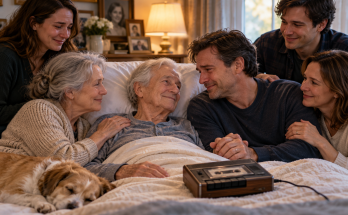
On Sophie's third morning home, Claire woke to the sound of cupboard doors opening downstairs.
For one terrified second, hospital instincts took over.
She sat upright, listening for monitors that were no longer there.
Then she heard Sophie's voice.
“Dad, we have no cereal.”
Daniel answered from the kitchen.
“We have four cereals.”
“Those are hospital-parent cereals.”
Claire lay back down.
She had no idea what hospital-parent cereal meant.
She was grateful enough to laugh.
Home required relearning.
Sophie tired after climbing the stairs.
Food tasted wrong.
Cold drinks bothered her teeth.
Sometimes she stopped midsentence because a headache made her nervous, even when it disappeared seconds later.
Nobody said Kevin every time.
That was progress.
Daniel returned to work part-time from home.
Eric visited without trying to occupy every available hour.
The three adults had accidentally developed a system.
Daniel handled mornings.
Claire managed medical schedules.
Eric took over school assignments because, to Daniel's irritation, he was better at explaining fractions.
Sophie remained convinced all three were incompetent.
Maya texted daily.
Lucas sent photographs of constellations he could see from his rehabilitation room.
Emily's nerve symptoms continued improving under Miriam's temporary protocol.
Caleb sent Maya voice messages instead of letters now.
She answered every one.
Arthur remained under federal supervision while prosecutors sorted through his decades of concealment, evidence gathering, obstruction, unauthorized surveillance, and eventual cooperation.
He accepted the uncertainty.
Claire did not mistake acceptance for redemption.
Thomas began the pancreatic-cancer trial.
His first treatment made him profoundly sick.
He called Sophie afterward.
“This is your fault.”
Sophie stared at the phone.
“What?”
“You told me to come out dying.”
“Oh.”
“So now I have to actually do treatment.”
She considered that.
“Good.”
Thomas laughed until it hurt.
Samuel remained in custody.
He asked for regular updates about Sophie.
Claire refused to create a special channel.
If medical information needed his expertise, Dr. Shah contacted him through approved consultation.
Otherwise, no.
Sophie approved.
“He's Grandpa, not my doctor.”
The distinction mattered.
The first outpatient oncology visit happened four days after discharge.
Sophie wore her purple sweatshirt and complained throughout the car ride that appointments should not begin before ten in the morning.
Claire said cancer had not consulted her preferred schedule.
Sophie said that was another reason cancer was rude.
Dr. Shah greeted them without a white coat because Sophie had once told her white coats made every conversation sound worse.
Blood draw first.
Then neurological examination.
Eye movements improving.
Balance good.
Reflexes normal.
Incision healing.
Tumor markers continued falling.
Dr. Shah smiled.
Sophie narrowed her eyes.
“Real good?”
“Real good.”
Claire felt her shoulders loosen.
Then the immune-vector assay returned.
Dr. Shah stopped smiling.
Claire saw it immediately.
“What?”
“Probably nothing urgent.”
“That's not a useful sentence.”
Dr. Shah nodded.
“You're right.”
The laboratory had detected engineered sequence fragments.
Sophie groaned.
“Grandpa's?”
“At least partly.”
Claire sat straighter.
“I thought the renewal cells were gone.”
“Active renewal remains undetectable.”
“Then what are these?”
“We need to characterize them.”
Sophie looked toward Claire.
“Can I still go home after?”
“Yes,” Dr. Shah said.
“Promise?”
“Yes.”
That helped.
Samples were sent for deeper sequencing.
Claire refused to spend the day waiting inside the hospital.
They walked to the small garden courtyard.
Sophie fed part of a muffin to a sparrow despite signs clearly prohibiting feeding birds.
Daniel claimed criminal behavior ran in the family.
Claire told him not to encourage her.
Sophie said Grandma Miriam would have respected scientific observation of sparrow nutrition.
Daniel surrendered.
Three hours later, Dr. Shah called them back.
Rebecca joined remotely.
So did an outside gene-therapy specialist.
Claire hated group calls.
They rarely brought simple information.
Dr. Shah showed them the sequence map.
Most fragments belonged to inactive remnants of Samuel's original vector.
Expected.
A smaller set matched the rescue construct.
Also expected.
Then another cluster appeared.
Not expected.
Rebecca stared.
“I don't know that sequence.”
Neither did Samuel when consulted.
Amelia did not recognize it.
Lydia did not.
Arthur certainly didn't.
Claire looked at Sophie.
“Another thing?”
Sophie sighed.
“Of course.”
The unknown sequence appeared only in a very small population of immune cells.
Dr. Shah emphasized that it was not actively expanding.
No signs of malignancy.
No inflammation.
No renewal.
Still, nobody knew where it came from.
Claire remembered Emily's microchimeric cells.
“Could it be from Emily?”
Testing said no.
The cells carrying the sequence were genetically Sophie's.
Not donor cells.
Rebecca leaned closer.
“That means something modified her own cells.”
Dr. Shah nodded.
“When?”
“We don't know.”
Claire's chest tightened.
Every old intervention returned in memory.
Six weeks old.
Age three.
Age six.
Westbrook.
The nasal spray.
The rescue vector.
The antibody treatment.
The tumor-bait procedure.
The unknown sequence could have entered anywhere.
Sophie looked annoyed rather than frightened.
“Can you ask it?”
Daniel blinked.
“Ask what?”
“The cells.”
Rebecca almost smiled.
“We are.”
More sequencing followed.
The unknown construct contained no obvious self-renewal machinery.
No adaptive Cascade system.
No active oncogene.
It looked incomplete.
Like part of a larger genetic design.
One section encoded a regulatory tag.
Rebecca froze.
“I've seen that.”
“Where?” Claire asked.
Rebecca searched Miriam's archive remotely.
Not Miriam.
Nathan's records.
The tag appeared in notes from the reciprocal infant cell exchange.
Margaret joined by approved video.
Her face changed when Rebecca showed it.
“Nathan's tolerance marker.”
Claire's stomach tightened.
“What tolerance marker?”
Margaret explained that before exchanging cells between Sophie and Emily, Nathan had developed a method to label Sophie's modified immune cells so he could track whether Emily accepted them.
A temporary genetic barcode.
“He put another vector in Sophie?”
“Not intentionally.”
Claire's voice sharpened.
“Explain carefully.”
Nathan treated some of Sophie's cells outside her body before transferring them to Emily.
The label should never have gone back into Sophie.
Margaret remembered one problem during the exchange.
The tubing was reversed briefly.
Less than a milliliter of processed material may have returned to Sophie.
Claire closed her eyes.
Nobody documented it.
Of course not.
Dr. Shah looked at the sequence.
“That could explain the tag, not the rest.”
Rebecca agreed.
The barcode had become linked to another regulatory sequence.
Something happened after the accidental return.
Sophie frowned.
“So Nathan's thing changed inside me too.”
“Possibly.”
Samuel studied the data from custody.
Then asked one question.
“Does the construct contain a promoter associated with fetal immune tolerance?”
Rebecca checked.
Yes.
Samuel went silent.
Claire stared at his face.
“You know.”
“I know the mechanism.”
“Not the source?”
“No.”
Samuel explained that neonatal immune systems sometimes preserved foreign cells through tolerance pathways far more effectively than adult immune systems.
Nathan's accidental return of altered cells might have become integrated into a tiny population during infancy.
Over time, those cells could have evolved regulatory behavior under pressure from Samuel's vector.
Dr. Shah frowned.
“Evolved naturally?”
“Selected naturally.”
Not engineered by a person.
Not entirely.
A biological consequence.
Sophie looked interested.
“So my body made it?”
“In a sense,” Rebecca said.
“What does it do?”
That took another day to answer.
The cells seemed to suppress excessive immune activation around engineered sequences.
A naturalized tolerance circuit.
Tiny.
Stable.
Not spreading.
Claire stared at the report.
“Is that why Sophie tolerated the rescue vector better than Maya?”
Rebecca nodded slowly.
“Emily's donor cells may have helped. This may have helped too.”
Maya joined the call when Sophie asked her.
“So she got lucky.”
Dr. Shah chose her words.
“Biologically, several factors may have reduced the severity of her reaction.”
Sophie translated.
“Lucky.”
Maya rolled her eyes.
“Fine.”
Claire did not like calling stolen experiments luck.
But something had emerged from the chaos that no scientist designed.
Sophie's body had spent ten years adapting to what people forced into it.
Not perfectly.
Not safely.
But actively.
She had never been a passive container.
That mattered.
Then Dr. Shah explained the problem.
The tolerance circuit might also protect abnormal cells.
Including residual tumor cells.
Claire felt the floor fall again.
“You just said it was helping.”
“Both can be true.”
Sophie groaned.
“Complicated.”
Yes.
If the circuit suppressed immune attacks too strongly around Kevin's remaining microscopic disease, it might make recurrence harder to detect or treat.
They needed to know where those cells were located.
Blood.
Bone marrow.
Possibly near the residual brain tissue.
A new PET scan and specialized immune imaging were scheduled.
Sophie stared at the calendar.
“I thought home meant less hospital.”
“It does.”
“This feels like same hospital.”
Claire put an arm around her.
“Home means we leave afterward.”
Sophie considered that.
“Okay.”
Imaging happened two days later.
No unexpected tumor activity.
No new lesions.
Kevin's tiny remnant continued shrinking.
But specialized imaging showed increased tolerance-circuit cells clustered near the surgical bed.
Dr. Chen looked uncomfortable.
“They're there.”
Claire stared.
“Protecting Kevin?”
“Maybe protecting injured tissue.”
“Same location.”
“Yes.”
Sophie pointed toward the image.
“Can you tell them Kevin is bad?”
Rebecca laughed despite herself.
The solution was not obvious.
Destroying the tolerance cells could reignite the broader immune instability.
Leaving them might theoretically shelter tumor remnants.
Dr. Shah chose monitoring.
No emergency intervention.
Claire almost asked, And if—
She stopped.
Monitoring was allowed.
Waiting was allowed.
Sophie noticed.
“You didn't panic.”
“I considered it.”
“Progress.”
Daniel nodded solemnly.
“Mark the calendar.”
Over the next week, Kevin's markers continued improving.
No tolerance-cell expansion.
No immune crisis.
The unknown sequence remained stable.
Dr. Shah finally classified it as a likely acquired regulatory adaptation rather than an active therapeutic vector.
A weird biological scar.
Sophie's phrase.
She liked that better.
Then something unexpected happened.
Samuel asked to stop receiving detailed Sophie updates.
Claire thought she misheard.
“Why?”
His answer came through Bell.
Because he recognized that every new result made him want to intervene.
Interpret.
Correct.
Design.
He did not trust that instinct anymore.
Claire stared at the message.
Sophie read it too.
“He's learning.”
“Maybe.”
“Slow.”
“Very.”
Sophie asked whether she could write to him.
Claire said yes if she wanted.
She wrote one sentence.
Grandpa, you can care about me without fixing me.
Samuel wrote back.
I am trying.
Sophie pinned the note beside the exploding-sun drawing.
Claire did not ask why.
Three days later, Sophie returned to school for two hours.
No classes at first.
Just lunch and a meeting with teachers.
Everyone stared at her cap.
Noah Patterson asked whether she had brain surgery.
Sophie said yes.
He asked whether doctors removed the part that made her annoying.
She replied that they had looked for his but couldn't find his brain.
Claire, waiting outside the classroom, heard the laughter.
Normal.
Messy.
Wonderful.
On the drive home Sophie fell asleep.
Claire watched her in the mirror.
The unknown cells inside her no longer felt like another secret.
They were documented.
Named.
Watched.
Sophie knew.
That difference changed everything.
At home, Bell was waiting.
Claire's stomach tightened anyway.
“What?”
“Not Sophie.”
Good beginning.
Bell held a folder concerning Miriam's prenatal registry.
One family had found an old preserved sample.
Not from a treated child.
From a pregnancy that never reached term.
Claire stared.
Bell continued.
The sample carried the same combination of Hale risk and Morgan protective variants as Sophie.
Impossible unless—
Claire turned toward Eric.
His face changed.
“No.”
The record predated Sophie by two years.
The mother's name had been removed.
Father listed only as HALE-LINE A.
Eric stood.
“I never had another pregnancy with anyone.”
Bell looked toward Samuel's records.
“Maybe not you.”
Arthur looked up.
Samuel had another child.
Lydia.
Adrian had children.
Maya and Christopher.
Lucas was Samuel's son.
The Hale line sprawled everywhere.
Rebecca studied the old fetal genetic profile.
Then she noticed the Morgan protective variant.
“That requires Mom’s family.”
Claire stared.
Not simply Hale.
Morgan too.
Someone had created the same genetic pairing before Sophie.
Not by chance.
A planned pregnancy.
Bell opened the next page.
Archived embryology records.
An IVF clinic.
Embryos created using reproductive material from two donors.
One associated with the Hale family.
One with Miriam Morgan's line.
Claire's skin went cold.
“They made embryos.”
Before Sophie existed.
Before Claire and Eric conceived naturally.
Someone had tried to create the genetic combination deliberately.
Sophie, half-awake on the couch, whispered, “Me before me?”
Rebecca looked toward her.
“No.”
But the distinction was terrifyingly narrow.
Someone had tried to manufacture the biology Samuel later found in Sophie.
Bell said the IVF clinic records named the supervising researcher.
Not Ward.
Not Cross.
Not Samuel.
Miriam Morgan.
Claire stared at her mother's name.
For all Miriam's warnings, for all her later ethical clarity, she had once gone further than anyone admitted.
Before she learned to stop.