The anniversary of Dad's death arrived on a cold morning.
Mom suggested that we visit the cemetery together.
Noah drove.
I sat in the passenger seat.
Mom sat behind us.
Nobody spoke much during the trip.
We had made this drive before.
But this time felt different.
There was no court date waiting.
No investigation.
No new document.
No unanswered legal question.
Just the three of us.
At the cemetery, the trees were bare.
The ground was damp from overnight rain.
We walked together toward Dad's grave.
Mom carried flowers.
Noah carried nothing.
I had the old letter in my pocket.
We stood there.
Mom placed the flowers against the stone.
“Hi, Thomas.”
She smiled faintly.
“I brought the children.”
Noah laughed.
“I'm thirty.”
“You'll always be one of my children.”
He nodded.
We stood quietly.
Then Mom said, “We did okay.”
I looked at her.
She shrugged.
“We did.”
Noah put his hands in his coat pockets.
“I think he'd be proud.”
Mom nodded.
“I hope so.”
I took out the letter.
“I brought this.”
Mom looked at it.
“You don't need to read it.”
“I know.”
I unfolded it anyway.
The paper was worn.
The ink had faded slightly.
But Dad's handwriting remained clear.
I read the final lines.
Then I stopped.
Noah asked, “What?”
I looked at the letter.
“I never noticed this.”
There was a small notation in the margin.
A date.
And beneath it, one word.
“Enough.”
Mom leaned closer.
“What does that mean?”
“I don't know.”
Noah looked at it.
“Maybe he meant enough evidence.”
“Maybe.”
Mom smiled.
“Or maybe he meant enough secrets.”
We laughed quietly.
That seemed more likely.
Dad had spent years carrying information because he believed it protected us.
But perhaps he had eventually understood that protection had limits.
At some point, truth had to be shared.
At some point, people had to be trusted.
At some point, the searching had to stop.
We stood there until the cold became uncomfortable.
Then Mom said, “Let's go home.”
Noah looked at the grave.
“Goodbye, Dad.”
I said it too.
Mom touched the stone.
“Thank you.”
We walked away.
Halfway to the car, I turned around.
The grave looked small from a distance.
That surprised me.
For years, Dad's death had seemed enormous.
It had filled courtrooms.
News reports.
Family conversations.
Prison visits.
Investigations.
Years of our lives.
But standing there, I realized a single death could be enormous and still be only one part of a life.
Dad had been more than his last day.
He had been the years before it.
The jokes.
The arguments.
The mistakes.
The birthdays.
The lessons.
The love.
The ordinary things.
That was what we were taking home.
Not the murder.
Him.
A month later, Mom reorganized her house.
She moved the family photograph from the hallway to the living room.
The scholarship certificates moved to another wall.
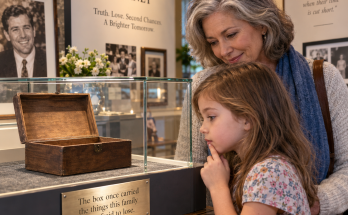
Dad's letters went into a small wooden chest.
The drawing remained framed.
Noah objected.
“People are going to ask why there's a child's drawing in the living room.”
Mom smiled.
“Let them.”
I laughed.
She was right.
It belonged there.
It was not evidence anymore.
It was part of our family history.
Years later, when Noah had children of his own, he showed them the drawing.
His oldest asked who had drawn it.
“I did.”
“Why?”
“Because I remembered something important.”
“What?”
Noah looked at me.
I was standing across the room.
He smiled.
“Something that helped us tell the truth.”
The child looked at the picture.
“Was it scary?”
Noah thought about it.
“Yes.”
“Are you still scared?”
“No.”
“Why?”
“Because it happened a long time ago.”
I almost corrected him.
It hadn't felt long ago to me.
But I understood what he meant.
Time had not erased the past.
It had changed our relationship with it.
Mom lived long enough to see the foundation grow beyond anything Dad had imagined.
She attended every major event.
She met scholarship recipients.
She kept in touch with Eleanor.
She occasionally spoke with Maria.
Mr. Harris became something close to family.
The people connected by the case slowly became ordinary people again.
That was perhaps the greatest gift.
They were no longer witnesses.
Accountants.
Investigators.
Defendants.
Survivors.
They were simply themselves.
And so were we.
One afternoon, Mom and I sat on her porch.
She was older.
Slower.
But still sharp.
She looked at me.
“Do you ever wonder what would have happened if Noah hadn't remembered?”
“Yes.”
“What do you think?”
I considered the question.
“I think the truth would have taken longer.”
She nodded.
“Maybe.”
“But I don't think it would have disappeared.”
She smiled.
“Your father would have liked that answer.”
I laughed.
“You always say that.”
“Because it's true.”
The sun was lowering.
The garden smelled of soil and rosemary.
Mom looked toward the framed photograph inside the house.
“Do you know what I wanted most when I was in prison?”
“What?”
“To hear someone say my name like they believed I was still me.”
I looked at her.
“You are still you.”
She smiled.
“I know.”
She reached for my hand.
“That's enough.”
Those were the same words written in Dad's margin.
Enough.
Enough searching.
Enough guilt.
Enough punishment.
Enough letting one terrible night define an entire family.
I understood then why the word had stayed with me.
It wasn't an instruction.
It was permission.
Permission to stop.
Permission to remember without reopening every wound.
Permission to love Dad without solving him.
Permission to love Mom without pretending I had never failed her.
Permission for Noah to move forward without carrying the responsibility of saving everyone.
The story had begun with a murder.
It had continued through a conviction, a prison sentence, a child's memory, a hidden recording, and years of searching.
But the ending was not the conviction of Greg.
It was not the reversal of Mom's sentence.
It was not the discovery of the trust.
Those were answers.
The ending was what came afterward.
A family sitting together.
A photograph on a wall.
A child growing into a man.
A mother finally sleeping without wondering whether the world believed her.
A son finally understanding that forgiveness did not require forgetting.
And a dead father whose final legacy was not the violence that ended his life, but the people he had tried to protect.
I still keep a copy of his last letter.
Sometimes I read it.
Sometimes years pass without opening it.
I no longer need it to tell me what happened.
I know.
I know who killed Dad.
I know why.
I know how Mom was framed.
I know how Noah's memory survived.
I know why the evidence failed.
I know why Dad kept secrets.
I know what he was trying to protect.
And I know what came after.
The answers matter.
They always will.
But they are not the whole story.
The whole story is what we chose to do once we knew.
We chose to stay together.
We chose to forgive what could be forgiven.
We chose boundaries where forgiveness was not possible.
We chose to remember Dad as a person rather than a case.
We chose to build something useful from what had nearly destroyed us.
And eventually, we chose to stop looking backward.
That was the final freedom.
Not forgetting.
Not pretending.
Simply turning around and realizing that the people we loved were still beside us.
Then walking forward with them.
Click here to continue reading: PART 17: A Letter From Noah’s First Case Reminded Me How Easily Fear Can Distort the Truth We Think We Remember
Six Years After My Father’s Murder, I Returned to the Prison Where My Mother Was Waiting for Her Final Goodbye
Part 16 of 27