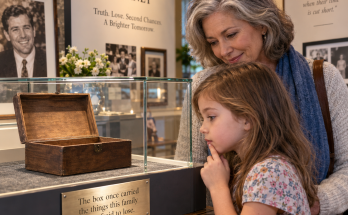
The letter remained in Mom's desk for three weeks.
She knew it was there.
So did I.
Neither of us mentioned it.
It was the final letter Dad had addressed directly to her, the one she had taken from the wooden box and folded into the back of a drawer.
One evening, she called me.
“Can you come over?”
I drove there immediately.
She was sitting at the kitchen table with the letter in front of her.
“I think I'm ready.”
I sat opposite her.
“Do you want me here?”
“Yes.”
She opened the envelope.
Dad's handwriting covered both sides of the paper.
He began by apologizing.
Not for the murder.
Not for the financial problems.
For keeping secrets.
He wrote that he had believed silence was protection.
He admitted that he had been wrong about how much a family could survive without knowing the truth.
Mom stopped reading.
“Do you want me to continue?”
She nodded.
I read aloud.
Dad explained that he had seen Greg's behavior changing long before the murder.
He had noticed missing money.
He had confronted him.
But he had also been afraid of breaking the family apart.
That hesitation had given Greg time.
Time to hide records.
Time to build false explanations.
Time to turn suspicion toward Mom.
Then Dad wrote about me.
He said I had always been stubborn.
Mom laughed through her tears.
“He got that right.”
I smiled.
The letter said he hoped I would someday understand that stubbornness could be useful when directed toward the truth.
Then he mentioned Noah.
He said Noah watched everything.
That he remembered details adults ignored.
Mom stopped again.
I understood why.
Noah's memory had eventually saved her.
Dad had seen that quality in him years before.
The final page contained a message for both of us.
He wanted us to take care of each other.
He wanted us to remember that family was not defined by never failing one another.
It was defined by what we did after we failed.
Mom folded the letter.
For a while, she said nothing.
Then she whispered, “I forgive him.”
I looked at her.
“For keeping secrets?”
“For thinking he had to carry everything alone.”
We sat quietly.
Then Mom smiled.
“I think he would have hated how much paperwork this caused.”
I laughed.
“That sounds more like him.”
The following month, we held a small memorial for Dad.
Not a funeral.
That had already happened.
This was different.
There were no speeches about murder.
No mention of Greg.
No discussion of the trial.
We invited family friends who had known Dad before the worst night of our lives.
Mr. Harris came.
Eleanor came too.
She stood near the back at first.
Mom walked over and hugged her.
“You helped us.”
Eleanor shook her head.
“I should have spoken sooner.”
“But you did speak.”
“That doesn't erase the years.”
“No,” Mom said. “But it changed the ending.”
Eleanor cried.
Mom held her hand.
I realized then that everyone connected to the case had carried some form of guilt.
Some had stayed silent from fear.
Some had believed the wrong evidence.
Some had been too intimidated to question the story.
The truth had not been blocked by one person's lie alone.
It had been buried under many people's silence.
That lesson stayed with me.
Noah eventually graduated.
He wore a dark suit and looked uncomfortable beneath the graduation cap.
Mom cried before the ceremony even began.
“You promised you wouldn't,” Noah said.
“I never promised that.”
I laughed.
Afterward, we took photographs.
One of them showed the three of us together.
Mom in the middle.
Noah on one side.
Me on the other.
Dad was missing from the picture.
But he wasn't absent.
We carried him with us.
Noah accepted a position working with a legal advocacy organization.
He wanted to help people whose cases had been overlooked.
Mom worried about him.
“You don't have to spend your whole life fixing what happened to us.”
He smiled.
“I know.”
“Then why do it?”
“Because someone should ask why.”
Mom looked at me.
We both smiled.
Years passed.
The case became old news.
People stopped recognizing our names.
That was fine.
We didn't need strangers to remember.
We remembered.
Every anniversary of Dad's death, we gathered together.
Sometimes we visited his grave.
Sometimes we stayed home.
Sometimes we cooked one of his favorite meals.
We never followed a rule.
The important thing was being together.
On the sixth anniversary after Mom's release, we returned to the old house.
It had been renovated by another family.
We did not go inside.
We stood outside the gate.
Mom looked at the windows.
“I don't feel afraid anymore.”
I nodded.
“That matters.”
She smiled.
Then she turned toward the road.
“Let's go.”
We did.
As we drove away, I realized something.
For years, I had thought closure meant discovering exactly what happened.
But the truth was only the beginning.
Closure was learning to live after knowing.
It was forgiving yourself without pretending you had done nothing wrong.
It was remembering Dad without remembering only the kitchen.
It was seeing Mom as my mother again instead of as the woman who had once sat behind prison glass.
It was watching Noah become the person he wanted to be.
And it was accepting that none of us could change the past.
We could only decide what we carried forward.
That evening, Mom called me.
“I found another photograph.”
I laughed.
“Another one?”
“Yes.”
“Where?”
“In Dad's old desk.”
I became quiet.
“What kind of photograph?”
She hesitated.
“One I have never seen.”
I drove over.
The photograph showed Dad standing outside the company office.
Beside him was Arthur Bell.
But someone else stood behind them.
A young woman.
I recognized her immediately.
Eleanor.
I looked at Mom.
“This was taken before she worked for Dad.”
Mom nodded.
“How do you know?”
“Because she told me.”
I turned the photograph over.
There was writing on the back.
A date.
And one sentence.
“Before any of this began.”
We stared at it.
For the first time in years, neither of us felt compelled to investigate.
We simply looked at the photograph.
Then Mom put it away.
“Some things can stay mysteries.”
I smiled.
“Dad would disagree.”
“He would.”
She closed the drawer.
“But he's not here to argue.”
That was the truth we had finally learned to live with.
Click here to continue reading: PART 12: The Final Photograph Changed Nothing About Dad’s Death, but It Gave Us One Last Piece of the Man We Had Lost
Six Years After My Father’s Murder, I Returned to the Prison Where My Mother Was Waiting for Her Final Goodbye
Part 11 of 27