The call came on a Tuesday morning.
I was standing at the kitchen window when my phone rang.
Mom's name appeared on the screen.
I answered immediately.
“Everything okay?”
There was a pause.
Then she said, “I found something.”
I closed my eyes.
After everything we had been through, those four words still had the power to change the temperature of a room.
“What did you find?”
“I don't know what it means.”
“Where are you?”
“At home.”
“I'll come.”
“No.”
Her voice was calm.
“Not yet.”
I waited.
“First, I want you to listen.”
She told me she had been sorting through old photographs when she noticed an envelope tucked behind the backing of one of the frames.
It had been there for years.
Maybe decades.
She had never opened the frame because she had never needed to.
The envelope had no stamp.
No address.
Only a name.
Mine.
I felt the old instinct return.
The urge to search.
To connect.
To assume that every forgotten object contained another missing piece.
I almost told her not to open it.
Instead, I asked, “Have you read it?”
“Yes.”
“And?”
“I think you should see it.”
I drove to her house.
The envelope was on the dining table.
It was yellowed around the edges.
My name was written in Dad's handwriting.
But the paper looked different from the letters we had already preserved.
Mom sat across from me.
“I almost threw the photograph away,” she said.
“What photograph?”
“The one that held the envelope.”
She pushed it toward me.
It showed Dad standing beside the old company building.
The same building.
The same smile.
But this photograph was older than the one Samuel had given us.
Dad looked barely older than Noah was now.
I turned it over.
Nothing.
Then I looked at the envelope.
“You said you found it behind this?”
“Yes.”
I opened it carefully.
Inside was a single page.
No greeting.
No explanation.
Just a few paragraphs.
Dad wrote that if I was reading the letter, then enough time had passed that he could finally tell me something he had never wanted me to carry while I was young.
He said the family had survived difficult years before I understood what they were.
He wrote that adults sometimes hide painful information from children because they believe silence is protection.
Then he admitted that silence can also leave children alone with their own explanations.
I stopped.
Mom watched me.
“Keep reading.”
I did.
Dad wrote about the night before he died.
He said he had met with someone privately.
He did not name the person.
He wrote that he believed the meeting might finally settle the financial dispute that had been growing around the company.
Then came the sentence that made my hands go cold.
“If something happens to me, do not assume the last person who argued with me is the person who wanted me dead.”
I looked at Mom.
She had already read it.
“Why didn't you tell me?”
“I didn't know about it.”
“Until today?”
“Yes.”
I read the next line.
Dad said he had made mistakes.
He said he had trusted people because he wanted to believe they were better than their actions suggested.
He wrote that he had also been wrong about how much danger he was in.
Then, beneath that, he wrote something that stopped me completely.
“I don't want you to spend your life trying to turn my death into a puzzle.”
I lowered the page.
Mom looked at me.
“That sounds like him.”
“It does.”
“But there is more.”
She pointed to the bottom.
I continued.
Dad wrote that if the truth about his death had already been established, I should accept it.
Not because every question had been answered.
Because some questions would never have answers.
He wanted me to live.
He wanted Noah to live.
He wanted Mom to live.
And he wanted the three of us to understand that his final day did not belong to us.
It belonged to him.
His life belonged to us.
His death did not.
I read the letter twice.
Then I put it down.
For years, I had believed closure meant discovering everything.
Dad was telling me the opposite.
Closure did not require possession of every detail.
It required knowing when enough truth had been found.
Mom folded her hands.
“I think this is what you needed.”
“I don't know.”
“You've been searching for the last sentence for years.”
I looked at her.
“Maybe.”
“And now you have it.”
I stared at Dad's handwriting.
The strange thing was that I did not feel excited.
I felt tired.
Not physically.
Something deeper.
The kind of tiredness that comes after carrying an object for so long that you forget what it feels like to put it down.
I thought about the empty box.
The documents we had preserved.
The photographs.
The statement.
The foundation.
The people who had finally spoken.
Nothing about the new letter contradicted what we knew.
If anything, it confirmed the lesson we had already reached.
Dad had understood that his death might never be completely explainable.
He had wanted us to survive the uncertainty.
Not worship it.
I looked at Mom.
“Do you think he knew he was going to die?”
“No.”
“Neither do I.”
She nodded.
“He was afraid.”
“Yes.”
“But being afraid doesn't mean you know what will happen.”
I folded the letter.
“I think that's what he was trying to say.”
We called Noah.
He came over that evening.
He read the letter without interrupting.
When he finished, he sat back.
“So that's it.”
I smiled.
“Maybe.”
He looked at Mom.
“Did he write anything else?”
“No.”
“Then I think he meant what he said.”
We sat quietly.
Noah tapped the paper.
“You know what bothers me?”
“What?”
“He still apologized for keeping things from us.”
I looked at the letter.
“He thought he was protecting us.”
“He always did.”
Noah shook his head.
“Parents are strange.”
Mom laughed.
“You're learning.”
That broke the tension.
We laughed together.
Then Noah became serious.
“I don't think this changes anything.”
“No.”
“It just tells us what Dad wanted.”
“And what did he want?”
He looked at me.
“For us to stop.”
I nodded.
That night, we made a decision.
The letter would not become another investigation.
It would not be used to reopen questions that had already been answered.
It would be preserved.
Nothing more.
I scanned it.
Then I placed the original in the family archive.
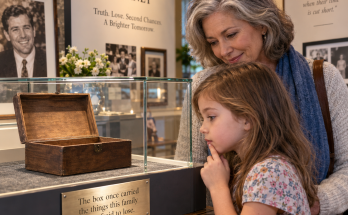
The empty wooden box stayed empty.
I thought about putting the letter inside.
But I didn't.
Instead, I placed it beside Dad's photograph.
It belonged with his life.
Not with his death.
Before Noah left, he stood at the door.
“You okay?”
“Yes.”
“Really?”
I thought about it.
“Yes.”
He smiled.
“I believe you.”
After he left, I stood alone in the hallway.
The house was silent.
But this time, I wasn't listening for the past.
I was listening to the ordinary sounds of the present.
The refrigerator humming.
A car passing outside.
The pipes settling in the walls.
A neighbor closing a gate.
Life.
Just life.
I went into my study.
The empty box sat on the shelf.
I touched its lid.
Then I left it alone.
For the first time, I understood that an empty box could be a beautiful thing.
It meant nothing was trapped inside.
Click here to continue reading: PART 26: We Took Dad’s Final Letter to His Grave, Not to Find Another Answer, But to Tell Him What Happened After He Was Gone
Six Years After My Father’s Murder, I Returned to the Prison Where My Mother Was Waiting for Her Final Goodbye
Part 25 of 27