Years passed.
Not dramatically.
One year became another.
Then another.
Mom grew older.
Noah's children became adults.
The foundation expanded into several cities.
Samuel occasionally sent photographs from his retirement.
Eleanor moved again.
Maria returned every summer.
And I kept living.
That was the strange miracle.
Life did not become perfect.
It became ordinary.
And ordinary was enough.
One autumn afternoon, my granddaughter came to visit.
She had grown up hearing stories about our family.
Not the details.
We had protected her from those when she was young.
But she knew there had been a difficult time.
She knew Grandpa had died before she was born.
She knew Grandma had spent years fighting to prove something that should never have needed proving.
She also knew there was an old box.
“Can I see it?”
I smiled.
“The box?”
“Yes.”
“Why?”
“Dad said it's empty.”
“He's right.”
“That makes me want to see it more.”
Children had not changed.
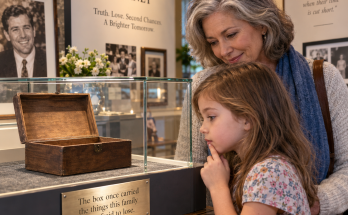
I took her to the archive.
The wooden box sat behind glass.
She studied it.
“That's it?”
“Yes.”
“It looks old.”
“It is.”
“What's inside?”
“Nothing.”
She frowned.
“Why keep an empty box?”
I thought about Dad.
About Noah.
About Mom.
About the first drawing.
The court.
The prison.
The letters.
The years.
Then I answered.
“Because it wasn't always empty.”
She looked at me.
“What was in it?”
“Things we were afraid to lose.”
“Like what?”
“Letters.”
“Photos.”
“Records.”
“Memories.”
She considered that.
“Why were you afraid?”
“Because we thought forgetting would mean losing someone.”
“Did it?”
“No.”
“Then why did you keep everything?”
“Because at the time, we needed to.”
She nodded.
Then she asked the question I had been expecting.
“What happened to Grandpa?”
I sat beside her.
“He was killed a long time ago.”
“Did they find who did it?”
“Yes.”
“Was Grandma sad?”
“Yes.”
“Were you?”
“Yes.”
She looked at the box.
“Are you still sad?”
I thought about it.
“Yes.”
She seemed surprised.
“Even now?”
“Yes.”
“Why?”
“Because missing someone doesn't have an expiration date.”
She nodded slowly.
“But you're okay.”
“Yes.”
“How?”
I smiled.
“Because being sad and being okay can happen at the same time.”
She looked at the box again.
“Is that why it's empty?”
I laughed softly.
“Maybe.”
She waited.
I told her the story.
Not every detail.
Not the frightening parts.
Not the names of every person involved.
I told her about a family that lost trust in one another.
A child who remembered something important.
A mother who was blamed for something she did not do.
A brother who carried a memory for years.
A family that eventually found the truth.
And a father who wanted his children to live instead of spending their lives searching for him.
When I finished, she was quiet.
Then she asked, “Was Grandpa a good person?”
I smiled.
“He was a person.”
She frowned.
“That's not an answer.”
“It is.”
She waited.
“He was good sometimes.”
I continued.
“He made mistakes.”
“Everybody does.”
“Yes.”
“He was scared.”
“Probably.”
“He loved you.”
“Yes.”
“Then I think he was good.”
I smiled.
“I think so too.”
She reached toward the glass.
“Can we take the box home?”
“No.”
“Why?”
“Because it belongs here.”
She nodded.
Then she asked, “What would Grandpa want you to do?”
I knew the answer.
“Live.”
She smiled.
“Then go home.”
I laughed.
“That sounds like Grandma.”
We left the archive together.
Outside, the afternoon sun was low.
She held my hand.
We walked slowly.
For a moment, I imagined Dad walking beside us.
Not as a ghost.
Not as a memory from the courtroom.
Just as the grandfather he never got to become.
I could picture him teasing her.
Arguing about vegetables.
Giving her too much dessert.
Pretending he didn't see her steal food.
The image made me smile.
She noticed.
“What?”
“Nothing.”
“You're thinking about Grandpa.”
“Yes.”
“What are you thinking?”
“That he would have liked you.”
She smiled.
“I would have liked him too.”
We kept walking.
That night, I called Noah.
I told him what she had asked.
He laughed.
“Sounds like her.”
“She wanted the box.”
“She always wanted the box.”
“She thinks empty things are interesting.”
“She's related to us.”
We laughed.
Then Noah became quiet.
“Do you ever wish Dad had lived long enough to see all this?”
“Yes.”
“Me too.”
We did not try to solve that feeling.
There was nothing to solve.
Some losses remain losses.
Healing does not turn them into something else.
It simply teaches you how to carry them without dropping everything else.
Years later, Mom passed peacefully.
She was surrounded by family.
There was no courtroom.
No accusation.
No investigation.
No unfinished argument.
Only people who loved her.
Before she died, she asked me one question.
“Are you still searching?”
I knew what she meant.
“No.”
She smiled.
“Good.”
Then she closed her eyes.
That was our final conversation.
I carried those words for years.
Not because they were profound.
Because they were hers.
After Mom's funeral, Noah and I stood outside the house.
The garden was full of flowers.
She had always loved flowers.
He looked at me.
“We're really the older generation now.”
I laughed.
“Don't say that.”
“It's true.”
“I don't like it.”
“Neither did Mom.”
We smiled.
Then he looked toward the house.
“What happens to the box?”
“It stays in the archive.”
“Good.”
We never moved it.
The foundation eventually created a small family history room.
The empty box became part of the display.
Visitors asked about it.
Sometimes children asked why an empty box deserved a place behind glass.
The answer remained the same.
Because it represented what the family had finally learned.
You can preserve the past without living inside it.
You can remember someone without becoming trapped by the circumstances of their death.
You can forgive without pretending nothing happened.
You can stop searching without surrendering the truth.
And you can carry grief while still making room for happiness.
Years later, my granddaughter brought her own daughter to see the box.
Three generations stood in front of it.
The little girl pressed her nose near the glass.
“What's inside?”
Her mother laughed.
“Nothing.”
The child looked disappointed.
My granddaughter smiled.
“That's the point.”
I stood behind them.
For a moment, I thought about the nineteen-year-old version of myself.
She had believed certainty would save her.
She had believed remembering everything would protect the people she loved.
She had believed that if she stopped searching, she would be betraying Dad.
She had been wrong.
But she had not been foolish.
She had been afraid.
And fear had taught her to search.
Love had taught her when to stop.
That was the lesson Dad had left behind.
Not in the letter.
Not in the records.
Not in the watch.
Not even in the empty box.
It was in the life that followed.
Mom lived.
Noah built a family.
I built mine.
The foundation helped strangers begin again.
Dad's name became connected to something larger than the night he died.
And the family he left behind became exactly what he had wanted us to become.
Alive.
I looked through the glass one last time.
The wooden box was empty.
Completely empty.
No letters.
No photographs.
No secrets.
No evidence.
Nothing waiting to be discovered.
And somehow, that emptiness held everything.
I placed my hand against the glass.
Then I stepped away.
My granddaughter took my hand.
“Ready?”
I smiled.
“Ready.”
We walked outside together.
The afternoon was warm.
People were talking.
Children were laughing.
Cars moved along the street.
Somewhere, a door slammed.
Someone called a name.
Life continued.
And this time, I did not turn around to see whether the past was following.
It wasn't.
The past had finally become what it was always supposed to be.
A place we had come from.
Not a place we had to remain.
I thought about Dad.
About Mom.
About Noah.
About the child who had drawn a picture because he was afraid.
About the young woman who had believed the wrong story because uncertainty frightened her.
About the family that had spent years finding its way back to itself.
Then I smiled.
We had not forgotten.
We had not erased anything.
We had simply learned how to live after it.
And that, finally, was the ending.
The End
Read more original stories on Feel Every Story.
Six Years After My Father’s Murder, I Returned to the Prison Where My Mother Was Waiting for Her Final Goodbye
Part 27 of 27