Years had passed since the day we stood at Dad's grave and finally decided that we had searched enough.
Life became quieter after that.
Not empty.
Not perfect.
Simply quieter.
Mom's garden grew wild in the corners because she stopped trying to make every plant behave. Noah settled into his career and learned how to carry difficult stories without bringing every one of them home. I built a life that had little to do with courtrooms, investigators, or old financial records.
For the first time, our family was no longer organized around Dad's murder.
That felt strange at first.
Then it became normal.
I thought the past had finally found its proper place until Noah called me one Thursday evening.
“I need your opinion.”
I was halfway through making dinner.
“About what?”
“A letter.”
“What kind of letter?”
“One I received at work.”
His hesitation made me turn off the stove.
“Is this about our case?”
“No.”
“Then why do you sound like it is?”
He laughed quietly.
“Because it reminded me of us.”
I waited.
“One of the witnesses in a case I'm working on changed her statement.”
“Changed it how?”
“She remembered something differently.”
I leaned against the counter.
“Did you believe her?”
“That isn't the point.”
“Then what is?”
“The point is that everyone around her immediately decided she was lying.”
I understood.
“And you don't think she is?”
“I think we don't know yet.”
That answer sounded like the Noah I knew.
He no longer treated uncertainty as weakness.
He treated it as a reason to keep asking questions.
The next afternoon, we met at Mom's house.
Noah brought the letter.
He placed it on the table but did not open it.
“She was a teenager when the incident happened,” he said.
“Like you.”
“Yes.”
“Does she remember the event clearly?”
“No. That's what makes everyone uncomfortable.”
I nodded.
“I know.”
“She remembered one detail last year. Now she remembers another.”
“That doesn't automatically make either memory false.”
“I know.”
He looked at me.
“That's what I wanted to hear.”
Mom entered carrying tea.
“What are you two discussing?”
Noah explained.
Mom listened.
Then she sat down.
“When I was in prison,” she said, “I thought memory was the most useless thing in the world.”
We looked at her.
“People kept telling me what I remembered was wrong.”
She wrapped both hands around her cup.
“Then Noah remembered something everyone else had forgotten.”
I thought about the drawing.
The crooked lines.
The kitchen.
Greg.
Mom continued.
“Memory isn't perfect.”
“No,” Noah said.
“But imperfect doesn't mean worthless.”
That became the theme of our conversation.
Noah explained that the case he was working on involved an assault that had happened years earlier.
The witness had initially identified one person.
Later, she became uncertain.
Then she remembered another person being present.
The investigators had treated the change as suspicious.
Noah had not.
He had requested the original interview.
Then the follow-up interview.
Then school records.
Then photographs.
He was reconstructing the environment around the memory rather than demanding that the memory fit a predetermined story.
It reminded me of Dad's case.
The difference was that this time someone was asking why before deciding what had happened.
A week later, Noah called again.
“They found another witness.”
“That's good.”
“It changes the timeline.”
“Bad?”
“Not necessarily.”
He paused.
“It makes the original statement impossible.”
I smiled.
“Then that's important.”
“Yes.”
“What are you going to do?”
“Tell the truth.”
I knew he would.
The case eventually proved that the original suspect had been wrongly identified.
Noah's work helped correct the mistake before charges were filed.
When he told Mom, she hugged him.
“You did what nobody did for me.”
He shook his head.
“Other people taught me how.”
Mom looked at me.
We both knew what she meant.
The lesson had started with a frightened child.
It had survived a courtroom.
It had followed Noah into adulthood.
And now it was helping someone else.
That evening, Noah and I sat on the porch.
He looked exhausted.
“You ever wish none of this happened?”
“All the time.”
“Even now?”
“Yes.”
He nodded.
“I thought you might say that.”
“But I don't wish you had forgotten.”
He smiled.
“Me neither.”
We sat quietly.
Then he said, “Do you remember the first time you saw the drawing?”
“Yes.”
“You looked terrified.”
“I was.”
“I thought you'd hate me for saying it.”
I turned toward him.
“Why would I?”
“Because you believed Mom was guilty.”
I thought about that.
“I never hated you.”
“I know that now.”
He looked down at his hands.
“I was afraid you'd think I was making it up.”
“I did wonder.”
He nodded.
“But I was wrong to doubt you.”
“You were scared.”
“So were you.”
He smiled.
“That seems to be the family tradition.”
We laughed.
The next morning, Mom called.
She had found something in her attic.
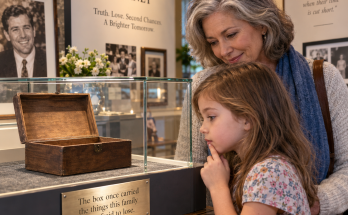
It was a small wooden box.
Inside was a watch.
Dad's watch.
I remembered it immediately.
He had worn it every day.
Mom said she had forgotten about it.
She handed it to me.
The watch no longer worked.
I turned it over.
There was an engraving on the back.
A date.
Not our wedding date.
Not my birth date.
Not Noah's.
A date from before either of us was born.
“Do you know what this means?” I asked.
Mom shook her head.
“No.”
I searched my memory.
Nothing.
Noah looked at the date.
“Maybe Dad bought it that day.”
“Why?”
“I don't know.”
Mom smiled.
“Maybe we should leave one mystery alone.”
I laughed.
“Agreed.”
But that night, I couldn't stop thinking about it.
Not because I believed it hid another crime.
I didn't.
I simply wondered what Dad's life had been like before I knew him.
Before Mom.
Before us.
We had spent years reconstructing the final months of his life.
Perhaps we had forgotten that he had lived decades before that.
He had been a young man once.
He had made mistakes.
He had dreamed.
He had probably been frightened sometimes.
He had loved someone.
He had chosen a family.
His final years were not the whole story.
Neither were ours.
The watch stayed on my desk for several weeks.
Eventually, I gave it back to Mom.
She placed it beside the family photograph.
“Where it belongs,” she said.
I agreed.
Some things did not need answers.
Some things only needed a place.
Click here to continue reading: PART 18: Noah Asked Me to Review One Old Statement, and Reading My Own Words Forced Me to Remember the Brother I Had Been
Six Years After My Father’s Murder, I Returned to the Prison Where My Mother Was Waiting for Her Final Goodbye
Part 17 of 27