We returned to the cemetery the following Sunday.
This time, we brought the letter.
Mom carried it.
Noah brought flowers.
I brought nothing.
The morning was cool.
The trees were almost bare.
Mom walked slowly between the graves.
She had become accustomed to this place.
Years ago, she had avoided it.
Then she visited reluctantly.
Later, she came alone.
Now she walked toward Dad's grave without hesitation.
That difference mattered.
When we reached the stone, she placed the flowers down.
Noah stood beside her.
I remained a few steps away.
For a moment, nobody spoke.
Then Mom took the letter from her coat.
“I thought you should hear this here.”
She unfolded it.
She did not read every word.
She summarized it instead.
Dad's message.
His warning.
His apology.
His wish that we would not spend our lives searching for him.
When she finished, she folded the letter.
Noah looked at the stone.
“You got your wish.”
Mom smiled faintly.
“We took a while.”
I laughed.
“So did he.”
Noah looked at me.
“What?”
“Dad.”
I nodded.
“He took a while to tell us anything.”
Mom laughed.
“He was terrible at explaining himself.”
We stood there smiling.
It felt almost wrong.
Then I realized it wasn't.
We were not disrespecting Dad by laughing beside his grave.
We were giving him something he had lost.
An ordinary family moment.
The kind he should have had.
Mom touched the stone.
“You missed a lot.”
Her voice trembled.
“But we didn't stop.”
She paused.
“We raised the children.”
She looked toward Noah.
“Your son knows your name.”
Noah swallowed.
“Your granddaughter knows your photograph.”
I looked at Mom.
“And she thinks you looked nice.”
Mom smiled.
“She was right.”
The wind moved through the branches.
I looked at the engraving.
For years, those letters had seemed like the end of a sentence.
Now they felt like a beginning.
A place where memory could rest.
Not a place where life had to remain.
Noah took a step forward.
“I used to think I had to remember every detail.”
Mom looked at him.
“Why?”
“Because I was afraid that if I forgot something, then Dad would disappear.”
Mom shook her head.
“No.”
She touched his shoulder.
“People don't disappear because we forget a detail.”
She pointed toward the flowers.
“They disappear when nobody remembers that they mattered.”
Noah nodded.
“I understand that now.”
We stayed for another hour.
Not discussing the case.
Talking about Dad.
His bad jokes.
His impatience.
His terrible singing.
The way he would read the newspaper from back to front.
The way he always carried extra change.
The way he would pretend not to notice when one of us stole food from his plate.
Small things.
The things that had nothing to do with murder.
Those were the memories I wanted.
When we finally left, Mom looked back once.
Then she turned away.
On the drive home, Noah said, “I think today was the real goodbye.”
Mom looked out the window.
“Yes.”
I understood.
Not goodbye to Dad.
Goodbye to the version of him that existed only in the final years of our memories.
The frightened man.
The murdered man.
The name in the case file.
The photograph from the newspaper.
We had remembered those things because they had hurt.
Now we could remember the rest.
At Mom's house, we made lunch.
No ceremony.
No speeches.
Just sandwiches and coffee.
Noah's children arrived later.
They ran through the house.
One of them found an old photograph.
“Is this Grandpa?”
Mom smiled.
“Yes.”
“Was he funny?”
“Sometimes.”
“Was he nice?”
“Most of the time.”
I laughed.
“That's generous.”
Mom looked at me.
“He'd say the same about you.”
The children laughed.
Then one asked, “Did he know us?”
Mom's smile softened.
“He didn't get to meet you.”
The child frowned.
“That's sad.”
“Yes.”
“But you remember him.”
“Yes.”
“Then he's still part of the family.”
Mom looked at me.
I nodded.
Children could make peace sound simple.
That evening, after everyone left, Noah and I sat on the porch.
The sky was turning dark.
“I've been thinking,” he said.
“That sounds dangerous.”
He laughed.
“I think Dad would be happy about the foundation.”
“I think so too.”
“He always wanted people to have a second chance.”
“Yes.”
“And Mom gave people that.”
“She did.”
He looked toward the garden.
“She gave us one too.”
I knew what he meant.
Mom could have stayed angry.
She could have built her entire identity around what had been done to her.
Instead, she built something.
A foundation.
Scholarships.
Support.
A future.
She transformed six stolen years into something that outlived the people who caused them.
Not because the pain was good.
It wasn't.
Because she refused to let the pain decide what came next.
That was her choice.
And it had changed all of us.
Later that night, I returned home.
The letter was no longer in my possession.
Mom had kept it.
I was glad.
Some things belonged with her.
I stood before the framed drawing.
The child who made it had been afraid.
The adult who looked at it now was not.
The drawing had not changed.
I had.
That realization felt final.
Not dramatic.
Not loud.
Simply final.
I went to the shelf.
The wooden box remained empty.
I opened it anyway.
Inside there was nothing.
I smiled.
Then I closed it.
There are moments when emptiness means loss.
And there are moments when emptiness means completion.
This was the second kind.
The next morning, I called Noah.
“I have an idea.”
“What?”
“We should put the empty box in the foundation archive.”
He laughed.
“Why?”
“So someday someone asks why it's empty.”
“And what will we tell them?”
“The truth.”
“What truth?”
“That we finally had nothing left to hide.”
He became quiet.
“I like that.”
So we did it.
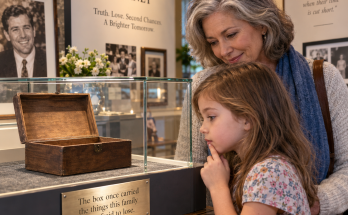
We placed the box in the archive.
Beside the records.
Beside the photographs.
Beside the history of the foundation.
There was no explanation longer than one sentence.
“The box once carried the things this family was afraid to lose.”
That was enough.
People could interpret it however they wanted.
For us, it meant something simple.
The past had been carried.
The truth had been found.
The family had survived.
And the box was finally empty.
Click here to continue reading: PART 27: Years Later, My Granddaughter Asked About the Empty Box, and I Finally Understood What Dad Had Been Trying to Teach Us
Six Years After My Father’s Murder, I Returned to the Prison Where My Mother Was Waiting for Her Final Goodbye
Part 26 of 27