
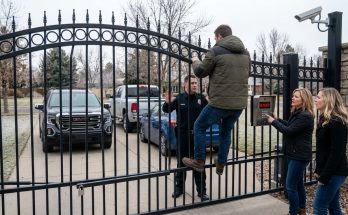
Michael had one foot between the iron bars when a man’s voice came from behind him.
“Sir. Get down from there.”
Michael froze.
Jennifer turned first.
Lisa, who had just emerged from her car, lifted her phone instinctively.
The uniformed security officer I had hired for the holiday week walked into the camera frame.
I had almost canceled him two days earlier.
The expense had seemed excessive.
At that moment, I would have paid double.
Michael climbed down.
“What the hell is this?”
The officer did not react to his tone.
“This is private property. The homeowner has not authorized your entry.”
Michael pointed toward my house.
“The homeowner is my mother.”
“That doesn’t change the access list, sir.”
I was listening through the intercom, one hand pressed against the kitchen counter.
Jennifer leaned toward the camera.
“Mom, seriously?”
“Yes.”
“We drove all the way here.”
“I told you not to come.”
Lisa raised her phone.
“Are you recording this?”
“The security system records the gate.”
She stared at the camera as if I had personally transformed into a surveillance satellite.
“That’s unbelievable.”
I almost apologized.
That reflex was so strong I actually inhaled to do it.
Then I looked at Michael, who had just attempted to climb a gate because the keypad had refused him.
“No,” I said. “What’s unbelievable is coming after I told you not to.”
Jennifer’s expression changed.
“The kids are in the cars.”
That sentence nearly opened the gate.
My grandchildren.
Sophie and the others had done nothing.
They were probably sitting in heated vehicles wondering why Grandma would not let everyone inside two days before Christmas.
I pictured their faces.
I pictured hot chocolate.
The ornaments Richard and I had collected.
The long dining table.
For a few seconds, guilt almost restored the old order.
Then I saw the trap, whether Jennifer had consciously intended it or not.
The children had been brought to a gathering I had explicitly declined.
Their disappointment could not become the mechanism by which my no turned into yes.
“I’m sorry they were brought into this,” I said. “Please take them somewhere warm.”
Jennifer stared at the camera.
“You’ve changed.”
I swallowed.
“Yes.”
She meant it as an accusation.
For once, I accepted it as a fact.
The security officer looked toward the camera.
“Ma’am, would you like these people removed from the property?”
Three months earlier, I would have opened the gate rather than embarrass my children.
Three years earlier, I would have apologized for making them wait.
For most of my life, keeping peace had meant absorbing discomfort before anyone else had to feel it.
I looked at the screen.
“Yes,” I said. “Please ask them to leave.”
The argument lasted several more minutes.
Michael paced beside his truck.
Lisa kept filming.
Jennifer cried.
I cried too, although I waited until the vehicles disappeared.
The security officer came to the house afterward.
“You okay, ma’am?”
I almost said yes.
That was another habit.
Instead I said, “No.”
He nodded as if no were a perfectly acceptable answer.
It was.
A boundary can be necessary and still hurt.
That lesson took longer to learn than installing the gate.
The next morning, I called Thomas.
I told him what happened, including Michael’s attempt to climb over.
Thomas’s first question surprised me.
“Are you safe?”
“Yes.”
“Do you believe any of your children intend to hurt you?”
“No.”
“Good. Then don’t turn this into something it isn’t.”
“I didn’t call the police.”
“I’m glad.”
“I did have security remove them.”
“You were entitled to ask people to leave your property.”
I sat down.
“I want them out of the will.”
There was a pause.
“All of them?”
“Yes.”
“Why?”
“Because they showed up after I said no.”
“That explains your anger. It doesn’t tell me your long-term intentions.”
I hated him a little for being sensible.
“They think everything I have is already theirs.”
“Maybe. Maybe not. But an estate plan should still represent what you want after the temperature of this week drops.”
So we reviewed it again.
I did reduce what my adult children would eventually receive directly compared with my older arrangements.
I increased provisions for grandchildren through structures appropriate for their ages.
I strengthened charitable gifts.
I ensured professional administration.
Most importantly, I protected my own future care before any inheritance calculation.
I did not write a revenge document.
That would have given the Christmas confrontation far too much power over the rest of my life.
Thomas also referred me to Elena Park, a certified financial planner.
Elena was brisk without being cold. She put projections on a large monitor and made me confront possibilities I had treated as abstractions.
Living to ninety.
Market downturns.
Home health aides.
Assisted living.
Major medical expenses.
Inflation.
“What’s the biggest mistake I’m making?” I asked.
She studied the numbers.
“Assuming your future self will cost roughly what your present self costs.”
I frowned.
“I don’t spend extravagantly.”
“That isn’t the problem.”
She pointed to a long-term-care projection.
“Your biggest future expense may have nothing to do with whether you order dessert.”
The numbers startled me.
For the first time, I understood what “figure it out yourself” could mean if I stripped Michael’s cruelty from the sentence and treated it as information.
I could build a future that did not depend upon one of my children becoming my unpaid nurse, driver, accountant, cook, advocate, or emergency response system.
That did not mean refusing their help.
It meant not requiring it.
Two days after Christmas, Lisa texted.
The kids don’t understand why Grandma wouldn’t let them in.
Guilt surged.
Then anger.
I waited before answering.
Please tell them I love them. The adults disagreed about a visit I had already said I wasn’t hosting. The children did nothing wrong and should not be asked to fix it.
Lisa did not reply.
Jennifer emailed the following week.
Her message was long.
She accused me of becoming suspicious, secretive, and obsessed with money.
She insisted the discussion about downsizing had come from concern.
I read the email three times.
On the fourth reading, I admitted something difficult.
She might partly have been right.
Not about my incapacity.
Not about entering my property.
But about concern.
My children were not villains plotting around a cauldron labeled INHERITANCE.
Jennifer could genuinely worry about me and simultaneously imagine the house as a future family asset.
Those motives could coexist.
I did not have to prove which one was pure.
My response was short.
I am capable of managing my affairs and have professional advice. I will request help when I want it. Do not come to my home without an invitation.
Michael called from a number I did not recognize.
I answered.
“This has gone far enough,” he said.
“Hello to you too.”
“Mom, you had a security guard throw your own children out at Christmas.”
“I told you not to come.”
“We’re family.”
“Yes.”
“You’re acting like we’re criminals.”
“You climbed my gate.”
“I was trying to get your attention.”
“You were speaking to me through the intercom.”
Silence.
Then he said, “This is about the money, isn’t it?”
I almost laughed.
“The money is the easiest part.”
“What does that mean?”
“I can organize money. I can change documents. I can hire professionals.”
“So you changed the will.”
“I’m not discussing my will.”
“There. Exactly.”
“No, Michael. This is about whether I’m allowed to say no and have you believe me.”
“You’re our mother.”
“And?”
He did not answer.
“That does not make my no temporary.”
He hung up.
I sat with the dead phone in my hand.
It hurt.
But I did not call him back.
Over the following weeks, I began noticing how often my own behavior had trained people to expect that pressure would work.
For years my refusals had sounded like invitations to negotiate.
I don’t think so.
Maybe not this weekend.
I’m pretty tired.
We’ll see.
Then someone pushed.
I surrendered.
My children were responsible for ignoring an explicit no.
But I could acknowledge the history without excusing the present.
So I practiced on smaller things.
Jennifer asked whether she could store several boxes in my basement.
“No.”
“Why not?”
“I don’t want to store them.”
“That’s it?”
“That’s it.”
Lisa asked whether I could babysit one Saturday.
“I’m not available.”
“What are you doing?”
“I have plans.”
I resisted the urge to submit my itinerary as evidence.
Michael wanted Richard’s old extension ladder.
“Yes. If you return it Saturday.”
“I’ll bring it back when I’m done.”
“Then no.”
A pause.
“Saturday.”
“Good.”
The world did not collapse.
The more clearly I spoke, the less resentment accumulated afterward.
I had spent decades over-explaining because, beneath all my reasons, I was asking permission to make my own choice.
I stopped.
Then Thomas raised a subject that infuriated me.
We were sitting in his office reviewing the revised documents when he asked, “Have any of the children suggested you’re cognitively impaired?”
My spine stiffened.
“Jennifer called me paranoid.”
“That’s not a diagnosis.”
“Lisa said I was acting irrationally.”
“Also not a diagnosis.”
“Michael told Jennifer I’m losing it.”
Thomas put down his pen.
“That one interests me.”
“Why?”
“Because you’ve made substantial changes to an estate plan late in life after family conflict.”
“So?”
“So someday somebody could argue that you lacked capacity.”
I stared at him.
“You think my children would do that?”
“I’m saying good planning considers foreseeable disputes without predicting them.”
“What do you want me to do?”
“Have an independent capacity evaluation.”
The phrase offended me immediately.
“You want me examined because my children don’t like being told no?”
“I want contemporaneous documentation that you understand what you’re doing.”
“That sounds like surrender.”
“It’s the opposite.”
I crossed my arms.
“I know exactly what I’m doing.”
“Excellent. Then an independent physician should have no difficulty documenting that.”
For three days, I refused.
On the fourth, I made the appointment.
Dr. Ellen Shaw was a geriatric psychiatrist whose office contained neither the infantilizing pastel artwork nor the enormous-print brochures I had feared.
She asked about my health.
My medications.
My finances.
My family.
She tested memory and reasoning.
She asked me to explain my assets approximately.
She asked what my legal documents did.
She asked what alternatives I had considered.
She asked why I had changed my plan.
“Because my children disappointed me.”
“Is that the only reason?”
“No.”
“What else?”
“Because I discovered the old plan depended on assumptions that weren’t reliable.”
“Such as?”
“That one of them would automatically be available if I became incapacitated.”
She nodded.
“Did anyone pressure you into making these changes?”
“No.”
“Are you afraid of your children?”
“No.”
“Are you trying to punish them?”
I hesitated.
“I was angry enough to want to.”
“And now?”
“Now I want a plan that works whether they become more involved or not.”
Dr. Shaw made another note.
Later she asked, “If your children disagree with your decisions, does that mean your decisions are irrational?”
“No.”
“Could you make a bad decision?”
“Obviously.”
“Could you make one while still having capacity?”
I smiled despite myself.
“Yes.”
That turned out to be the central distinction.
Competence did not mean perfect judgment.
Age did not mean incapacity.
Anger did not mean incapacity.
Grief did not mean incapacity.
Disagreement certainly did not mean incapacity.
Dr. Shaw documented that I understood my circumstances, my assets, my family relationships, my choices, and their consequences.
I sent the report to Thomas.
Then I put it out of my mind.
I did not send copies to my children.
I did not announce that I had been declared competent.
I was not assembling ammunition.
I was creating a clean record.
Then, without intending to, I began creating something else.
A life that contained more than waiting for my children.
I joined a walking group.
I returned to watercolor classes.
Twice a month, I volunteered at the hospital where Richard had died, helping visitors locate elevators, waiting rooms, cafeterias, and departments.
It sounds insignificant.
It was not.
I remembered wandering those corridors after Richard’s collapse, unable to process signs that were directly in front of me.
If I could make one frightened person’s day ten percent easier, I wanted to.
There I met Denise.
She was seventy-four, widowed, sharp-tongued, and constitutionally incapable of polite dishonesty.
When I eventually told her about the Christmas gate, she listened while eating half a blueberry muffin.
Then she asked, “Are your children terrible people?”
The question offended me.
“No.”
“Then why are you telling the story like you need me to call them terrible?”
I opened my mouth.
Closed it.
Denise ate another piece of muffin.
Jennifer was generous with colleagues and hopeless around emotional discomfort.
Michael had once spent three days repairing a neighbor’s storm-damaged roof for almost nothing, yet could become astonishingly entitled where family was concerned.
Lisa was adored by her students and avoided confrontation until avoiding it became impossible.
They had failed me.
That did not make them monsters.
The realization mattered because monsters cannot repair relationships.
People sometimes can.
Jennifer did not contact me for two months.
Michael sent angry messages occasionally.
Lisa sent photographs of the grandchildren.
I answered those.
Tell them Grandma loves them.
Nothing about the gate.
Nothing about the estate.
Then one afternoon Sophie called from her own phone.
She was fourteen.
“Grandma?”
“Hello, sweetheart.”
A pause.
“Are you mad at me?”
The question cut through every defense I had built.
“No.”
“Mom says you need space.”
“From some grown-up problems. Not from you.”
“Can I come over?”
I looked toward the window.
“Yes, if your mother agrees and we arrange it first.”
I would not recruit my granddaughter into a secret relationship against her mother.
That would simply repeat the same disregard for boundaries from another direction.
The following month Jennifer dropped Sophie at the gate.
She did not enter.
I opened it remotely.
Sophie came into the kitchen, shrugged off her coat, and inspected me with the directness only teenagers possess.
Then she glanced toward the driveway.
“Uncle Michael actually tried to climb that thing?”
I pressed my lips together.
“He made a poor decision.”
“That means yes.”
I laughed.
For the first time in months, the gate did not feel like a symbol of war.
Sophie and I baked cookies.
She talked about school, friends, art, and a teacher who pronounced her surname incorrectly despite being corrected repeatedly.
She never asked about money.
She never asked about my will.
When Jennifer collected her, Sophie hugged me so tightly my glasses shifted.
Standing at the window afterward, I understood what I was trying to protect.
Not merely my estate.
The possibility that my family could someday relate to me without every interaction being tangled in ownership, obligation, fear, or guilt.
Three days later, Lisa called.
Not texted.
Called.
“Mom?”
“Yes?”
“Can I come over?”
My stomach tightened.
“What do you want to talk about?”
There was a pause.
“Us.”
“Not the house?”
“No.”
“Not my money?”
“No.”
I looked toward the gate.
“All right.”
“When?”
“Saturday.”
Another pause.
“Will you let me in?”
“If you use the intercom.”
Lisa gave a small, shaky laugh.
“I can do that.”
When Saturday arrived, she came alone.
Click here to continue reading: PART 4: My Daughter Arrived Alone and Said She Was Sorry, but One Question Revealed Whether She Wanted Forgiveness or Something Else
The Night I Came Home From the Hospital Alone, Three Short Messages Forced Me to Question Everything I Believed About Family
Part 3 of 28

One Comment on “PART 3 – When My Son Climbed the Locked Gate After I Said No, I Had Seconds to Decide Whether My New Boundaries Meant Anything”