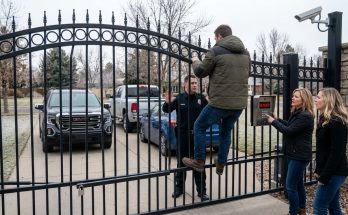
Lisa pressed the intercom button even though she could see me standing at the kitchen window.
That small act mattered more than she knew.
I opened the gate remotely.
She drove in, parked beside the garage, and remained behind the wheel for almost a minute before getting out.
No husband.
No children.
No siblings.
No boxes of documents.
She carried only her purse.
When she entered the kitchen, I had coffee waiting.
She removed her coat, folded it over the back of a chair, looked at me, and began crying.
A year earlier, I would have crossed the room immediately.
I would have put my arms around her.
I would have started comforting her before I even knew what had hurt her.
That morning, I remained beside the counter.
“Mom, I’m sorry.”
I waited.
Lisa wiped her face with the heel of her hand.
“Did you hear me?”
“Yes.”
She seemed confused by my stillness.
“For what?” I asked.
“For everything.”
“That’s too large to mean anything.”
Her expression changed.
Not anger.
Surprise.
I poured coffee into two mugs and sat down.
Lisa followed slowly.
“What do you want me to say?”
“The truth.”
“I am telling you the truth.”
“Then tell me what you’re apologizing for.”
She stared into her coffee.
For perhaps thirty seconds, neither of us spoke.
Then she inhaled.
“I’m sorry I didn’t come to the hospital.”
I nodded.
“I’m sorry I acted like a text the next day counted as showing up.”
Another nod.
“I’m sorry I kept talking about you selling this place when you never asked me to help you move.”
My throat tightened.
Lisa continued.
“And I’m sorry we came at Christmas after you told Jennifer not to.”
“Yes.”
She twisted a tissue between her fingers.
“And…”
She stopped.
“And?”
“I’m sorry we brought the kids.”
I looked at her.
“They would have come to Christmas anyway.”
“That isn’t what I mean.”
“What do you mean?”
Lisa looked miserable.
“I think part of me knew you’d have a harder time turning us away if the children were sitting in the cars.”
There it was.
The most honest sentence anybody in my family had spoken about that afternoon.
I closed my eyes briefly.
“Thank you.”
“For what?”
“For saying it.”
She started crying again.
This time I reached across the table and put my hand over hers.
Not because the apology had erased anything.
Because she had finally named what happened without dressing it up as concern.
After several minutes, Lisa whispered, “Do you forgive me?”
I withdrew my hand.
Her eyes widened.
“I accept your apology.”
“That’s not the same thing.”
“No.”
“What does that mean?”
“I don’t know yet.”
Her face crumpled slightly.
I hated causing that expression.
But I had spent too much of my life answering emotional questions before I knew my own answer.
“Lisa, I love you.”
“I love you too.”
“But I’m not going to say everything is fixed because we cried in the same kitchen.”
“I’m not asking that.”
“You asked whether I forgive you.”
She looked down.
“I guess I wanted to know we were okay.”
“We aren’t completely okay.”
That hurt both of us.
Then something unexpected happened.
Lisa nodded.
“All right.”
No argument.
No accusation.
No demand that I recognize how difficult the apology had been for her.
Just all right.
We finished our coffee.
Eventually she told me about school.
Her principal had instituted a new reporting system that required teachers to enter essentially the same information twice.
I complained on her behalf.
She told me Sophie wanted to change an elective.
We discussed that.
For nearly an hour, we talked about ordinary life.
It felt awkward and wonderful.
As Lisa put on her coat, she paused.
“Can I ask one thing?”
My body tensed before she spoke.
“What?”
“Did you cut us out of the will?”
There it was.
I must have changed expression because Lisa immediately raised both hands.
“I’m sorry. Forget it.”
“No.”
“I shouldn’t have asked.”
“You shouldn’t.”
“I’m trying to be honest.”
“So am I.”
I walked to the kitchen table and rested my fingers against the back of a chair.
“My estate plan is private.”
She swallowed.
“I understand.”
“I’ve arranged things carefully. I have professional advice. You should organize your own financial future on the assumption that you will inherit nothing from me.”
“That sounds harsh.”
“It’s practical.”
“Nothing?”
“That isn’t what I said.”
She frowned.
“I’m saying you should not build your life around a future inheritance.”
Lisa looked around the kitchen.
At the cabinets.
The long windows.
The house where she had grown up.
For a moment, I saw the child she had been.
Then she nodded.
“Okay.”
She left.
I stood at the window and watched her drive through the gate.
The next afternoon, my phone rang.
Lisa.
My stomach tightened again.
I answered.
“Hello?”
“How was watercolor?”
I blinked.
“What?”
“You said you had watercolor class today.”
“Oh.”
“How was it?”
I looked at the unfinished painting on my dining table.
A ridiculous attempt at aspens in autumn.
“Terrible.”
Lisa laughed.
“Can I see it?”
“Absolutely not.”
That was the beginning.
Not the apology.
The call afterward.
Then another.
Lisa began calling on Sunday evenings.
Sometimes for five minutes.
Sometimes forty.
She missed one Sunday and texted Monday morning.
I forgot. Can I call tonight?
No excuse.
No elaborate explanation.
She simply acknowledged what happened and followed through.
That mattered more than tears.
A few weeks later, she asked if there was anything specific she could do to rebuild trust.
“Call when you say you will.”
She stared at me.
“That’s all?”
“For now.”
I had learned that reliability is built out of boring things.
Grand gestures impress people.
Small promises kept repeatedly make them feel safe.
Lisa began visiting every few weeks.
Sometimes she brought Sophie and her younger child.
Sometimes she came alone.
She never asked about my estate again.
She used the intercom.
Eventually I gave her a temporary visitor code for scheduled visits.
The first time she entered it, she looked at the keypad and smiled.
“Promotion?”
“Probation.”
She laughed.
The gate was slowly becoming technology again instead of a family monument.
Jennifer remained more difficult.
She did not apologize.
Instead she tried to solve me.
She sent an article about downsizing.
I ignored it.
Then a brochure arrived for a retirement community twenty minutes away.
I called her.
“Did you send this?”
“I thought you might like to see it.”
“Did I ask you to research communities?”
“No, but—”
“Then don’t.”
“Mom, information isn’t control.”
“Sometimes it is.”
“That doesn’t even make sense.”
“It makes sense when the information arrives because you’ve already decided I should want what you want.”
Jennifer became quiet.
“I’m trying to help.”
“I know.”
That surprised her.
“Then why are you fighting me?”
“Because help I didn’t request is still something I’m allowed to decline.”
She sighed.
“What am I supposed to do, wait until you fall down?”
“If you’re worried about something specific, ask.”
“I am worried.”
“About what?”
“The stairs. The yard. You being alone. The size of the place.”
Those were real concerns.
I had to admit that.
The stairs were becoming more tiring.
The property required maintenance.
I did live alone.
But acknowledging a concern did not automatically transfer decision-making authority.
“I’ll think about those things.”
“When?”
“When I decide to.”
“That’s exactly the problem.”
“No. That’s exactly the difference.”
“What difference?”
“Between advice and authority.”
She hung up frustrated.
I was frustrated too.
Yet something had changed.
I could now hear concern without automatically obeying it.
Months later, I needed a colonoscopy.
Nothing dramatic.
Routine.
The clinic required someone to collect me because of sedation.
I had already arranged transportation when Lisa called.
“What day is it?”
“Thursday.”
“I can drive you.”
“You’re working.”
“I can take the morning.”
“You don’t need to.”
“I know.”
That answer caught me.
“I know,” she repeated. “I’m asking whether you want me to.”
I sat with the distinction.
Need and want.
Dependence and chosen help.
“No,” I said first.
Then reconsidered.
Actually, I did want her.
“Yes.”
Lisa arrived at six thirty Thursday morning carrying two coffees even though I was not allowed to drink mine.
“That is cruel.”
“I forgot.”
“You’re drinking it in my car.”
“It’s my car.”
“Then I’ll resent you in your car.”
She grinned.
The procedure went normally.
When I woke, foggy from sedation, Lisa was sitting beside me reading something on her phone.
Apparently I looked at her and said, “You finally came to the hospital.”
I do not remember saying it.
Lisa never forgot.
She told me later that she made it all the way to the parking lot before crying.
That incident changed something between us.
Not because she had redeemed the earlier hospital absence by attending one appointment.
Relationships are not arithmetic.
It mattered because she came without being compelled.
I had transportation.
I had a plan.
She was not rescuing me.
She was accompanying me.
Meanwhile, I became busier.
Watercolor improved slightly.
My walking group became a collection of friendships rather than strangers moving in the same direction.
Denise and I began having lunch after hospital volunteer shifts.
I met Harold, a widower with no children who found my inheritance anxiety endlessly amusing.
One afternoon I told him I still worried that changing my estate plan would permanently damage my family.
He stirred sugar into his coffee.
“Some of us are going to die without anybody fighting over a nine-hundred-thousand-dollar house.”
I stared at him.
“That’s a strange thing to say.”
“It’s true.”
“What’s your point?”
“That property makes people think feelings can be calculated.”
I considered that.
Harold shrugged.
“A half-hour visit might matter more than ten thousand dollars. Good luck putting that in a will.”
He was right.
I had been trying to make legal documents carry emotional meaning they were not designed to hold.
Thomas had warned me about the same thing.
If I wanted my children to know they had hurt me, I should tell them while I was alive.
If I wanted to define authority and distribute assets, legal documents could do that.
Mixing the two invited trouble.
My relationship with Sophie also deepened.
She visited without becoming my confidante about her mother.
Once she complained about Jennifer after a family dinner and seemed to expect me to join her.
I stopped her.
“I’m not recruiting you.”
“What?”
“To my side.”
“I didn’t know there were sides.”
“Good. Keep it that way.”
Sophie rolled her eyes.
Teenagers have a remarkable ability to make responsible adult behavior feel embarrassing.
Still, I meant it.
Loneliness can make alliance tempting.
I could easily have strengthened my bond with Sophie by telling her every way her mother and aunt and uncle had disappointed me.
I refused.
She deserved a grandmother, not a witness for the prosecution.
Then, almost a year after my hospital scare, Thomas called.
“I want to check something.”
“That sounds expensive.”
He laughed.
“This call is free.”
“Then proceed.”
“Any new concerns about capacity?”
“No.”
“Any pressure regarding the estate?”
“No.”
“Any reason you want to alter the plan?”
I thought about Lisa.
Jennifer.
Michael, who remained mostly distant.
“No.”
“Good.”
“That’s it?”
“That’s it.”
I understood what he was doing.
He was establishing that my decisions were not changing with every emotional fluctuation.
My estate plan had become quieter.
That was a good sign.
The family relationships, however, were beginning to move.
Lisa’s repair was steady.
Jennifer’s was more complicated.
Michael still believed I had humiliated him.
And I had begun to realize the next stage would be harder than locking a gate.
Boundaries had protected the space in which relationships might change.
They could not make anyone change.
Then one Sunday evening, Lisa called at her usual time.
After ten minutes of conversation, her voice shifted.
“Mom, Jennifer asked me something.”
“What?”
“She wants to know if I’ve seen your estate documents.”
My hand tightened around the phone.
“What did you tell her?”
“That I haven’t.”
“Good.”
“She thinks you’re making decisions because you’re angry.”
“I was angry.”
“She thinks Thomas is encouraging you.”
“He isn’t.”
“I know.”
I stood and walked toward the window.
Outside, snow had begun falling in soft flakes over the gate.
“Why are you telling me this?”
“Because she wants the three of us to talk to you together.”
My chest tightened.
“No.”
“I told her you’d probably say that.”
“What does she want to discuss?”
“Your future.”
The phrase had become almost poisonous.
Lisa continued quickly.
“I told her if she wants to repair things, she should stop making every conversation about managing you.”
I said nothing.
“Mom?”
“I’m here.”
“She didn’t like that.”
“I imagine not.”
“She says somebody has to be responsible.”
I looked at the snow accumulating on the driveway.
For most of my life, that sentence would have sounded loving.
Now I heard the question beneath it.
Responsible for whom?
For what?
And by whose permission?
“Lisa,” I said, “tell Jennifer something for me.”
“What?”
“If she wants to talk to me, she can call me herself.”
“You sure?”
“Yes.”
“No group meeting?”
“No.”
“No intervention?”
I almost smiled.
“Especially no intervention.”
We hung up.
The phone rang twenty minutes later.
Jennifer.
I watched her name flash on the screen.
Once.
Twice.
Three times.
Then I answered.
“Hello?”
Jennifer did not bother with small talk.
“Mom, we need to settle something.”
“No,” I said. “We need to understand something.”
Silence.
Then, carefully, I told my eldest daughter the rule that would determine whether she remained part of my future.
“You may help me,” I said, “but you do not get to manage me unless I ask.”
Jennifer did not answer immediately.
When she finally spoke, her voice was quieter.
“And if I think you’re making a mistake?”
“Then you may tell me.”
“And if you think I’m wrong?”
“I decide.”
Another silence.
For the first time since the hospital, Jennifer seemed to understand that the conversation was not about the house, the will, or even the gate.
It was about who owned the remaining years of my life.
“I don’t know if I can do that,” she said.
I closed my eyes.
At least it was honest.
“Then we finally know what we have to work on.”
Click here to continue reading: PART 5: Jennifer Said She Could Not Promise to Stop Managing Me, and Her Answer Forced Us Into the Most Honest Conversation We Had Ever Had
The Night I Came Home From the Hospital Alone, Three Short Messages Forced Me to Question Everything I Believed About Family
Part 4 of 28