The charitable organization was the cardiac rehabilitation foundation Richard and I had supported after his first minor heart scare, years before the fatal attack.
We had donated modestly.
Nothing memorable.
The anonymous gift was twenty-five thousand dollars.
My first reaction was suspicion.
That embarrassed me.
A year earlier, I would have assumed generosity.
Now my mind immediately began searching for hidden motives.
“Why did they contact you?” I asked Thomas.
“The donor wanted confirmation that the gift could be acknowledged in Richard’s name without identifying the donor publicly.”
“And they knew you represented me?”
“The donor mentioned me.”
“Who?”
“I can’t disclose information I don’t formally have.”
“That sounds irritatingly lawyer-like.”
“It is one of my professional strengths.”
“Do you know?”
“I have a strong suspicion.”
“Tell me.”
“No.”
“Thomas.”
“Ask your family.”
I almost hung up on him.
Instead I called Lisa.
“Did you donate twenty-five thousand dollars in your father’s name?”
“What?”
“That sounds like no.”
“Definitely no. I’m a teacher, Mom.”
Fair.
“Did Jennifer?”
“I have no idea.”
“Michael?”
Another pause.
“I have no idea.”
That pause interested me.
“Lisa.”
“Ask him.”
So I did.
Michael answered from a job site.
Power tools roared in the background.
“What?”
“Did you donate money to the cardiac rehabilitation foundation?”
The tools stopped.
Not physically.
He had moved somewhere quieter.
“Who told you?”
My heart shifted.
“You did.”
He swore softly.
“Michael.”
“Yes.”
“Why?”
“It’s not a big deal.”
“Twenty-five thousand dollars is a big deal.”
“Not compared to—”
He stopped.
“Compared to what?”
“Nothing.”
I sat down at my new kitchen table.
“Where did the money come from?”
“My money.”
“Your business is recovering.”
“I know.”
“You told me you had debt.”
“I paid most of it.”
“Michael.”
“It was Dad’s money.”
“No.”
He exhaled hard.
“Sort of.”
“What does that mean?”
He remained silent long enough that I thought he might disconnect.
Then he said, “Can we talk later?”
“No.”
“Mom.”
“You started this conversation by accidentally confessing to a twenty-five-thousand-dollar donation. I think we’re past casual.”
He laughed once.
Then sighed.
“When Dad died, you gave each of us some money.”
I remembered.
Not inheritance.
A gift from insurance proceeds.
Twenty-five thousand dollars to each child.
I had told them to use it for something meaningful or practical.
Jennifer paid student loans.
Lisa used part toward her first home.
Michael had told me he invested his.
“You kept it?”
“Mostly.”
“For thirteen years?”
“I moved it around.”
“What does that have to do with the foundation?”
“It grew.”
My eyes filled unexpectedly.
“You donated the original amount?”
“Yeah.”
“Why?”
He made an irritated sound.
As though I were forcing him to translate something he preferred expressing through lumber and bolts.
“Because I was being an ass.”
“That narrows nothing down.”
“About the inheritance.”
I waited.
“I kept thinking about what Dad left.”
His voice was rough.
“Then after we talked, I remembered you already gave me something from it.”
I said nothing.
“I’d spent a year acting like his money was something waiting for me in the future, when you had already trusted me with part of it.”
The words sat heavily.
“So you gave it away?”
“I gave that amount away.”
“Why not keep it?”
“Because every time I looked at the account, I started thinking like an idiot again.”
I covered my mouth.
Michael continued.
“Dad got scared after that first heart thing. Remember?”
“Yes.”
“He actually used the rehab program.”
“For a few months.”
“He hated the treadmill.”
“He complained constantly.”
Michael laughed.
“Yeah.”
We both went quiet.
Then he said, “I figured somebody else’s dad could use it.”
I cried.
Quietly.
Michael pretended not to notice.
“I didn’t want you to know.”
“Why?”
“Because I didn’t do it for you.”
That sentence made me cry harder.
“Good.”
“You sound terrible.”
“I am crying.”
“I know.”
“You said you didn’t notice.”
“I said no such thing.”
We laughed.
When the call ended, I sat alone in my new kitchen.
I had spent months looking for evidence that my children cared.
Visits.
Calls.
Apologies.
Respect.
Meanwhile, Michael had made a private act of grief and release I might never have discovered.
It reminded me of something uncomfortable.
I had once assumed absence meant indifference.
Then I learned Jennifer’s absence at the hospital had included fear.
I had assumed Michael’s anger was simply greed.
Then I found grief tangled inside money.
People rarely offer us motives in clean containers.
Love and selfishness coexist.
Fear and control.
Generosity and resentment.
We are untidy creatures.
Jennifer called that evening.
“Michael is furious at Lisa.”
“I gathered.”
“She told you?”
“She pointed me toward him.”
“He wanted it anonymous.”
“I won’t tell anyone else.”
“Good.”
A pause.
Then Jennifer said, “I knew.”
“You knew about the donation?”
“He asked me how to make it anonymously.”
That surprised me.
“And you kept the secret?”
“I can occasionally refrain from project-managing things.”
“Progress.”
She laughed.
Then her voice softened.
“Mom?”
“Yes?”
“I want to tell you something.”
The old alarm rose in me.
“What?”
“I started therapy.”
That was not what I expected.
“Oh.”
“Very supportive.”
“Don’t ruin it.”
She laughed.
“I started a few months ago.”
“Why didn’t you tell me?”
“Because it’s mine.”
The answer pleased me.
“All right.”
“I realized I do this thing where I try to organize people when I’m scared.”
“I’ve heard rumors.”
“My therapist says certainty is my coping mechanism.”
“Are therapists paid by the word?”
“Mom.”
“Sorry.”
She hesitated.
“I think Dad’s death messed me up more than I knew.”
I looked toward the pond.
“I think it did that to all of us.”
“You too?”
The question startled me.
“Of course.”
“I know, but you always seemed…”
“Capable?”
“Yes.”
“That was not the same as okay.”
We talked for almost an hour.
Jennifer told me that after Richard died, she had become obsessed with contingency planning.
Insurance.
Emergency contacts.
Calendars.
Backups.
It worked professionally.
People praised her for it.
Nobody told her that sometimes control was fear wearing sensible shoes.
When I went to the hospital, she had frozen.
Then she compensated by trying to organize my future more aggressively.
“I’m not saying that excuses anything,” she said.
“It doesn’t.”
“I know.”
“But it explains something.”
“Maybe.”
I smiled.
“Explanation is not the enemy of accountability.”
“Did Thomas teach you that?”
“No. I’m becoming unbearable independently.”
She laughed.
The following Sunday, all three children came for dinner.
Invited.
That detail mattered.
Michael used the intercom, although I had given each of them scheduled visitor access.
Jennifer arrived with dessert.
Lisa brought salad.
Sophie brought a friend.
The house was smaller, so everybody bumped into everybody else.
I loved it.
At dinner, nobody discussed estate planning.
Then Sophie’s friend asked how long I had lived there.
“Two weeks.”
Sophie said, “Grandma had a giant house before.”
“It wasn’t giant.”
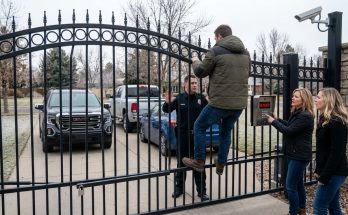
“It had a gate.”
Michael groaned.
“Can we not?”
Sophie grinned.
“Uncle Michael tried to climb it.”
Her friend’s eyes widened.
“You climbed your mom’s gate?”
Jennifer nearly choked on her water.
Lisa covered her face.
I looked at Michael.
He pointed his fork at Sophie.
“You were not there.”
“I’ve heard the legend.”
I laughed until tears came.
Michael tried to look offended, failed, and eventually laughed too.
The moment mattered more than anyone else realized.
For nearly a year, the gate had carried humiliation, anger, defiance, and fear.
Now it had become a ridiculous family story.
Not harmless.
Not forgotten.
But survivable.
After dinner, Michael helped me carry plates.
“You told Sophie?”
“No.”
“Lisa.”
“Probably.”
“I’m changing my number.”
“You’ll still be related to us.”
“Unfortunate.”
He rinsed a dish.
Then said, “You like this place?”
“Yes.”
“Really?”
“Yes.”
“Better than the old house?”
I considered the question.
“Different.”
He nodded.
“Dad would’ve liked the pond.”
“Yes.”
“He would’ve built something out there.”
“Probably an unnecessary dock.”
“Definitely an unnecessary dock.”
We smiled.
Later, after everyone left, I realized I had gone an entire evening without evaluating who called enough, who visited enough, who owed what, who might inherit what, or who would show up in an emergency.
I had simply been with my family.
That should not have felt revolutionary.
It did.
My relationship with my children continued improving over the winter.
Not perfectly.
Jennifer occasionally slipped into command mode.
I occasionally reacted to suggestions as though they were invasions.
Michael disappeared into work for weeks at a time.
Lisa sometimes promised a call and forgot.
But now we repaired things faster.
A missed call became a missed call.
Not proof of abandonment.
Advice became advice.
Not automatically an attempted takeover.
And when a boundary was crossed, I spoke before resentment fermented.
In January, I had another health scare.
This one was real.
I woke with severe abdominal pain.
Within an hour, I knew something was wrong.
I had learned enough not to minimize symptoms.
I called emergency services.
Then I called the person listed first in my medical support plan.
Lisa.
She answered on the second ring.
“Mom?”
“I’m going to the hospital.”
Her voice changed instantly.
“What happened?”
“Severe abdominal pain.”
“Are you alone?”
“Paramedics are coming.”
“I’m leaving now.”
“You’re working.”
“I know.”
I almost told her she did not have to come.
Then I stopped.
She had chosen.
“Meet me there.”
“Yes.”
At the hospital, doctors discovered gallstones and signs of inflammation.
Surgery was recommended.
Not immediately life-threatening.
But not optional either.
Lisa arrived before the imaging was finished.
Jennifer came ninety minutes later.
Michael arrived directly from a job site wearing work boots and dust on his coat.
I stared at all three.
“You’re all here.”
Michael frowned.
“Where else would we be?”
The question hurt in the best possible way.
The surgeon explained the procedure.
I listened.
Asked questions.
Made my own decision.
Nobody interrupted.
Nobody took over.
Jennifer wrote notes because I asked her to.
Michael called the house security company because I asked him to.
Lisa texted Sophie because I asked her to.
Help by invitation.
The difference was almost invisible from the outside.
Inside me, it was enormous.
Surgery went well.
When I woke, all three children were still there.
Michael was asleep in a chair.
Lisa had her shoes off.
Jennifer was answering work email but closed her laptop when my eyes opened.
“You stayed,” I whispered.
Jennifer leaned forward.
“Yes.”
I dozed again.
Later, after the others went for coffee, Jennifer remained.
“Mom?”
“Yes?”
“I’m sorry about the first hospital.”
I looked at her.
She continued.
“I keep thinking about it.”
“So do I.”
“I should have come.”
“Yes.”
She swallowed.
“I can’t change it.”
“No.”
“I wish I could.”
I reached for her hand.
“You came this time.”
Tears filled her eyes.
For the first time, I understood forgiveness not as declaring the past acceptable.
It was allowing new evidence to exist beside old injury.
I had wanted my children to prove that the hospital abandonment did not define them forever.
Now they were doing exactly that.
Two days later, I returned home.
Lisa stocked the refrigerator.
Michael checked the bathroom rails.
Jennifer organized a medication chart until I told her the pharmacy had already done one.
She looked offended.
Then laughed.
They left one by one.
I sat alone in the quiet house.
My abdomen hurt.
The dishwasher hummed.
Outside, winter sunlight shone across the pond.
On the table stood flowers from all three children.
I looked at them for a long time.
Then I called Thomas.
“I think I want to revise something.”
He paused.
“What?”
“Not because I’m emotional.”
“That is usually what people say immediately before proving otherwise.”
“I’m serious.”
“All right.”
“I want to talk about the grandchildren.”
“What about them?”
“I don’t want money to damage them the way expectations damaged us.”
Thomas became quiet.
Then he said, “That is a very good conversation to have before anyone knows exactly what they might receive.”
I looked at the flowers.
The central problem had changed.
A year earlier, I had been asking whether my children loved me enough to deserve an inheritance.
Now I understood that was the wrong question.
The next question was harder.
How could I leave something behind without allowing money to become the measure of what my family meant to me?
Click here to continue reading: PART 9: Thomas Asked What I Wanted My Grandchildren to Inherit Besides Money, and the Answer Changed Every Assumption Behind My Estate Plan
The Night I Came Home From the Hospital Alone, Three Short Messages Forced Me to Question Everything I Believed About Family
Part 8 of 28