For several weeks after Pennsylvania, I kept thinking about that brass key.
Not obsessively.
It simply returned at odd moments.
While washing dishes.
While walking around the pond.
While sorting paperwork in my study.
The key no longer opened the old house.
New owners lived there now. Different furniture stood in the rooms. Different children probably slid down the banister and left fingerprints on the windows.
Yet Richard had carried that key to Columbus and placed it in David’s hand.
A key to a home David had never entered.
At first, the gesture struck me as sad.
Then almost cruel.
What good was access offered only symbolically?
But Richard had always been better at objects than explanations.
A medal instead of a declaration.
Money instead of a confession.
A key instead of an introduction.
He kept giving physical form to conversations he could not manage.
That realization softened nothing.
But it clarified him.
A week before Christmas, Michael called.
“Are you busy Saturday?”
“That depends on what you want.”
“Drive somewhere with me.”
“Where?”
“You’re going to say no if I tell you.”
“That is not a promising strategy.”
He sighed.
“The old neighborhood.”
I went quiet.
“Why?”
“I have a job nearby.”
“That has nothing to do with me.”
“I drove past the house yesterday.”
My chest tightened.
“And?”
“The maple’s gone.”
For one irrational second, I felt physically injured.
“Gone?”
“Cut down.”
“That tree was healthy.”
“I don’t know why they removed it.”
Richard had planted that maple the year Lisa was born.
It had grown from a thin sapling into a massive tree that shaded half the driveway.
We photographed children beneath it.
Hung lights from it once.
Argued about leaves every autumn.
“It’s their tree,” I said.
“I know.”
Michael sounded almost defensive.
“I’m not saying they did anything wrong.”
“Then why do you want me to go?”
“I don’t know.”
That answer persuaded me more than any explanation.
“All right.”
Saturday morning was gray and dry.
Michael picked me up.
As we drove, familiar roads began appearing.
The grocery store had changed names.
A gas station was now a bank.
The diner where Richard used to order breakfast had become a pharmacy.
Then we turned onto the old street.
My stomach tightened before the house came into view.
It looked smaller.
That was my first thought.
Not different.
Smaller.
The maple was indeed gone.
Only a wide circle of pale sawdust marked where it had stood.
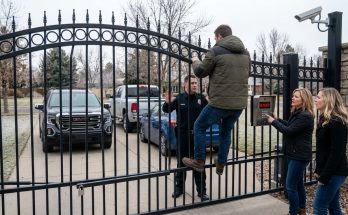
The gate remained, though the new owners had painted it black.
I almost laughed.
“That gate survives everything.”
Michael parked across the street.
We sat silently.
Christmas lights outlined the roof.
A bicycle lay on the front lawn.
The family had hung a wreath on the same front door where mine used to hang too long after Christmas.
Michael asked, “Do you miss it?”
“Yes.”
“Want it back?”
“No.”
That answer surprised him.
“Really?”
“Really.”
I looked at the upstairs windows.
For years, the house had existed in my mind almost exactly as I left it.
Seeing someone else’s decorations corrected that illusion.
Homes continue.
They do not freeze when we depart.
A little boy emerged carrying a basketball.
A man followed him.
The current owner.
I had met him briefly at closing.
He noticed our car, looked uncertain, then recognized me.
He waved.
I rolled down the window.
“Maggie?”
“Yes.”
He crossed the street.
“Everything okay?”
“Fine. My son had work nearby.”
Michael raised a hand.
The man smiled.
“We’ve been meaning to contact you.”
My body tensed.
“Why?”
“We found something.”
Of course.
Apparently Richard had converted death into an archaeological profession.
The owner laughed at my expression.
“Nothing dramatic. At least I don’t think so.”
“What?”
“We’re redoing a built-in cabinet in the basement. There was a loose back panel.”
I closed my eyes.
Michael whispered, “You’ve got to be kidding.”
The owner looked concerned.
“What?”
“Family history has recently become very storage-intensive.”
He did not understand.
“I found a metal box. It has Richard’s name on it.”
I looked at Michael.
He looked at me.
Neither spoke.
The owner said, “I didn’t open it.”
“Thank you.”
“It’s still inside. Do you want it?”
Yes.
No.
Maybe.
I was suddenly tired of being summoned by Richard’s hidden objects.
Then I thought about secrecy.
Leaving unknown things sealed did not make them harmless.
“Yes.”
The current owner invited us in.
That was how, years after selling, I entered the old house again.
The smell had changed.
New paint.
Coffee.
Something cinnamon.
The furniture was entirely different, yet my body remembered where everything used to stand.
I almost turned toward the kitchen automatically.
The living room wall was now blue.
Richard would have hated it.
I liked it.
The owner led us downstairs.
The basement had been remodeled.
Our storage shelves were gone.
Richard’s workbench too.
I felt another small tug of loss.
Then the man handed me the box.
Gray metal.
About the size of a large dictionary.
A strip of masking tape across the top read:
R. HART — PERSONAL.
Michael stared.
“Did Dad hide this?”
“I don’t know.”
The owner said, “It was behind the cabinet. Could have fallen back there.”
That possibility sounded wonderfully ordinary.
I thanked him.
Before leaving, his wife came downstairs.
She recognized me too.
“We love the house,” she said.
“I’m glad.”
“Our kids love the basement.”
“Good.”
Then, hesitantly, she added, “I hope it isn’t strange that we changed things.”
I looked around.
Different flooring.
Different lights.
Different paint.
“No.”
And I meant it.
“You should change things.”
Her relief was visible.
Outside, Michael carried the metal box.
“Want to open it now?”
“No.”
“In the car?”
“No.”
“Your place?”
“Yes.”
He grinned.
“You’re learning suspense.”
“I’m exhausted by suspense.”
At home, I put the box on the kitchen table.
Michael fetched a screwdriver.
The latch was not locked.
Inside were old financial statements, receipts, warranties, and a small notebook.
I nearly laughed.
“This is what was hidden behind a wall?”
Michael lifted a warranty for a water heater that had died twenty years earlier.
“Dad really knew how to build tension.”
We sorted papers.
Nothing important.
Then Michael opened the notebook.
His expression changed.
“What?”
“Dad’s handwriting.”
“Of course.”
“No. Look.”
He turned it toward me.
The notebook contained names.
Dates.
Amounts.
At first, I thought it was another financial record.
Then I recognized some entries.
Jennifer — tuition shortfall.
Michael — workshop loan.
Lisa — closing costs.
Those made sense.
Then:
David — Rachel medical.
Elaine — travel reimbursement.
And dozens of other names I did not know.
“Who are these people?”
Michael turned pages.
Beside many names were brief notes.
Roof after storm.
Funeral expenses.
Cancer treatment travel.
Temporary rent.
Tools stolen.
I stared.
Richard had apparently kept a private record of money he gave or loaned to people.
Some amounts had check marks beside them.
Others were crossed out.
A few said forgiven.
Michael looked at me.
“Did you know Dad did this?”
“No.”
We kept reading.
Neighbors.
Employees.
A cousin I barely remembered.
A mechanic.
Someone named Curtis.
Richard had quietly distributed thousands over many years.
Not enormous amounts.
Enough to matter.
At the end of the notebook was a page labeled:
RULES.
Michael read aloud.
“Never lend what you cannot afford to lose.”
I smiled.
That sounded exactly like him.
“Help the problem, not the habit.”
Also Richard.
“Do not make people perform gratitude.”
My throat tightened.
“Keep Maggie protected first.”
I closed my eyes.
Michael stopped reading.
For a while neither of us spoke.
Then he continued.
“Kids get help, not guarantees.”
That sentence almost made me laugh.
Richard had apparently spent years thinking more clearly about inheritance than any of us realized.
The final line was underlined twice.
Money should make a life easier, not make another person smaller.
I sat back.
Michael reread it.
Then said, “We really are all living through Dad’s unfinished philosophy course.”
I laughed.
The notebook did not absolve him.
Nothing could.
But it revealed a pattern I had missed.
Richard had not simply saved.
He had used money quietly.
I had known about some generosity.
Not the extent.
Not the intentionality.
I thought of my hospital program.
My travel.
Sophie’s education.
The gifts I had structured carefully.
Perhaps I had not moved away from Richard’s values as much as I imagined.
Perhaps I had simply inherited parts of them without knowing.
Michael turned another page.
A folded sheet slipped out.
This time, I groaned.
“No.”
“What?”
“If that is another letter, burn it.”
Michael unfolded it.
“It’s not.”
“What is it?”
“A list.”
He read the heading.
Things I still need to tell Maggie.
I froze.
Michael lowered the paper.
“Mom?”
“Give it to me.”
My hands shook as I took it.
The list contained only five items.
David.
Account consolidation.
New roof timeline.
Insurance update.
Stop pretending I like cruises.
I laughed so suddenly that I cried.
Michael stared.
“Cruises?”
“Your father hated them.”
“You went on three.”
“He complained through all three.”
The list was painfully ordinary.
Four practical subjects.
One life-changing truth.
David’s name sat at the top.
No details.
No speech prepared.
Just a task Richard knew he needed to complete.
I cried harder.
Michael put one hand on my shoulder.
“He really was going to tell you.”
“Yes.”
“And didn’t.”
“Yes.”
Both.
Always both.
The paper did not transform intention into action.
But it answered one question.
Richard had not forgotten.
He had not decided I never deserved the truth.
He had failed to cross the last distance between knowing and doing.
That mattered.
Not enough.
But something.
Michael sat beside me.
“I spent so long thinking Dad knew exactly what he was doing.”
“So did I.”
“He didn’t.”
“No.”
“That’s kind of terrifying.”
“It should be comforting.”
“How?”
“Because neither do we.”
He laughed.
I folded the list.
Then unfolded it.
On the back was one more note.
No heading.
Just three words.
Tell her myself.
I pressed my thumb against the handwriting.
Richard had understood at least this much.
No lawyer.
No letter.
No child.
He wanted to tell me himself.
He simply ran out of courage before he ran out of time.
Michael said quietly, “Does that help?”
“Yes.”
“Does it fix it?”
“No.”
“Good.”
I looked at him.
“Why good?”
“Because I think we’ve all gotten better at not requiring one thing to do two jobs.”
That sounded like something Thomas would say.
“What does that mean?”
“The note can help without fixing.”
I smiled.
“Look at you.”
“Don’t make it weird.”
Too late.
A week later, I invited all three children for dinner.
Jennifer came from Chicago for the weekend.
Lisa brought dessert.
Michael brought the metal box.
I showed them the notebook.
The list.
The three words on the back.
Jennifer cried.
Lisa cried.
Michael pretended allergies.
Then Jennifer laughed at the cruise line.
“Dad absolutely hated cruises.”
“He liked the buffets,” Michael said.
“He liked complaining about buffets.”
Lisa smiled.
“He liked complaining recreationally.”
We sat around the table with Richard’s unfinished list between us.
No one defended him.
No one condemned him.
We simply knew more.
Then Jennifer asked, “What happens to the notebook?”
I looked at the worn cover.
“Copies.”
“Who gets the original?”
I thought of David.
The obvious answer surprised me.
“Him.”
Michael nodded immediately.
Lisa too.
Jennifer asked, “Why?”
“Because the notebook contains a record of something Richard did for all of us.”
“And?”
“And David has fewer objects from him than we do.”
Nobody argued.
I mailed the original to David after scanning every page.
A week later he called.
“I don’t know what to say.”
“You could complain about cruises.”
He laughed.
Then his voice broke.
“He wrote my name.”
“Yes.”
“That sounds stupid.”
“No.”
“I spent so much of my life being unofficial.”
“I know.”
“And there it is.”
David’s name.
One line among many.
Not hidden from Richard himself.
That mattered more than I had expected.
After Christmas, I returned to the old neighborhood one last time.
Alone.
I parked across from the house.
The maple stump had been removed.
A small new tree had been planted nearby.
Thin trunk.
Bare branches.
Too young to provide shade.
Perfect.
I did not knock.
I did not need anything from the house.
I simply looked.
Then I drove away.
On the passenger seat lay a copy of Richard’s list.
Tell her myself.
He had failed.
But because the truth finally surfaced, the rest of us had been given a chance to do something different.
Speak sooner.
Ask instead of assume.
Tell people ourselves.
That became my next rule.
And before long, it would be tested.
Click here to continue reading: PART 22: When Denise Asked Me a Question About Dying, I Realized All My Careful Planning Had Left One Person’s Wishes Almost Completely Unspoken
The Night I Came Home From the Hospital Alone, Three Short Messages Forced Me to Question Everything I Believed About Family
Part 21 of 28