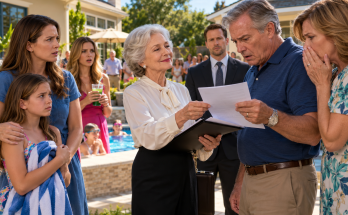
Claire read her mother’s name three times.
MIRIAM MORGAN, PRINCIPAL SCIENTIFIC CONSULTANT.
The embryology file was dated twelve years before Sophie’s birth.
Miriam had not merely studied family genetics.
She had helped create embryos combining them.
Rebecca refused to believe it.
“That contradicts everything in her later notebooks.”
Arthur did not.
His face told Claire before he spoke.
“You knew.”
“Some.”
Claire stood.
“How much?”
Arthur looked at Sophie.
“Enough that this should not be discussed casually.”
Sophie rolled her eyes.
“I'm already here.”
Claire almost sent her upstairs.
Then stopped.
No.
Not automatically.
She looked at Sophie.
“You want to hear?”
“Yes.”
“Tell me if you want to stop.”
“Okay.”
Arthur began.
Before Miriam rejected permanent biological engineering, she believed the safest way to understand hereditary cancer might be before disease existed at all.
Embryos.
Not implantation initially.
Laboratory observation.
Miriam and Samuel both collaborated with a private reproductive-medicine program.
Samuel studied the Hale mutation.
Miriam studied the protective Morgan variants.
Their hypothesis was that combining the two genetic backgrounds could reveal why protective pathways sometimes overcame inherited cancer risk.
Rebecca looked disgusted.
“Creating embryos for research.”
Arthur nodded.
“Legally?”
“At the time, through private funding and consent structures that would not satisfy current standards.”
Claire stared.
“Whose reproductive material?”
Arthur hesitated.
“Miriam’s.”
Claire stopped breathing.
Rebecca stood.
“What?”
Their mother donated eggs.
Samuel donated sperm.
Sophie whispered, “Grandma and Grandpa Samuel?”
Daniel covered his face.
“This family tree needs professional assistance.”
No one laughed much.
Arthur continued quickly.
The embryos were created for research and were not supposed to be implanted.
Miriam believed they would be studied only through early developmental stages.
Then destroyed according to protocol.
“What changed?” Claire asked.
Samuel answered from custody after being added to the call.
“Helen Ward.”
Ward and the reproductive clinic wanted longer developmental data.
Miriam refused.
Samuel did not refuse strongly enough.
One embryo was preserved beyond the agreed period.
Another was transferred.
Claire stared.
“Into who?”
Samuel looked down.
“A volunteer surrogate.”
Rebecca went pale.
“No.”
Arthur closed his eyes.
The pregnancy ended at twelve weeks.
The preserved sample Bell found came from that pregnancy.
Miriam was furious.
She ended the project.
Withdrew her reproductive material.
Demanded every remaining embryo be destroyed.
Ward documented compliance.
Claire already knew what came next.
“They weren't all destroyed.”
Samuel whispered, “No.”
“How many?”
“Two remained.”
Sophie leaned forward.
“What happened to them?”
Samuel did not know.
Arthur looked toward Bell.
His archive contained hints but not answers.
Rebecca stared at her father.
“You knew two embryos survived.”
“Yes.”
“And never told Mom?”
“I told her one might.”
“What did she do?”
“She went after Ward.”
That confrontation contributed to the collapse of their professional relationship.
Miriam learned how quickly research goals could transform potential children into scientific assets.
Arthur believed that was one of the experiences that changed her ethical thinking completely.
The later Miriam.
The woman who wrote that patients were people before experiments.
She had not begun there.
Claire looked at Miriam’s letter.
The knowledge complicated it without invalidating it.
Her mother’s wisdom had been purchased through mistakes.
Serious ones.
Sophie said quietly, “Grandma messed up worse than we thought.”
“Yes,” Claire said.
“But she stopped.”
“Eventually.”
“That's better than not stopping.”
Arthur looked toward her.
“Yes.”
Bell searched the clinic archives.
The facility closed years earlier.
Remaining frozen inventory transferred twice.
Final storage company later acquired by—
Claire sighed.
“NorthStar.”
Bell nodded.
Of course.
Adrian inherited the two embryos.
Rebecca looked sick.
“Did he use them?”
No clear record.
One identifier appeared.
M-H 02.
Status: DEVELOPMENTAL HOLD.
Another:
M-H 05.
Status: TRANSFERRED EXTERNAL.
Claire felt cold.
“Transferred where?”
Unknown.
Samuel had never seen these records.
Ward initially denied knowledge.
Bell showed her the identifiers.
She began crying.
“That wasn't supposed to happen.”
Claire stared.
“You preserved them.”
Ward admitted preserving two embryos because she believed Miriam would eventually reconsider.
She never did.
Years later Adrian discovered them.
Ward claimed she told him to destroy them.
He did not.
Maya joined the conversation.
“Did Dad make a baby?”
Nobody answered.
Adrian was questioned.
For once he replied immediately.
Yes.
M-H 05 had been transferred to a surrogate fourteen years earlier.
A child was born.
Claire stared.
Another genetically manufactured child.
Biological child of Miriam and Samuel.
Technically half-sibling to Claire and Rebecca through Miriam.
Half-sibling to Eric and Lydia through Samuel.
Sophie looked at the ceiling.
“No.”
Daniel whispered, “Don't try the family tree.”
“What happened to the child?” Bell asked.
Adrian refused.
Maya leaned toward the screen.
“Dad.”
He looked at her.
“Who?”
Adrian said the child had been part of a separate program.
Not NorthStar's main vector cohort.
Raised away from the Hale and Morgan families.
Observed genetically.
Never treated with Samuel’s neonatal vector.
Rebecca stared.
“Then what was the point?”
“A natural control.”
Claire felt nausea.
A child created partly to function as comparison.
No vector.
No intervention.
Simply watched.
“What name?” Claire asked.
Adrian remained silent.
Bell threatened legal consequences that barely mattered anymore.
Maya asked instead.
“Did you love them?”
Adrian looked startled.
“What?”
“The kid.”
His expression changed.
“No.”
Maya nodded sadly.
“Then it was easier.”
Adrian looked away.
Claire understood Maya's point.
It was easier to turn someone into data if you never allowed relationship to interfere.
Finally Adrian gave the name.
Sarah Reed.
Fourteen years old.
Living with adoptive parents in Vermont.
Claire closed her eyes.
Another Reed.
Another hidden identity.
Bell located the family.
This time federal agents did not arrive with weapons.
A child-welfare specialist and genetic counselor contacted the parents.
They had no idea Sarah was born from a research embryo.
They believed her birth parents had relinquished her through a private adoption.
The adoption agency had ties to Cross.
Claire felt anger rise again.
But Sarah was safe.
That mattered first.
Her parents asked for time before any contact.
Claire agreed instantly.
So did Rebecca.
Sophie asked, “Can I meet her?”
“Maybe someday.”
“If she wants.”
Claire smiled.
“Yes.”
Correct order.
Sarah’s parents were told enough to seek independent legal and medical advice.
No blood samples requested.
No testing demanded.
Information first.
Choice later.
Sophie approved.
“What about the other embryo?” Daniel asked.
M-H 02.
Developmental hold.
Adrian said he never transferred it.
When NorthStar storage moved, Lydia took custody.
Lydia was questioned.
Her face changed.
“It still exists.”
Everyone went quiet.
Frozen.
Untransferred.
An embryo created twelve years before Sophie’s birth still remained in cryogenic storage.
Claire felt disturbed in a completely different way.
No child currently suffering.
No emergency.
A profound ethical decision nonetheless.
Who had authority over it?
Miriam was dead.
Samuel alive but incarcerated.
Arthur was Miriam’s spouse at the time of creation but not genetic contributor.
The original research consent had lapsed decades ago.
The embryo had been preserved beyond agreed conditions.
Sophie frowned.
“Is it a person?”
Nobody answered quickly.
Dr. Shah declined.
“This isn't my specialty.”
Good.
A reproductive-ethics expert joined later.
They explained legal and ethical questions varied by jurisdiction and contract.
Claire did not want philosophy reduced to paperwork.
Rebecca said, “Mom wanted them destroyed.”
Samuel looked toward her.
“She did later.”
“Do you?”
Samuel took a long time.
“Yes.”
Claire looked surprised.
“You're sure?”
“No.”
At least he admitted it.
He continued.
The embryo had been created for research without any future child’s consent.
He no longer believed preserving it to satisfy scientific curiosity was defensible.
Rebecca agreed.
Arthur agreed.
Claire hesitated.
Not because she wanted implantation.
Because destruction felt like another irreversible decision about potential life made by people who had already made too many.
Sophie watched her.
“You don't know.”
“No.”
“Then wait.”
Claire looked at her.
The simplest principle again.
If there was no emergency, uncertainty did not require immediate action.
The embryo remained securely frozen under court supervision pending independent legal and ethical review.
No research access.
No transfer.
No unilateral decision.
Samuel accepted it.
Weeks passed.
Sophie’s treatment continued.
Her hair thinned more.
She eventually let Daniel shave the remaining long sections.
This time she shaved one strip of Claire's hair too because “solidarity should be fair.”
Claire regretted agreeing.
Daniel thought it was hilarious.
Sophie returned to school three mornings a week.
Noah Patterson remained annoying.
Good.
Kevin’s markers normalized.
The residual mass continued shrinking.
Dr. Shah used the phrase remission trajectory but refused to declare remission yet.
Sophie demanded a simpler version.
“Cancer is losing.”
That she accepted.
Sarah’s adoptive parents eventually agreed to a video conversation with Claire and Rebecca before involving Sarah directly.
They were furious.
Rightly.
They feared the research families would claim Sarah.
Claire answered immediately.
“No.”
Rebecca nodded.
“She is your daughter.”
Biology did not erase parenthood.
Daniel looked at Claire when she said it.
Claire squeezed his hand.
Sarah's mother asked whether Sarah was medically at risk.
Possibly.
She carried the Hale cancer mutation and Morgan protective variants by design.
No experimental vector.
Dr. Shah recommended ordinary genetic counseling through an independent institution.
Not NorthStar-linked anyone.
Sarah's parents agreed.
Testing later confirmed the expected profile.
No disease.
No urgent abnormality.
Sarah chose to learn the truth gradually.
First that she was adopted.
Then that unusual circumstances surrounded her conception.
Her parents refused to dump decades of unethical research onto a fourteen-year-old in one afternoon.
Claire respected that.
One evening Sophie asked whether Sarah was her aunt.
Claire stared at the ceiling.
“Technically something like a great-aunt and half-aunt hybrid that I refuse to calculate.”
Sophie smiled.
“So family.”
“If she wants.”
“Yes.”
Sophie was learning to add those words automatically.
Then another result arrived.
Not about Sarah.
Not Sophie.
The preserved embryo M-H 02 underwent only noninvasive record review.
No new testing.
Old embryology notes showed something unusual.
The embryo had undergone one experimental edit before Miriam discovered Ward preserved it.
Claire stared.
“Edited how?”
Ward had attempted to insert Miriam’s protective regulator.
It failed according to the records.
But Samuel noticed the technique.
Early CRISPR-like targeted nuclease work.
Years before such methods became standard.
Rebecca leaned closer.
“This wasn't Mom.”
Ward admitted it.
She had ordered the edit.
Miriam discovered it and ended the collaboration completely.
Claire understood why her mother’s later warnings sounded so absolute.
She had watched every boundary move.
Embryo research.
Unauthorized transfer.
Genetic editing.
Hidden persistence.
Each step justified as only one more.
Ward whispered during questioning, “We thought we were close.”
Sophie, overhearing, said, “Everybody was always close.”
Claire looked at her.
“To what?”
“Doing one more bad thing.”
Ward heard.
She had no answer.
The embryo remained frozen.
No one touched it.
For the first time, a potentially extraordinary scientific object stayed exactly where it was because nobody had the authority to decide quickly.
That became important to Claire.
Not everything discovered had to be used.
Then, six weeks after Sophie came home, Dr. Shah scheduled the scan everyone had been waiting for.
Post-treatment MRI.
Full tumor-marker panel.
Bone-marrow vector assay.
Endocrine evaluation.
The closest thing they had yet to a verdict.
Sophie wore her purple sweatshirt.
Same as the day she left the hospital.
Daniel brought coffee.
Eric brought math homework Sophie refused to touch.
Claire brought Miriam’s letter folded in her purse.
The MRI took forty-one minutes.
One less than the first terrifying scan.
Sophie pointed that out afterward.
“Progress.”
They waited.
Dr. Shah entered with Dr. Chen.
Claire stood.
Nobody smiled yet.
Sophie looked between them.
“Say it.”
Dr. Shah opened the report.
“No measurable malignant tumor markers.”
Sophie froze.
“No active vector renewal.”
Claire stopped breathing.
“The residual brain mass is now tiny and continues to regress.”
Daniel covered his face.
Dr. Chen smiled.
“No hydrocephalus. No new lesions.”
Sophie stared.
“So Kevin?”
Dr. Shah's smile finally appeared.
“Kevin appears to be losing very badly.”
Sophie began crying.
Claire was already holding her.
Daniel wrapped both of them.
Eric stood beside the wall crying openly.
No one pretended not to see.
Sophie pulled back.
“Am I in remission?”
Dr. Shah answered carefully.
“Not formally yet. We need sustained results.”
Sophie groaned through tears.
“Doctors.”
Claire laughed.
But the direction was clear.
For once, the future looked less like an emergency.
Then Bell called.
Not because something had gone wrong.
Because prosecutors needed to know whether Sophie’s family wanted to submit a victim-impact statement at the first major sentencing hearing.
Adrian Hale.
Claire looked at Sophie.
Another choice.
Not medical.
Still hers.
Sophie wiped her face.
“Do I have to?”
“No.”
“Can I?”
“Yes.”
“Can I say whatever I want?”
“Within courtroom rules.”
Sophie thought.
Then said, “I want to.”
The next chapter would not happen inside a laboratory.
It would happen where adults finally had to answer for what they chose.