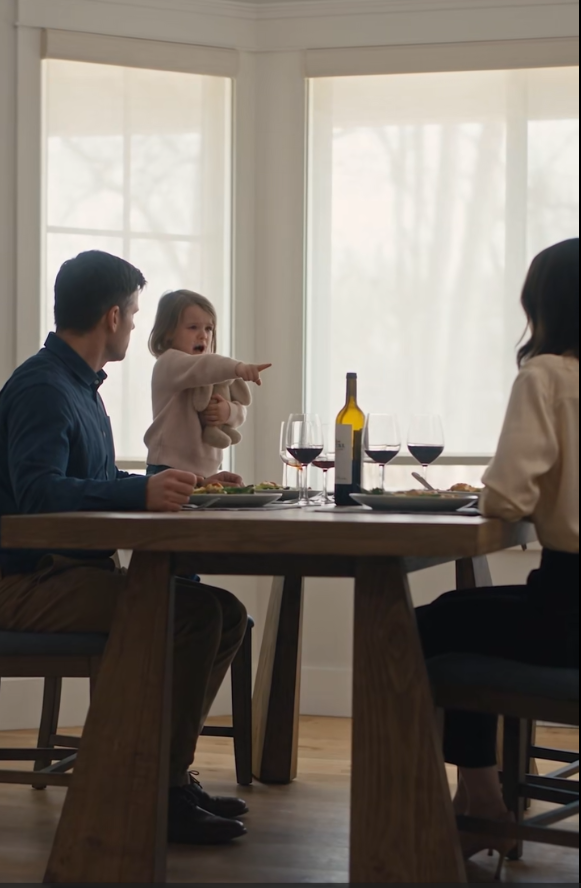
My four-year-old daughter was standing on her chair with her stuffed rabbit pressed tightly to her chest. Then she stretched out her finger and pointed across the dinner table at my wife.
“She scares me.”
Nobody moved.
Vanessa gave an awkward little laugh. I nearly laughed too. Nearly.
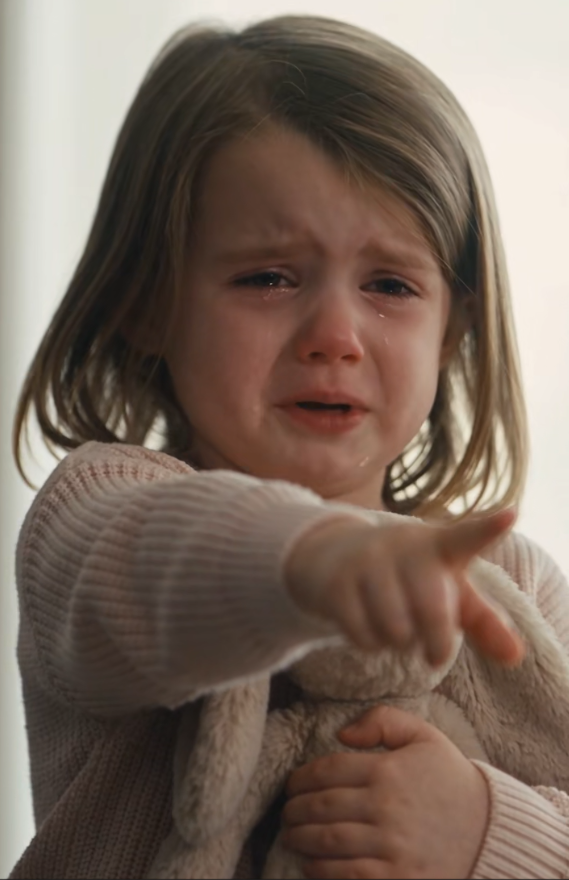
Then my daughter burst into tears.
My name is Daniel Mercer, and before that evening, I had convinced myself Emma was simply struggling with my remarriage. She had lost her mother. She was only four. I kept telling myself that changes in her mood were understandable. That Vanessa needed more time. That Emma simply needed patience.
Then Emma stared at me while tears rolled down both of her cheeks.
“She closes my door.”
Vanessa stopped smiling.
“She takes Bunny.” Emma pulled the stuffed rabbit closer to her body. “She moves Mommy’s picture.”
My stomach tightened instantly.
“Emma, what are you saying?”
She lifted her hand and pointed straight at Vanessa.
“She tells me I have to stop talking about Mommy.”
The whole table went completely quiet.
Vanessa answered almost instantly.
“That is absolutely not what happened.”
Too immediate. Too defensive.
I looked at Vanessa.
Then at Emma.
There was something in my daughter’s face that made every excuse forming in my mind disappear.
This wasn’t some ordinary disagreement over bedtime or toys.
She was genuinely upset.
I pulled up the security footage from our house.
Vanessa told me I was making an embarrassing family argument into something much larger because of the imagination of a four-year-old child.
Then the footage appeared.
Vanessa was right there.
She was guiding Emma toward the laundry room.
The door closed.
Vanessa walked away.
Emma stayed inside for a while before the door opened again.
Then the microphone captured a sentence that I would remember for a long time.
“Maybe tomorrow we can try again, and you’ll remember that things are different now.”
I stopped the recording.
Vanessa immediately tried to explain herself.
I didn’t want another argument in front of Emma.
“I think you should stay somewhere else tonight.”
Her entire expression shifted.
“Daniel—”
“Please. Not tonight.”
Before she had a chance to answer, Emma tugged softly on my sleeve.
“Daddy.”
I looked down at my daughter.
She pointed toward the bookshelf in her bedroom.
“There’s another camera.”
I assumed she was talking about one of the cameras I had installed.
She wasn’t.
Tucked between several of her stuffed animals was a tiny black camera lens.
I had never put it there.
The police came to the house.
They searched the rooms carefully.
And they found more devices.
One was in the hallway.
Another was near the laundry area.
Another was inside my office.
Someone had been observing activity inside our home without my knowledge.
At first, I assumed Vanessa must have installed them sometime after she moved in.
That possibility was disturbing enough.
Then Detective Sarah Ramirez inspected the camera they had found in Emma’s bedroom.
Her face changed.
“How long has your wife lived here?”
I told her.
She checked the device once more.
Then she turned toward me.
“This camera appears to have been here much longer than three weeks.”
My chest tightened.
“How long?”
“Approximately eleven months.”
I just stared at her.
Vanessa hadn’t even been living with us eleven months ago.
That meant someone had placed a camera in my daughter’s room long before my new wife ever moved into our house.
The police removed the camera’s memory card.
What they discovered only created more questions.
The recordings didn’t come only from our home.
There was another house.
Another family.
And another young girl.
I stared at the footage and then looked over at Detective Ramirez.
“Who is she?”
The detective remained silent for a moment.
Eventually, she answered.
“We’re still trying to identify her.”
On the other side of the room, Emma sat quietly with Bunny clutched to her chest.
I looked at my daughter.
Then I looked at all the cameras laid out across the evidence table.
And for the first time, a different possibility crossed my mind.
Maybe Vanessa hadn’t met a widowed father completely by chance.
Maybe our marriage had not begun as simply as I had believed.
Maybe someone had known far more about our family before Vanessa stepped into our lives.
And if that was true, there was one question I could not stop asking.
Why had our family been watched?
The rest of the story is in the first comment.
Detective Ramirez asked Vanessa to remain available while the devices were examined. Vanessa had already packed a small overnight bag and gone to her sister’s apartment, insisting that I was misunderstanding everything.
She called twice that evening.
I didn’t answer.
Instead, I sat beside Emma on the couch while she watched an animated movie she had seen at least fifty times. She barely followed the story. Every few minutes, she glanced toward the hallway as if expecting someone to walk through it.
I tried not to make a big deal out of it.
“Want some warm milk?”
She shook her head.
“Toast?”
Another shake.
Finally she whispered, “Is Vanessa coming back?”
“Not tonight.”
Emma considered that answer.
“Tomorrow?”
“I don’t know.”
She lowered her face into Bunny’s ears.
For months, I had believed the quietness I saw in her was grief. Some of it probably was. But now I wondered how many small things I had dismissed simply because I desperately wanted life to feel normal again.
My first wife, Laura, had passed away nearly two years earlier after a long illness.
Emma was young enough that many of her memories of her mother existed in fragments.
A yellow sweater.
A song before bed.
Pancakes shaped like stars.
The smell of lavender lotion.
One photograph on Emma’s nightstand showed Laura holding her when she was a baby.
That photograph had become precious to Emma.
Vanessa knew that.
At first, she had seemed to respect it.
When Vanessa and I began dating, she never tried to replace Laura. In fact, that was one of the reasons I trusted her.
“I’m not trying to be Emma’s mother,” she had told me during one of our first serious conversations. “I just want her to feel safe around me.”
At the time, those words had meant everything.
Now they sounded different in my memory.
Continue reading in the first comment.
The following morning, Detective Ramirez returned with another officer and a technician from the department’s digital evidence unit.
Emma stayed with my sister, Rachel, while I answered questions.
The technician placed the recovered devices into separate evidence bags and explained that the cameras were basic consumer models. Nothing about them was particularly sophisticated.
That somehow made the situation stranger.
Whoever had installed them had not needed expensive equipment.
They had simply needed access to my house.
Detective Ramirez sat across from me at the kitchen table.
“Think carefully,” she said. “Who had keys eleven months ago?”
I started listing people.
My sister.
My parents.
Our longtime babysitter, Megan.
A contractor who had repaired water damage upstairs.
A cleaning service we had stopped using.
My neighbor, Greg, who once fed our dog while Emma and I spent a weekend with my parents.
Then I remembered something.
Vanessa.
Not as my wife.
Not even as my girlfriend.
Eleven months earlier, Vanessa and I had only recently met.
But she had been inside the house.
Once.
Maybe twice.
My expression must have changed because Ramirez noticed.
“What?”
“Vanessa was here around then.”
The detective leaned forward slightly.
“Explain.”
I told her how we met.
It had been at a children’s charity event organized through a local community center. I had almost skipped it. Emma’s preschool teacher had recommended the event, and I decided getting out of the house might be good for both of us.
Vanessa was volunteering at the registration table.
She remembered Emma’s name after hearing it once.
She found a purple marker when Emma refused every other color.
She somehow made me laugh after months in which laughing had felt inappropriate.
We exchanged numbers.
Two weeks later, we had coffee.
A month after that, she came to the house for dinner.
I had always thought our meeting was one of those random moments people later described as fate.
Detective Ramirez wrote something down.
“Do you still have messages from that period?”
“Yes.”
“Don’t delete anything.”
I nodded.
Then another memory surfaced.
“There was a problem with my back door.”
“When?”
“Around the same time. The lock sometimes didn’t catch.”
Ramirez looked up.
“For how long?”
“Maybe a few weeks.”
“Who knew?”
I thought about it.
“Anyone who came through the kitchen.”
That included Vanessa.
But it also included family, contractors, delivery workers and a dozen other people.
The detective didn’t accuse anyone.
Neither did I.
Not yet.
Later that afternoon, the department called.
They had identified the second house in the recordings.
It belonged to a family in another county, about seventy miles away.
The little girl in the video was named Sophie.
She was safe.
That was the first piece of news that allowed me to breathe normally.
Her parents were confused but cooperative.
They had discovered an unexplained camera in their living room nearly a year earlier but assumed it had belonged to a previous owner. They removed it, put it in a box and forgot about it.
Detective Ramirez told me something else.
Sophie’s father had also attended the same community-center charity program.
I sat down.
“You’re sure?”
“Yes.”
“Did he know Vanessa?”
“We’re checking.”
My thoughts immediately raced ahead.
Ramirez stopped me.
“Daniel, don’t build the entire story before we have the facts.”
“I’m trying not to.”
“I know. But right now, similarities are not proof.”
She was right.
Still, the coincidence felt enormous.
That evening, Vanessa appeared at the front door.
I saw her through the video doorbell.
For several seconds, I considered pretending I wasn’t home.
Then she called.
I answered.
“I need to talk to you,” she said.
“Not inside.”
“Daniel, please.”
“Emma is with my sister.”
“I know.”
That answer made me pause.
“How do you know?”
“Because Rachel texted me. She wanted to know if I was coming back.”
I checked my phone.
Rachel had sent me a message twenty minutes earlier saying Vanessa had contacted her.
So there was an explanation.
But I hated how suspicious my mind had become.
I stepped onto the porch and closed the door behind me.
Vanessa looked exhausted.
She wasn’t wearing makeup. Her hair was tied back. She looked less like the composed woman I had married and more like someone who hadn’t slept.
“I did not install those cameras,” she said.
I didn’t answer.
“I need you to believe me.”
“I watched the footage with Emma.”
“I know.”
“You put her in that room and walked away.”
“I was trying to get her to calm down.”
“By closing the door?”
“For ten minutes.”
“It was longer.”
Vanessa looked toward the street.
“I made a mistake.”
“That’s not the only problem.”
“I know.”
“She says you moved Laura’s photograph.”
Vanessa’s jaw tightened.
“I moved it once.”
“Why?”
“Because Emma brought it to the dinner table every night and stared at it instead of eating. I put it back afterward.”
“She says you told her not to talk about her mother.”
“That isn’t what I said.”
“What did you say?”
Vanessa folded her arms tightly.
“I said I didn’t want every conversation to become about someone I could never compete with.”
I stared at her.
The moment the words left her mouth, she seemed to regret them.
“She’s four,” I said.
“I know.”
“She isn’t comparing you.”
“I know that now.”
“No. You knew it then.”
Vanessa looked down.
For several seconds, neither of us spoke.
Then I asked the question that had been sitting in my mind all day.
“When did you first hear about me?”
Her eyes lifted.
“At the charity event.”
“You’re sure?”
“Yes.”
“You had never heard my name before?”
“No.”
“You didn’t know Emma?”
“No.”
“You weren’t familiar with our house?”
“Daniel, what are you asking?”
“I’m asking because one of those cameras was installed around the same time we met.”
Vanessa went completely still.
For the first time since she arrived, she didn’t look defensive.
She looked confused.
“What?”
“That camera is about eleven months old.”
She shook her head.
“No.”
“That’s what the technicians found.”
“Then someone else put it there.”
“Who?”
“I don’t know.”
I watched her carefully.
Then she said something I wasn’t expecting.
“You need to look at the charity organization.”
“Why?”
Vanessa rubbed her hands together.
“Because that wasn’t the first event I volunteered at.”
I waited.
She continued.
“There were several family events that year. Different locations. Same organizer.”
“Who?”
“A man named Peter Caldwell.”
The name meant nothing to me.
“He coordinated volunteers,” she said. “Background forms, schedules, family registrations, donation lists. Everything.”
“Did he have information about the families?”
“He had registration information.”
My stomach dropped.
“What kind?”
“Names. Phone numbers. Email addresses. Sometimes home addresses for mailing.”
I stared at her.
“Did he know you and I started dating?”
“Probably. Everyone knew eventually.”
“Where is he now?”
“I don’t know. He stopped organizing events months ago.”
That night I passed the name to Detective Ramirez.
By morning, she already knew who Peter Caldwell was.
And she sounded more serious than she had the day before.
Peter had worked with several nonprofit community programs over five years.
He had access to volunteer databases and family-registration systems.
He had never been charged with anything connected to those programs.
But there had been complaints.
Nothing dramatic.
Missing paperwork.
Unauthorized copies of mailing lists.
Families receiving strange marketing calls after events.
A volunteer once reported that Peter asked overly detailed questions about which parents lived alone.
Another organization quietly ended its relationship with him after discovering he had downloaded a contact spreadsheet onto his personal laptop.
None of those incidents had seemed important by themselves.
Together, they created a pattern worth examining.
Police obtained permission to search records connected to the old community program.
Two days later, Detective Ramirez called me.
“We found your family registration.”
I sat down at my desk.
“What did it include?”
“Your name. Emma’s name. Your phone number. Your email. Your address.”
I closed my eyes.
“And Sophie’s family?”
“Yes.”
For the first time, the two homes were connected by something more than coincidence.
But there was another surprise.
Vanessa’s volunteer file had been accessed repeatedly after she started dating me.
Not by Vanessa.
By an administrator account assigned to Peter.
The dates matched weekends when Vanessa had updated her availability.
One access occurred three days after she changed her emergency contact information to include my name.
Another occurred after she listed our address as her mailing address shortly before our wedding.
When Ramirez told me this, the story in my head changed again.
Maybe Vanessa had not entered my life as part of a plan.
Maybe she had unintentionally provided someone else with more information.
I didn’t know whether that made me feel better.
It only made everything more complicated.
The investigators eventually located Peter living two states away.
He agreed to speak with police.
He denied installing any cameras.
He claimed he downloaded registration information because he had been building a donor-contact database.
When asked why footage from two registered families appeared on the same memory card, he said he had no idea.
There still wasn’t enough evidence to explain everything.
Then technicians found something on the oldest camera.
A partial wireless-network history.
The device had once connected to a temporary hotspot.
The hotspot name included three letters and four numbers.
Those characters matched an old mobile hotspot used by the charity organization during outdoor events.
Police obtained equipment records.
The hotspot had been assigned to Peter.
That still didn’t prove exactly who physically placed every device.
But it gave investigators a clear direction.
Several weeks passed before I received the explanation.
Peter had been collecting private information from families for reasons that were less dramatic than my imagination had feared, but still deeply inappropriate.
He wanted material he could use to build profiles of families for a private data business he had been planning.
He tracked routines.
Home layouts.
Purchasing habits.
Daily schedules.
He apparently believed that detailed household information could eventually be sold to advertisers, security companies and other commercial clients.
His plan was poorly organized, unethical and completely unauthorized.
He had used volunteer work to identify households and had placed small cameras in several locations while pretending to deliver documents, donation materials or event supplies.
Some devices were recovered.
Others had stopped working months earlier.
The second family had never been targeted because of their daughter specifically.
Neither had we.
That mattered to me more than I can explain.
My worst fear had been that Emma herself was the focus.
She wasn’t.
Our household had been selected because I was a recently widowed parent who had voluntarily provided contact information through the community program.
Peter assumed I would be busy, distracted and unlikely to notice minor changes around the house.
In one sense, he had been right.
I had been distracted.
But not for the reason he imagined.
I was trying to rebuild a life.
I was trying to be a father and a grieving husband at the same time.
I was trying to convince myself that moving forward did not mean leaving Laura behind.
And while all of that was happening, I had ignored another problem growing inside my home.
Vanessa had nothing to do with the hidden cameras.
The investigation established that.
But it did not erase what had happened between her and Emma.
That was the part Vanessa wanted me to understand least.
When she returned to speak with me after police cleared her of involvement with the devices, she expected relief to fix everything.
It didn’t.
“I told you,” she said quietly. “I told you I didn’t install them.”
“I know.”
She waited.
I could tell she wanted me to say she could come home.
Instead, I asked her to sit at the kitchen table.
The same table where Emma had finally told me something was wrong.
“I owe you an apology,” I said.
Vanessa looked surprised.
“For believing you might have installed the cameras.”
Her shoulders relaxed.
Then I continued.
“But that doesn’t change what happened with Emma.”
The relief disappeared.
“Daniel.”
“No. I need to finish.”
She looked away.
I had spent weeks thinking about what bothered me most.
It wasn’t one sentence.
It wasn’t one closed door.
It wasn’t even Laura’s photograph.
It was the fact that Vanessa had treated Emma’s grief as competition.
A four-year-old child had been trying to hold on to memories of her mother, and instead of helping her do that, Vanessa had started measuring herself against someone who was no longer there.
“You wanted her to move forward on your schedule,” I said.
“I wanted us to become a family.”
“She already had a family.”
“I know.”
“No. That’s the problem. You thought marrying me meant her old family needed to become smaller so there would be room for you.”
Vanessa’s eyes filled with tears.
“I made mistakes.”
“Yes.”
“I can fix them.”
“Maybe.”
She looked up hopefully.
“But not by pretending they didn’t matter.”
I told her I needed space.
Real space.
Not one night.
Not a week in a guest room.
Time apart.
She cried quietly.
I hated seeing it.
Despite everything, I loved her.
That was what made the decision difficult.
People sometimes imagine that once trust is damaged, love disappears immediately.
It doesn’t.
Sometimes love remains while your certainty disappears.
And certainty had disappeared for me.
Over the next two months, Vanessa and I attended counseling separately before agreeing to attend several sessions together.
Emma began seeing a child therapist who specialized in grief and family transitions.
Her therapist told me something I wish someone had told me much earlier.
Children do not always explain discomfort clearly.
They describe it through fragments.
A toy being moved.
A door being closed.
A picture disappearing.
A sentence repeated over dinner.
Adults tend to focus on whether each individual event sounds serious enough.
Children focus on how all those events make them feel.
Emma had been telling me for weeks that something felt wrong.
I had been translating every signal into something easier for me to accept.
That realization stayed with me.
I changed several things in our home.
Laura’s photographs were no longer treated as fragile objects that belonged only in one room.
We created a memory shelf in the living room.
Emma chose three photographs.
One of Laura holding her at the beach.
One of the three of us at a pumpkin patch.
One from Emma’s second birthday.
We put Bunny beside them sometimes because Emma insisted Bunny was part of the family too.
The first night the shelf was finished, Emma stood in front of it for a long time.
Then she asked me a question.
“Can Vanessa see Mommy’s pictures?”
“Yes.”
“Will she be mad?”
“No.”
Emma looked at me carefully.
“She was mad before.”
“I know.”
“Why?”
I sat on the floor beside her.
“Sometimes grown-ups have feelings they don’t understand very well. But that is never your job to fix.”
She thought about that.
Then she placed Bunny on the shelf.
“Mommy liked Bunny.”
“I remember.”
That was the first conversation we had about Laura in months that didn’t feel heavy.
Vanessa did not move back immediately.
She continued counseling.
Eventually, she asked if she could write Emma a letter.
The therapist suggested keeping it simple.
No explanations.
No asking for forgiveness.
No promises that put pressure on Emma.
Vanessa wrote:
Emma,
I was wrong when I acted like talking about your mommy was a problem. You can love her, remember her and talk about her whenever you want. I should have understood that before. I am sorry I made you feel like you had to choose.
Vanessa
I read it first.
Then the therapist read it.
Then I gave it to Emma.
She listened while I read the words aloud.
When I finished, she asked, “Does she still want to be my mommy?”
“No.”
“Good.”
I nearly laughed.
Then Emma added, “She can be Vanessa.”
That simple sentence became the beginning of something none of us had managed to understand before.
Vanessa didn’t need a title.
She didn’t need to replace anyone.
If she remained in our lives, she needed to build her own relationship with Emma rather than taking over someone else’s place.
Months later, we began short visits.
A park.
An ice cream shop.
An afternoon at the zoo.
Vanessa never came without asking first.
She never corrected Emma when she talked about Laura.
She stopped trying so hard to perform the role of a perfect new mother.
Ironically, the less she tried to become one, the more comfortable Emma became around her.
One afternoon, while we were sitting on a bench watching Emma throw crumbs near a group of ducks, Vanessa said quietly, “I think I was afraid of competing with a memory.”
I looked at her.
“There was never a competition.”
“I know that now.”
“She didn’t need you to replace Laura.”
“I know.”
“She needed you to be safe.”
Vanessa nodded.
“I know that too.”
Whether our marriage would survive was still uncertain.
But for once, uncertainty did not frighten me.
We were finally being honest.
Peter’s case moved forward separately.
The authorities contacted several families connected to the old community program. Most had never been recorded. A few discovered old devices that no longer functioned. The organization changed its privacy policies and began limiting access to family information.
Detective Ramirez called me one final time after the investigation was largely complete.
“There’s something you should know,” she said.
I braced myself.
“The other children connected to the recovered devices are safe. We have not found evidence that any child was individually selected.”
I closed my eyes.
“Thank you.”
“I thought you’d want to hear that.”
“I did.”
After we hung up, I stood alone in my office for several minutes.
For months, I had replayed one question.
What had someone wanted with my daughter?
Now I finally had the answer.
It had never been about Emma personally.
She had been caught inside an adult’s reckless attempt to collect private household information.
It was wrong.
It was invasive.
But the frightening story I had built in my head had not been the truth.
The real lesson was quieter.
And in some ways, harder.
The greatest problem inside my house had not been the cameras.
Those could be found.
Removed.
Cataloged.
Used as evidence.
The harder problem was everything I had failed to notice before Emma climbed onto that chair.
Her silence.
The way she held Bunny tighter whenever Vanessa entered the room.
The missing photograph.
The small questions she asked and then withdrew when I answered too quickly.
I had believed protecting my daughter meant providing a home, checking the doors, paying attention to obvious danger and making responsible choices.
I learned that protection also meant listening when the story made no sense yet.
Especially then.
Nearly a year after that dinner, Emma and I were eating pancakes on a Saturday morning.
Vanessa was no longer living with us, though we were still seeing each other and working slowly through whether our marriage could become something healthier.
Emma suddenly looked toward the memory shelf.
“Daddy?”
“Yes?”
“Do you remember when I stood on the chair?”
I smiled despite myself.
“I remember.”
“You told me chairs are for sitting.”
“I did.”
She grinned.
Then her expression became serious.
“But you listened.”
That sentence hit me harder than she could possibly have known.
I reached across the table and squeezed her hand.
“Yes.”
She picked up Bunny and made the rabbit wave at me.
Then she returned to her pancakes as if the conversation were finished.
Maybe for her, it was.
For me, it never would be.
Because that night had changed the way I understood trust.
I used to think trust meant believing the people you loved until you were given a reason not to.
Now I think it also means creating a home where the smallest person in the room knows she can tell the truth without first having to prove it.
Emma never needed me to solve everything instantly.
She needed me to hear her.
She needed me to believe that her feelings mattered even before I understood exactly why she felt them.
She needed permission to remember her mother without worrying that those memories would hurt someone else.
And she needed the adults around her to stop deciding what family was supposed to look like.
Laura would always be her mother.
I would always be her father.
Vanessa, if she remained part of our lives, would have to become someone important in her own way.
No replacement.
No competition.
No pretending the past had to disappear for the future to begin.
That was the truth I had missed.
A family does not heal by removing the people who came before.
It heals by making enough room for love, memory, grief and change to exist together.
I looked across the breakfast table at my daughter.
Her hair was messy.
There was syrup on her sleeve.
Bunny was lying upside down beside her plate.
She looked ordinary.
Safe.
Happy.
And after everything that had happened, ordinary felt like the most valuable thing in the world.
I didn’t know exactly what the future would look like.
I didn’t know whether Vanessa and I would rebuild our marriage or eventually accept that too much had changed.
But I knew one thing with absolute certainty.
If Emma ever stood on a chair again and told me something was wrong, I would listen before making excuses.
I would ask questions before explaining her feelings away.
I would remember that four-year-olds may not always have the perfect words, but they still know when something does not feel right.
And I would never again confuse peace and quiet with safety.
Sometimes the moment that changes a family doesn’t begin with a dramatic discovery.
Sometimes it begins with a child holding a stuffed rabbit, pointing across a dinner table, and finally finding the courage to say what the adults around her have failed to notice.
That night, Emma thought she was telling me she didn’t want a new mother.
What she was really telling me was much simpler.
She wanted to know that she was allowed to remember the one she had.
She wanted to know that no new relationship could erase the life we had before.
And most of all, she wanted to know that when she spoke, her father would hear her.
Now she knows.
And so do I.